

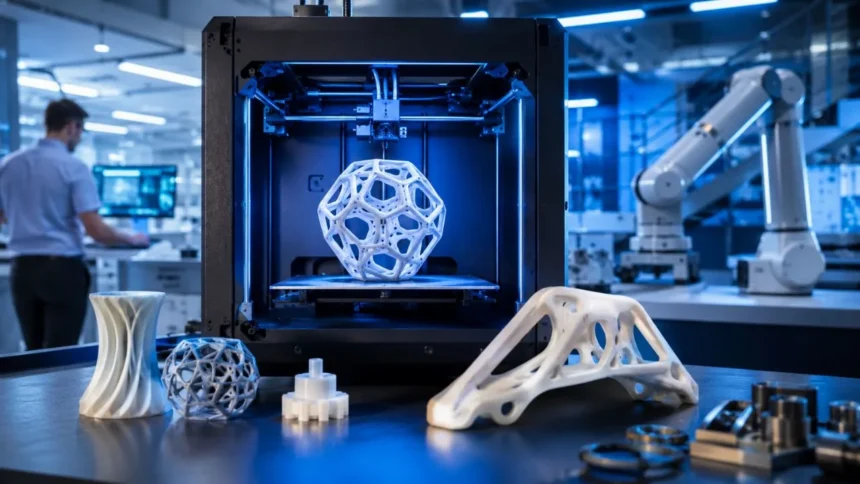
Introduction: A New Era of Making Things
3D printing was once viewed mainly as a tool for producing plastic prototypes. Engineers used it to test product shapes before committing to expensive molds, machining, or mass production. That role remains important, but additive manufacturing has moved far beyond basic rapid prototyping. Today, researchers and manufacturers can print aerospace components, medical implants, customized tools, construction elements, electronic devices, and structures containing living cells.
The technology works by turning a digital design into a physical object through the controlled addition of material. Unlike subtractive manufacturing, which cuts material away from a larger block, additive manufacturing places material only where it is needed. This approach gives designers greater freedom to create internal channels, lightweight lattices, curved surfaces, and customized shapes that would be difficult or impossible to produce through conventional methods.
Recent progress is not coming from printers alone. Advances in artificial intelligence, digital twins, robotics, material science, computer vision, high-powered lasers, and biological engineering are improving the entire 3D printing workflow. Printers are becoming faster, more accurate, more autonomous, and capable of processing a wider range of polymers, metals, ceramics, composites, concrete, hydrogels, and recycled materials.
The most important change is that 3D printing is gradually becoming a production technology rather than merely a design experiment. Its future impact will depend on whether the industry can deliver consistent quality, safe materials, reliable standards, and competitive costs. The following 3D printing innovations reveal where additive manufacturing is heading and how it may affect everyday life.
Why 3D Printing Is Moving Beyond Rapid Prototyping
Traditional manufacturing often depends on specialized tooling, molds, long supply chains, and large production runs. These systems can be highly efficient when millions of identical products are required, but they are less flexible when designs change frequently or customers need personalized products. 3D printing reduces the need for dedicated tooling, allowing manufacturers to move from a digital model to a physical component more directly.
This flexibility is especially valuable for low-volume production, spare parts, research equipment, medical devices, and complex industrial components. A manufacturer can adjust a computer-aided design file without rebuilding an entire production line. The same printer may produce several different parts during one week, helping companies respond more quickly to changing customer requirements or supply-chain disruptions.
Design freedom is another major advantage. Engineers can use topology optimization and generative design software to remove unnecessary weight while maintaining strength. They can also combine several traditionally separate components into one printable part. NASA has highlighted reduced part counts, shorter development cycles, integrated internal passages, and weight-saving structures among the important benefits of additive manufacturing for aerospace applications.
However, 3D printing will not replace every conventional process. Injection molding remains more economical for many high-volume plastic products, while machining and casting offer proven reliability for numerous industrial applications. The emerging future is therefore hybrid: manufacturers will use additive manufacturing where customization, complexity, speed, or material efficiency provides a clear advantage and conventional manufacturing where scale remains more important.
Volumetric 3D Printing Is Breaking the Layer-by-Layer Limit
Most familiar 3D printers build objects one layer at a time. Although this method is versatile, it can be slow, particularly when producing detailed components with thousands of thin layers. Volumetric additive manufacturing takes a different approach. Instead of tracing every layer, it projects calculated light patterns into a container of photosensitive resin, causing the required three-dimensional form to solidify within the liquid.
Researchers have demonstrated tomographic volumetric additive manufacturing that can create microscale objects within tens of seconds without traditional support structures. A 2025 Nature Communications study used holographic light control to improve projection efficiency and produced millimetre-scale objects with fine negative features in less than a minute.
Because the object forms throughout a volume rather than being deposited line by line, volumetric printing can reduce visible layer lines and make delicate geometries easier to produce. It is particularly promising for soft materials, complex internal cavities, biomedical structures, optical components, and parts that could be damaged by mechanical contact with a print nozzle.
The technology is still developing. Printable volume, resin chemistry, dimensional accuracy, thermal control, and material availability must improve before volumetric systems can replace established production methods. Nevertheless, its speed represents a significant shift. Future factories may use volumetric printers for customized parts that need to be produced in seconds or minutes rather than hours.
Adaptive Printing Can Build Around Existing Objects
One of the most unusual developments in additive manufacturing is context-aware printing. Conventional printers expect a predictable, empty build area. Adaptive systems can inspect the material or objects already present inside the printing environment and modify the new design accordingly. This enables printing around, across, or directly onto components that were manufactured previously.
In 2025, researchers reported an adaptive volumetric printing process that maps the chemical and physical composition of the printable environment. The printer can then make autonomous decisions about which geometry to create. Demonstrations included multicomponent structures, movable mechanical joints, hydrogels containing living cells, and tissue models incorporating different biological features.
This capability could transform repair and remanufacturing. Instead of discarding a damaged product, a future system might scan the surviving structure, identify missing material, and print a replacement section that fits its exact condition. Similar techniques could add customized grips to tools, protective layers to electronics, support structures around biological samples, or functional surfaces to existing components.
Adaptive printing also connects additive manufacturing with computer vision and robotic automation. A printer that understands its surroundings becomes more than a machine that follows fixed instructions. It begins to operate as a responsive manufacturing system capable of adjusting designs to real-world variation, although strong validation and safety controls will be essential before autonomous printing is trusted in critical industries.
Artificial Intelligence Is Making Printers Smarter
The quality of a 3D-printed part depends on many interacting variables, including temperature, material flow, laser power, layer thickness, humidity, scan speed, and cooling behavior. A small change can create pores, cracks, weak bonding, warping, or dimensional errors. Traditionally, manufacturers have relied on repeated test builds and post-production inspections to identify these problems.
Artificial intelligence can analyze sensor data while printing is taking place. Cameras, thermal sensors, acoustic systems, and laser-monitoring equipment can observe the melt pool, deposited layers, or material flow. Machine-learning models may then detect patterns associated with defects and recommend adjustments before an entire build is lost.
NIST’s AI for Additive Manufacturing work focuses on machine learning, digital twins, digital threads, and predictive models designed to support “first part correct” and “born qualified” production. The aim is to reduce uncertainty during design, fabrication, inspection, and acceptance rather than discovering quality failures only after a component has been completed.
The long-term goal is closed-loop additive manufacturing. In such a system, the printer would identify a developing problem, adjust its parameters, confirm that the correction worked, and document the complete process automatically. NIST has emphasized that achieving this vision will require trusted data, standardized measurement methods, validated AI models, and clearer regulatory frameworks.
Digital Twins Are Improving Predictability
A digital twin is a virtual representation of a physical machine, process, product, or production environment. In additive manufacturing, it can simulate how a specific part should behave during printing. Engineers may use the model to predict heat distribution, residual stress, deformation, material flow, or the final mechanical properties of a component.
By comparing live sensor information with the digital twin, a manufacturer can determine whether a print is developing as expected. Deviations may indicate poor powder distribution, incorrect curing, unstable extrusion, or overheating. This comparison supports faster troubleshooting and may reduce the need to destroy expensive components during testing.
Digital twins can also improve design decisions before production begins. Engineers can evaluate several orientations, support strategies, process parameters, and material combinations virtually. The most promising setup can then be transferred to the printer, reducing physical experimentation, wasted feedstock, and machine downtime.
NIST is developing approaches for linking part specifications, process models, measurement uncertainty, and acceptance requirements through fit-for-purpose digital twins. This work is particularly important for regulated sectors such as aerospace and healthcare, where manufacturers must demonstrate not only that a part looks correct but that its complete production history is controlled and traceable.
Multi-Material Printing Is Creating More Functional Products
Many early desktop printers produced objects from a single type of plastic. Newer multi-material additive manufacturing systems can place materials with different mechanical, electrical, optical, thermal, or biological properties within the same build. A printed component may therefore contain rigid sections, flexible joints, conductive pathways, transparent areas, or regions with different levels of strength.
This approach allows products to perform functions that once required several separately manufactured parts. A robotic gripper could contain a strong frame, soft contact surfaces, internal air channels, and embedded sensing features. A medical training model could reproduce both hard bone and soft tissue, while a wearable device could combine a flexible body with conductive circuits.
Recent research has focused on metal-polymer hybrids, graded materials, overprinting, functional gradients, and systems capable of coordinating several printhead operations. A 2025 study on multifunctional printhead control reported improved coordination of auxiliary devices, faster production, and the creation of complex material gradients using both advanced and affordable printers.
The challenge is controlling the boundary between different materials. They may shrink at different rates, respond differently to heat, or fail to bond securely. Future progress will depend on better interface design, compatible material combinations, standardized testing, and software that can plan transitions without introducing hidden weaknesses.
3D Bioprinting Is Advancing Tissue Engineering
Bioprinting uses cells, hydrogels, biomaterials, and biological molecules to create tissue-like structures. The objective is not simply to reproduce the outside shape of an organ. Researchers must also arrange cells correctly, deliver oxygen and nutrients, create blood-vessel-like networks, provide mechanical support, and maintain an environment in which the cells can survive and mature.
One major challenge is vascularization. Thick tissues cannot remain healthy unless nutrients can reach cells throughout the structure. In 2025, researchers reported high-resolution collagen-based scaffolds containing internal perfusable channels. These structures were designed to reproduce aspects of the extracellular matrix while allowing fluid to travel through their internal networks.
Bioprinting is already valuable for research models, drug testing, disease studies, tissue engineering, and the development of regenerative treatments. It may help scientists create more realistic laboratory models than flat cell cultures. These models could improve understanding of how tissues respond to medicines before clinical trials begin.
Fully printed transplantable human organs are not yet a routine medical reality. Current practical 3D-printing applications in healthcare include orthopedic and cranial implants, dental restorations, surgical instruments, anatomical models, guides, and prosthetics. The FDA notes that patient-specific devices and complex internal structures are among the technology’s most important medical advantages.
Patient-Specific Medical Devices Are Becoming More Practical
Human anatomy varies considerably from one patient to another. Standard implants are produced in a limited range of shapes and sizes, which may not perfectly match every person. 3D printing can use medical imaging data, including MRI or CT scans, to help create anatomical models, surgical guides, and implants designed around an individual patient.
A surgeon may use a printed model to understand a complex fracture, tumor, blood vessel, or congenital abnormality before entering the operating room. Patient-specific guides can help control the position and angle of surgical instruments, while customized implants may fit damaged bone more closely than a standard alternative.
Additive manufacturing can also create porous internal structures that encourage bone integration while reducing unnecessary weight. Such geometries are difficult to achieve through conventional machining. The FDA already recognizes orthopedic implants, cranial implants, crowns, prosthetics, and surgical instruments among the established categories of 3D-printed medical products.
Personalization does not remove the need for regulation. Every medical device must be produced from appropriate materials and validated for strength, sterilization, accuracy, consistency, and biological safety. Hospitals and manufacturers also need secure procedures for converting patient data into printable files without introducing design or identification errors.
Metal 3D Printing Is Reshaping Aerospace Manufacturing
Metal additive manufacturing uses processes such as laser powder bed fusion, directed energy deposition, binder jetting, and electron beam melting. These technologies can produce components from titanium, stainless steel, nickel alloys, aluminium, and other engineering metals. Their greatest strength is the ability to form complex structures that would be expensive or impossible to machine.
Aerospace engineers can create lightweight lattice structures, integrated cooling passages, fuel injectors, combustion components, brackets, heat exchangers, and consolidated assemblies. Reducing the number of separate components can simplify assembly and remove some potential points of failure. It may also shorten the development cycle when engineers need to test several design iterations.
Metal printing is especially useful for components exposed to demanding thermal and mechanical conditions. NASA continues to investigate printable alloys and production methods for rocket engines, spacecraft hardware, and high-temperature applications. Its work demonstrates how additive manufacturing can combine complex geometry with advanced materials designed for extreme environments.
Qualification remains a central issue. A tiny internal pore or crack can be unacceptable in an aircraft or rocket component. Manufacturers must carefully control powder quality, laser behavior, machine calibration, heat treatment, surface finishing, inspection, and documentation. AI-assisted monitoring and digital twins may eventually make this certification process faster and more reliable.
In-Space Manufacturing Could Reduce Mission Dependence on Earth
Space missions currently carry replacement parts, tools, and equipment from Earth. This requires careful prediction of future needs and consumes valuable launch capacity. For missions to the Moon or Mars, rapid delivery of an unexpected spare part may be impossible. On-demand manufacturing could allow astronauts to produce certain items when they are needed.
NASA has tested polymer 3D printing aboard the International Space Station and demonstrated that a digital design can be transmitted from Earth for production in orbit. Research has also progressed toward printing metal parts in microgravity and comparing their quality, strength, and material behavior with parts manufactured on the ground.
The next step is not simply carrying more printing material. Closed-loop systems may recycle packaging, failed components, or previously printed objects into new feedstock. NASA has tested technology that repurposes plastic materials in space, illustrating how future crews might reduce both launch mass and accumulated waste.
Reliable in-space manufacturing would require strict control of energy use, fumes, material particles, printer maintenance, and component verification. Astronauts could not safely install a critical printed part without evidence that it meets its engineering requirements. Nevertheless, the technology may become an essential part of long-duration exploration and off-Earth infrastructure.
3D Concrete Printing Is Changing Construction Methods
Construction-scale 3D printing uses robotic systems to place concrete, mortar, clay, or other building materials according to a digital model. The printer typically deposits continuous layers to create walls or structural sections. This makes it possible to form curved surfaces, hollow sections, and optimized shapes without building a separate mold for every design.
The technology may reduce some forms of material waste and manual formwork while improving geometric freedom. It can also help automate repetitive or physically demanding tasks. Researchers at Eindhoven University of Technology are studying how 3D concrete printing can progress toward safe and sustainable structural applications rather than remaining limited to demonstrations.
Real projects have already moved beyond small prototypes. Printed homes, commercial structures, bridges, and architectural elements have been tested in several countries. However, printing the walls is only one part of construction. Foundations, reinforcement, insulation, plumbing, electrical systems, windows, roofs, approvals, and interior finishes still require coordinated work.
Material consistency, layer bonding, weather conditions, reinforcement, building codes, and inspection remain important obstacles. Recent construction research emphasizes the need for better quality-control systems capable of monitoring geometry and surface condition during and after printing. The future will likely involve hybrid construction in which automated printing works alongside conventional building methods.
Sustainable Materials Are Supporting a Circular Manufacturing Model
3D printing is often described as sustainable because it adds material instead of cutting large amounts away. That description is incomplete. Environmental performance depends on the feedstock, printer efficiency, part design, production volume, transportation, product life, recycling system, and energy source. Some printing processes consume substantial electricity or require materials that are difficult to recycle.
The most promising development is the growing use of recycled, renewable, and bio-based materials. Researchers are studying recycled polymers, reclaimed metal powders, plant-based composites, waste-derived fillers, and materials designed for easier recovery. The goal is to transform waste into reliable manufacturing feedstock without sacrificing safety or mechanical performance.
A 2025 review of recycled thermoplastics in fused deposition modeling found strong potential for converting plastic waste into customized products. It also highlighted important limitations: repeated recycling can alter material properties, and recycled printed parts may still fall behind conventionally manufactured products in mechanical integrity, surface quality, and durability.
Sustainability will therefore require more than feeding shredded plastic into a desktop printer. Manufacturers need controlled sorting, cleaning, material characterization, traceability, reinforcement strategies, and product designs that support future disassembly or recycling. Circular additive manufacturing becomes meaningful when the entire material lifecycle is planned rather than when waste is merely moved into a different product.
Distributed Manufacturing Could Shorten Supply Chains
Traditional supply chains move physical products and spare parts through factories, warehouses, ports, distributors, and retailers. Additive manufacturing introduces the possibility of transporting a verified digital design and producing the item closer to the point of use. A hospital, maintenance center, military base, remote community, or industrial facility could maintain a controlled inventory of printable files instead of storing every physical part.
This approach may be particularly useful for rarely requested components. Keeping thousands of slow-moving spare parts in warehouses can be expensive, especially when products remain in service for decades. Digital inventory could reduce storage requirements while extending the useful life of older equipment whose original replacement components are no longer manufactured.
Distributed manufacturing does not mean that anyone should print any component anywhere. The production site must have the correct machine, material, process settings, inspection tools, trained personnel, licensing rights, and quality documentation. A part produced on one printer may not behave identically when printed on another system without careful process qualification.
Cybersecurity will also become a manufacturing concern. A corrupted design file, unauthorized modification, or stolen process parameter could affect product performance or intellectual property. Future digital supply chains will need secure file transfer, version control, authentication, traceability, and verification systems that connect each physical component to an approved digital record.
Mass Customization Is Becoming Economically Realistic
Customization has traditionally increased manufacturing costs because each variation requires new tools, molds, patterns, or assembly steps. With additive manufacturing, several unique products can be arranged in the same build without changing physical tooling. This makes it possible to personalize geometry while maintaining a largely automated workflow.
The clearest examples are hearing devices, dental products, prosthetics, surgical guides, protective equipment, footwear components, and ergonomic tools. Each item can be adjusted to a scan or measurement of the user. Customization may improve comfort and function rather than serving only as an aesthetic feature.
Future consumer products may also be designed around modular repair. Instead of replacing a complete appliance, a technician could scan the damaged area and produce a compatible replacement. Manufacturers might offer authorized digital part libraries, while local service providers handle production, finishing, installation, and quality checks.
The business model will change alongside the technology. Companies may earn revenue from design files, material specifications, printer certifications, production licenses, and updates rather than selling only finished physical inventory. The most successful systems will combine personalization with dependable quality, transparent pricing, secure data, and convenient customer support.
The Remaining Challenges Facing Additive Manufacturing
Consistency is the largest barrier between an impressive demonstration and dependable industrial production. Two parts that appear identical may contain different internal defects or material properties. Manufacturers need standardized methods for calibrating machines, testing feedstock, monitoring production, measuring final components, and documenting every important process variable.
Material limitations are equally important. A printable material must flow, cure, melt, solidify, or bond correctly while delivering the required strength, temperature resistance, flexibility, durability, and safety. Developing a new material for additive manufacturing can require extensive testing because its behavior depends on both chemical composition and printing conditions.
Regulation must also keep pace. Medical implants, aircraft components, construction elements, and food-contact products cannot be adopted safely without appropriate standards. NIST’s 2026 photopolymer workshop report emphasized the need to connect material innovation and printing hardware with AI-supported data infrastructure, standardized metrology, safety systems, and regulatory readiness.
Finally, businesses need people who understand design for additive manufacturing rather than simply operating printers. Engineers must know when to redesign a part, when to use conventional manufacturing, how to select materials, how to calculate total cost, and how to verify performance. The future of 3D printing will depend as much on skills and standards as on faster machines.
What the Future of 3D Printing May Look Like
The next generation of additive manufacturing systems will be more connected and autonomous. Printers will increasingly combine live sensors, simulation, AI-assisted design, and closed-loop control. Instead of following a fixed toolpath and waiting for inspection, they may continuously evaluate the developing component and adjust production in real time.
Factories will also become more hybrid. A component may be printed near its final shape, machined to achieve critical tolerances, heat-treated for strength, coated for durability, and inspected through automated scanning. The distinction between additive and conventional manufacturing will become less important than selecting the most effective combination of processes.
Healthcare may experience some of the most personal benefits. Better anatomical models, customized implants, tissue research platforms, prosthetics, and regenerative treatments could improve how care is planned and delivered. Yet responsible progress will require clinical evidence and regulatory oversight, particularly when printed products interact directly with the human body.
For consumers, the change may be less visible but equally significant. Products could become lighter, easier to personalize, faster to repair, and more locally manufactured. The object may look ordinary, but its internal design, material placement, production location, and digital history could be fundamentally different from products made today.
Conclusion
3D printing is evolving into a broad manufacturing platform that connects digital design with physical production. Volumetric printing is increasing speed, artificial intelligence is improving quality control, and multi-material systems are producing objects with more complex functions. At the same time, medical, aerospace, construction, and space applications are moving from experimentation toward practical use.
The technology’s value lies not only in printing unusual shapes. Its deeper advantage is flexibility. Additive manufacturing can help engineers consolidate components, reduce development time, personalize products, create internal structures, produce parts on demand, and explore materials that behave differently across a single object.
Significant limitations remain. Cost, production speed, material availability, energy use, regulation, repeatability, cybersecurity, and workforce skills will determine which innovations become widely adopted. Not every product should be 3D printed, and responsible manufacturers must evaluate the complete lifecycle instead of focusing only on design freedom.
Even with these challenges, the direction is clear. 3D printing is becoming faster, smarter, more biological, more sustainable, and more connected to real production systems. The innovations changing its future may eventually change how societies build homes, treat patients, explore space, repair products, and manufacture the objects used every day.
Frequently Asked Questions
What is the biggest recent innovation in 3D printing?
Volumetric 3D printing is one of the most significant advances because it can form an object throughout a resin volume instead of building every layer separately. This may dramatically reduce production time for suitable materials and applications.
Can 3D printers create human organs?
Researchers can print tissue-like structures, cell-containing scaffolds, and perfusable biological models, but fully functional printed organs are not routinely available for transplantation. Vascularization, long-term function, safety, and clinical validation remain major challenges.
How is AI used in additive manufacturing?
AI analyzes data from cameras, temperature sensors, acoustic monitors, and other equipment to identify defects or unstable printing conditions. More advanced systems may automatically adjust printer settings and support first-part-correct production.
Are 3D-printed houses safe?
They can be safe when designed, tested, reinforced, inspected, and approved according to applicable building regulations. Their safety depends on material quality, layer bonding, structural engineering, weather protection, and reliable construction procedures.
Is 3D printing better for the environment?
It can reduce some material waste, transportation, and unnecessary inventory, but it is not automatically sustainable. The environmental impact depends on energy consumption, feedstock, recyclability, product lifespan, production volume, and end-of-life planning.