
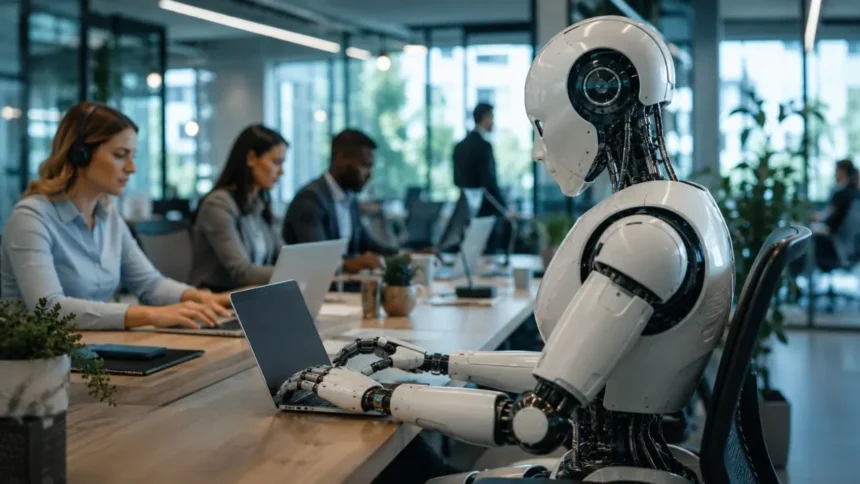
Robots are no longer limited to fenced-off areas inside large automobile factories. They now move products through warehouses, assist surgeons, inspect dangerous infrastructure, clean commercial buildings, transport hospital supplies, and work beside employees on production lines. As sensors, artificial intelligence, computer vision, and autonomous navigation improve, workplace robots are becoming more capable and easier to deploy across different industries.
This expansion is already visible in global adoption figures. The International Federation of Robotics reported that 542,000 industrial robots were installed during 2024, representing more than twice the annual number recorded a decade earlier. Approximately 4.66 million industrial robots were operating in factories worldwide by the end of that year, showing that robotic automation has become an established part of modern production.
However, the future of workplace robotics is not simply a story of machines replacing human employees. Most jobs contain a mixture of routine, physical, interpersonal, creative, analytical, and decision-making tasks. A robot may take over one part of a job while leaving the employee responsible for judgment, communication, troubleshooting, customer care, quality control, and unexpected situations.
The most important question is therefore not whether robots will enter more workplaces. They almost certainly will. The real question is how organizations will use them. Businesses that introduce robots only to reduce headcount may create fear and resistance, while those that redesign work around safety, productivity, employee development, and human strengths may create more valuable and sustainable results.
Workplace Robots Are Becoming More Diverse
An industrial robot is generally associated with activities such as welding, painting, assembly, material handling, and machine loading. These systems are designed to perform programmed physical movements repeatedly and accurately. They remain essential in manufacturing environments where speed, consistency, strength, or precision is required across thousands of production cycles.
Collaborative robots, commonly called cobots, are designed for applications in which people and robotic systems may work more closely together. Instead of remaining permanently separated behind a protective barrier, a cobot might hold a component while a technician completes a delicate task. Cobots accounted for about 10.5% of industrial robot installations worldwide in 2023, indicating growing interest in human-robot collaboration.
Service robots operate outside traditional industrial production. They include warehouse vehicles, commercial cleaning machines, agricultural robots, delivery systems, inspection devices, hospitality robots, and equipment used in laboratories or healthcare environments. Worldwide sales of professional service robots exceeded 199,000 units in 2024, while the IFR recorded particularly strong demand in transportation, logistics, cleaning, and medical applications.
Wearable robots and powered exoskeletons form another emerging category. These systems support rather than replace the employee by assisting movement, reducing physical strain, or helping a person lift and hold heavy equipment. NIOSH includes traditional robots, cobots, mobile systems, autonomous vehicles, wearable robots, and remotely controlled machines within its broad approach to occupational robotics.
Robots Could Remove Dangerous and Physically Demanding Tasks
One of the strongest arguments for workplace automation is its ability to reduce human exposure to dangerous environments. Robots can enter areas containing extreme heat, chemicals, radiation, unstable structures, heavy machinery, or contaminated material. They can also perform inspections in remote locations while employees control or monitor the operation from a safer position.
NIOSH notes that robots could inspect offshore oil platforms, assist with pesticide application, help healthcare workers lift patients, and perform other tasks that place people at physical risk. These applications demonstrate how robotics can support worker safety and health when the technology is selected for a clearly defined hazard rather than introduced only for speed.
The International Labour Organization describes many hazardous activities as “3D jobs”: work that is dirty, dangerous, or demeaning. Its 2025 workplace safety research explains that robots and automated systems can reduce exposure to dust, chemicals, noise, extreme temperatures, repetitive movements, and dangerous machinery. This could improve working conditions in sectors that have historically experienced high injury rates.
Robots may also support an aging workforce. An experienced employee might have valuable technical judgment but find repeated lifting, bending, reaching, or carrying increasingly difficult. A robotic assistant could handle the physical burden while the employee remains responsible for diagnosis, setup, inspection, problem-solving, and final approval.
Repetitive Work May Be Automated First
Robots are particularly effective when a task is structured, measurable, and repeated in a predictable environment. Moving boxes between fixed locations, placing products into packaging, applying a consistent weld, or loading a machine follows a stable sequence. Once the process is correctly designed, a robot can repeat it without becoming physically tired or losing concentration.
This does not mean that every repetitive task is easy to automate. A person can quickly recognize a damaged object, adjust to an unusual shape, respond to a coworker, or work around clutter. A robot may require cameras, force sensors, specialized gripping systems, detailed programming, and carefully controlled surroundings to handle the same variation safely.
Automation is therefore more likely to change individual tasks than eliminate complete occupations. The ILO’s research on technology and employment similarly finds that relatively few jobs consist entirely of tasks that can be automated with current technology. Most occupations continue to contain activities that require human involvement, interpretation, or responsibility.
For workers, this could make some jobs less monotonous and physically exhausting. Employees may spend less time repeating basic movements and more time coordinating production, solving problems, communicating with customers, maintaining equipment, or checking quality. Whether this improvement actually occurs will depend on how management redesigns workloads after automation is introduced.
Human-Robot Collaboration Could Become Normal
The traditional image of workplace automation involves a large machine operating inside a locked safety cage. That arrangement remains necessary for many high-speed and high-force applications. However, improved sensors, control systems, computer vision, and safety technology are supporting more collaborative forms of robotic automation.
A cobot may position a heavy item while a person installs a small component. It may deliver tools to a workstation, hold equipment steady, apply adhesive, or complete an ergonomically difficult movement. The employee can then concentrate on tasks requiring dexterity, adaptation, inspection, and practical judgment.
Successful human-robot collaboration requires more than purchasing a machine described as collaborative. OSHA guidance states that integrators must conduct a comprehensive hazard analysis and risk assessment for each collaborative application. Worker and employer participation is also recommended because the actual risks depend on the robot, tools, materials, speed, layout, and surrounding work processes.
Trust will be another essential factor. Employees need to understand what a robot can detect, when it will stop, how it makes movements, and what to do if its behavior appears unusual. Clear signals, predictable motion, emergency controls, practical training, and employee participation can make the technology feel like useful equipment rather than an unpredictable threat.
Manufacturing Jobs Could Become More Technical
Manufacturing will remain one of the largest areas of workplace robotics because many production processes are structured and repeatable. Robots can handle welding, painting, machine tending, product movement, assembly, dispensing, and inspection. Global installations have remained above 500,000 units annually for four consecutive years, showing sustained demand for factory automation.
As more physical tasks become automated, production employees may need broader technical responsibilities. A machine operator could become responsible for configuring equipment, checking digital work instructions, investigating errors, replacing tools, collecting process data, or coordinating several automated stations rather than operating one machine manually.
Maintenance roles may also expand. Robotic systems need cleaning, calibration, software updates, mechanical repairs, sensor checks, and preventive maintenance. Businesses will require technicians who understand mechanics, electronics, software, networking, safety procedures, and production requirements rather than treating robotics as a completely separate specialty.
This transition could create better-paid and more engaging work for some employees, but the benefits will not appear automatically. Workers who receive training may progress into technical positions, while those without access to learning opportunities could become more vulnerable. Employers therefore need to connect automation investments with realistic career pathways for their existing workforce.
Warehouses Could Become More Automated and Data-Driven
Warehouses are well suited to mobile robots because large amounts of work involve moving products between storage, packing, and shipping areas. Autonomous mobile robots can transport shelves, pallets, containers, or individual orders while navigating around obstacles and responding to updated instructions from warehouse management software.
Logistics and transportation are already among the strongest areas of professional service robotics. The IFR reports that automated guided vehicles and increasingly autonomous mobile robots are widely used in warehouses, with continuing development in internal logistics and last-mile delivery.
For employees, mobile robots can reduce long walking distances and repetitive cart pushing. A worker may remain at an ergonomic picking station while robots bring products to the correct location. This can improve order speed, but it can also create a faster work rhythm if management uses robotic efficiency to impose unrealistic performance expectations.
Warehouse automation therefore raises questions about job quality as well as productivity. Businesses should measure physical strain, workload, break access, employee control, and psychological pressure instead of focusing only on orders processed per hour. A faster system is not necessarily a better workplace when employees must constantly struggle to keep pace with it.
Healthcare Robots Could Support Rather Than Replace Care Teams
Healthcare robots can transport medication, laboratory samples, meals, laundry, and medical supplies through hospitals. These tasks are necessary but consume time that nurses, assistants, and other employees could spend on direct patient care. Autonomous transport systems may help reduce unnecessary walking and improve the availability of essential materials.
Robotic systems can also support surgery, rehabilitation, diagnostics, laboratory analysis, and non-invasive treatment. The IFR reported that sales of medical robots rose by 91% to approximately 16,700 units in 2024. Sales of rehabilitation and non-invasive therapy robots increased by 106%, while demand for surgical robots rose by 41%.
Physical assistance is another promising application. Patient lifting and repositioning can place substantial strain on healthcare employees. Robots, lifting devices, and wearable support systems may reduce musculoskeletal injuries when they are designed around the needs of both patients and caregivers.
However, empathy, reassurance, ethical judgment, sensitive communication, and responsibility cannot be reduced to mechanical efficiency. A patient may accept a robot transporting supplies but still expect a human professional to explain treatment and respond to emotional concerns. The best healthcare robotics strategies will protect time for human care rather than using technology to make already demanding workloads even heavier.
Robots May Enter Offices and Customer-Facing Workplaces
Office robotics may be less visually dramatic than factory automation, but physical robots could still take on selected tasks. Mobile systems can deliver documents or supplies, monitor buildings, manage inventory, guide visitors, or support cleaning and security operations. Telepresence robots can also allow a remote employee to move through a workplace and interact with colleagues.
Hotels, restaurants, airports, retail stores, and commercial buildings may use robots for cleaning, deliveries, basic customer guidance, and stock movement. These systems can be useful where tasks are frequent, routes are predictable, or staffing shortages make certain support activities difficult to maintain.
Customer-facing robots are unlikely to succeed simply because they attract attention. People usually care more about receiving accurate information, fast service, privacy, and respectful treatment. A robot that creates confusion or requires an employee to repeatedly correct it may add work instead of reducing it.
Organizations must therefore identify a genuine service problem before introducing customer-facing automation. A robot should shorten a delay, remove a physical burden, improve accessibility, or provide consistent support. Using one only to appear innovative may produce a short-lived novelty without creating lasting value for employees or customers.
Humanoid Robots Could Become More Visible but Face Practical Limits
Humanoid robots attract attention because their body shape allows them to operate in environments designed around human movement. In theory, they could walk through existing facilities, use stairs, handle tools, open doors, or work at stations originally built for people without requiring a complete redesign.
The International Federation of Robotics identified industrial humanoids as an important 2026 robotics trend, particularly in manufacturing and warehousing environments that require flexible movement. The automotive industry has been among the early sectors exploring whether humanoid systems can perform selected material-handling and production activities.
Despite this interest, humanoid robots still face demanding technical and economic tests. They must demonstrate safe movement, reliable balance, adequate battery life, useful payload capacity, maintainability, and consistent performance over long shifts. A specialized mobile robot or robotic arm may remain cheaper and more dependable for a narrowly defined task.
Humanoids are therefore more likely to enter workplaces gradually through controlled pilot programs. Early uses may involve moving standardized objects, completing simple inspections, or operating in areas where human-shaped mobility provides a clear benefit. Their long-term importance will depend on reliability and business value rather than impressive demonstrations.
Will Robots Replace Human Workers?
Some jobs will decline as businesses automate tasks that were previously completed manually. Roles dominated by predictable physical activities are generally more exposed than jobs requiring complex interpersonal contact, responsibility, creativity, negotiation, or adaptation. However, even highly exposed occupations may evolve rather than disappear completely.
The World Economic Forum’s Future of Jobs Report 2025 found that 58% of surveyed employers expected robotics and automation to transform their businesses by 2030. Across all major economic and technological forces—not robotics alone—the report projected 170 million new roles and 92 million displaced roles, resulting in a net gain of 78 million jobs.
These global projections should not be interpreted as a guarantee for any individual worker. New jobs may appear in different industries, cities, or skill categories from the jobs that are displaced. A positive total employment figure can still hide serious hardship for workers who cannot quickly move into emerging occupations.
The more useful approach is to examine how tasks are changing inside each role. Employers, educators, and governments can then develop training before displacement occurs. Early intervention gives workers time to build relevant skills, while waiting until a facility has already automated can leave employees with fewer realistic options.
New Skills Will Become More Valuable
Technical skills will grow in importance as robotics spreads. Organizations will need employees who can program, integrate, repair, supervise, and maintain robotic systems. Knowledge of automation software, sensors, industrial networks, data analysis, cybersecurity, machine vision, and mechatronics may become valuable across a wider range of occupations.
Human skills will remain equally important. Robots perform best when objectives and environments are clearly defined, while people are better at interpreting uncertainty, building trust, recognizing unusual situations, negotiating priorities, and understanding social context. Communication, leadership, creativity, and problem-solving may therefore become more valuable in increasingly automated workplaces.
Employees will not all need to become robotics engineers. A warehouse worker may need to understand how to safely interact with a mobile robot, while a supervisor may need to analyze performance data. A maintenance employee may require advanced technical training, whereas a human resources professional may focus on workforce planning and fair implementation.
The OECD reports that advances in artificial intelligence and robotics can now replicate some high-level cognitive abilities, but highly skilled occupations remain less exposed when they contain important bottleneck skills that technology cannot easily reproduce. This reinforces the importance of combining digital knowledge with judgment, adaptability, and social abilities.
Reskilling Must Be Part of the Automation Budget
Organizations often calculate the price of robotic equipment, integration, software, maintenance, and expected productivity gains. Training is sometimes treated as a secondary expense. This is a mistake because the performance of an automated workplace depends on whether employees understand how to use, supervise, maintain, and improve the new system.
Reskilling should begin before installation. Employees need an explanation of why the technology is being introduced, which tasks will change, what new responsibilities will appear, and what support will be available. Early communication reduces rumors and gives workers a meaningful opportunity to prepare.
Training should also be practical and role-specific. A short general presentation about robotics will not prepare a technician to troubleshoot a sensor or teach a production employee how to safely recover from a system fault. Workers need supervised practice, clear procedures, recognized learning outcomes, and time to build confidence.
Access must be fair. Employers should not limit advanced training to workers who already have strong technical backgrounds. Entry-level employees, older workers, temporary staff, people with disabilities, and employees from underrepresented groups should have realistic opportunities to develop new skills and compete for emerging positions.
Robot Safety Will Require Continuous Attention
Robots can remove employees from dangerous tasks, but they can also create new hazards. A moving robot may collide with a person, trap a worker against equipment, drop a load, restart unexpectedly, or behave incorrectly after a sensor, software, or communication failure. Maintenance and troubleshooting can be especially dangerous because normal safeguards may be interrupted.
Collaborative systems require careful assessment because the robot and employee may share part of the same workspace. OSHA emphasizes the need for application-specific hazard analysis rather than assuming that a machine is safe simply because it is marketed as a cobot. Speed, force, tooling, workpiece shape, and possible contact all affect the level of risk.
Safety planning should cover the entire lifecycle of the system. This includes design, installation, normal operation, cleaning, programming, maintenance, fault recovery, software updates, relocation, and eventual removal. Contractors and temporary employees must also receive information when they work near automated equipment.
Worker involvement can reveal risks that designers and managers overlook. Employees know where congestion occurs, which shortcuts people take under pressure, when visibility is poor, and how equipment behaves during unusual situations. Including them in risk assessments can make automation safer and easier to use.
Privacy and Algorithmic Management Could Become Major Concerns
Workplace robots frequently collect information through cameras, location systems, microphones, force sensors, or productivity software. Some data is necessary for navigation and safety, but the same information may also be used to track employee location, movement, pace, or behavior.
Excessive monitoring can reduce trust and create stress. Employees may feel that every pause or deviation is being judged without understanding the reason behind it. Automated performance systems can also miss important context, such as helping a coworker, resolving a safety issue, or handling an unusually difficult customer.
The OECD identifies privacy, transparency, discrimination, loss of worker agency, and automated management as important risks associated with workplace technology. It also notes that AI can improve productivity and job quality when implementation is trustworthy and human-centered.
Organizations should therefore explain what data a robot collects, why it is required, how long it is stored, who can access it, and whether it will affect employment decisions. Workers should also have a way to challenge inaccurate conclusions rather than being evaluated solely by an automated system.
Small Businesses Could Gain Access to Robotics
Industrial automation was once associated mainly with large manufacturers that could afford specialized engineering teams and long integration projects. Cobots, subscription models, simplified programming, modular equipment, and robotics-as-a-service arrangements are making some applications more accessible to smaller organizations.
A small manufacturer might use a cobot to load a machine during a difficult shift. A regional warehouse could rent mobile robots during a seasonal increase in orders. A commercial cleaning company might use autonomous equipment for large open areas while employees focus on edges, obstacles, sanitation, and customer needs.
However, affordability should be evaluated through total cost rather than purchase price alone. Integration, safety equipment, employee training, software, maintenance, spare parts, cybersecurity, downtime, and workflow redesign can significantly affect the final return on investment.
Small businesses should begin with a clearly defined bottleneck rather than attempting to automate everything. A limited pilot can reveal whether the robot performs reliably, improves working conditions, and delivers measurable value. It also gives employees time to develop experience before the system is expanded.
How Employers Can Prepare for a More Robotic Workplace
The first step is to identify tasks that are dangerous, repetitive, physically demanding, difficult to staff, or responsible for consistent quality problems. Employers should then consider whether automation is the best solution or whether better tools, job redesign, staffing, or process improvements could solve the problem more simply.
The second step is employee consultation. Workers should be involved before the final system is selected because they understand the practical details of the job. Consultation can improve equipment design, identify hazards, reduce resistance, and reveal opportunities to make work more meaningful.
The third step is to create a workforce transition plan. Employers should identify which tasks will disappear, which roles will change, what new positions may emerge, and what training employees need. This plan should include measurable commitments rather than vague promises that workers will somehow “move into higher-value work.”
The final step is ongoing evaluation. Businesses should track productivity, injuries, near misses, equipment downtime, employee turnover, workload, job satisfaction, and customer outcomes. A robotic system should be considered successful only when it improves the complete workplace rather than one isolated performance metric.
The Future Workplace Will Be Built Around Choices
Robots could make workplaces safer, more productive, and more accessible. They may remove people from hazardous environments, reduce physical strain, support employees with limited mobility, improve product consistency, and help essential services respond to labor shortages.
The same technology could also increase surveillance, intensify workloads, eliminate entry-level pathways, or shift benefits toward a small group of owners and highly skilled workers. These outcomes are not unavoidable consequences of robotics. They are influenced by management decisions, training policies, safety standards, labor protections, and employee participation.
The most successful organizations will treat robots as part of a broader human system. They will decide which tasks should be automated, which responsibilities must remain human, and how productivity gains should improve work. They will also recognize that trust and skill development are essential parts of the technology investment.
Robots will undoubtedly change the workplace, but they will not determine its future alone. People will determine how the machines are designed, deployed, governed, and evaluated. A human-centered approach can turn robotic automation from a source of fear into a practical tool for safer work, stronger skills, and better organizational performance.
Frequently Asked Questions
How will robots change jobs in the future?
Robots will automate selected physical, repetitive, and hazardous tasks while creating more demand for maintenance, programming, supervision, data analysis, and problem-solving. Many occupations are more likely to be redesigned than completely eliminated.
Will workplace robots replace all human workers?
No. Most jobs contain tasks requiring judgment, communication, adaptability, empathy, or accountability. Robots may replace some activities and certain roles, but human employees will remain essential across most workplaces.
What jobs are most likely to be affected by robots?
Jobs containing predictable physical activities, material movement, basic assembly, packaging, cleaning, or machine loading are among the most exposed. The level of impact depends on cost, workplace layout, safety requirements, and task complexity.
Can robots make workplaces safer?
Yes. Robots can reduce exposure to chemicals, heat, dangerous machinery, heavy lifting, and unstable environments. However, employers must assess collision, crushing, software, maintenance, and unexpected-movement risks before deployment.
What skills will workers need in a robotic workplace?
Workers will benefit from technical literacy, troubleshooting, data interpretation, equipment supervision, and safety knowledge. Communication, creativity, critical thinking, teamwork, and emotional intelligence will also remain highly valuable.