

For nearly two decades, smartphones have been the centre of digital life. People use them to communicate, navigate, take photographs, make payments, watch videos, manage work, search for information and access social media. Their success comes from combining hundreds of tools inside one familiar touchscreen device that fits inside a pocket.
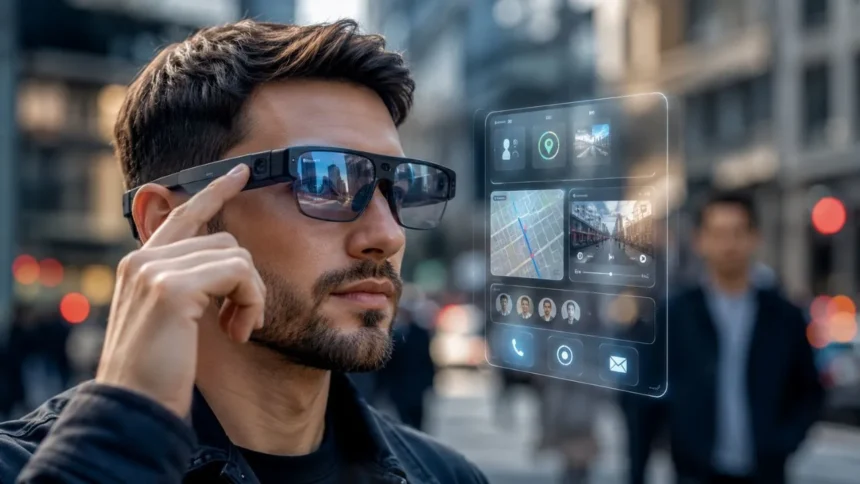
Smart glasses propose a different relationship with technology. Instead of repeatedly looking down at a screen, users could hear information through open-ear speakers or see it inside a transparent lens. Cameras, microphones, artificial intelligence and augmented reality could allow the device to understand what the wearer is seeing and provide assistance at the moment it is needed.
This transition has already moved beyond laboratory demonstrations. Display-free AI glasses can capture photographs, play audio, answer questions and translate conversations, while newer display glasses can show messages, directions, captions and visual AI responses. Google has also announced Android XR audio glasses for autumn 2026, with display-equipped models forming another part of its intelligent-eyewear strategy.
However, replacing the smartphone is a much greater challenge than adding a camera or voice assistant to a pair of frames. Smart eyewear must become comfortable, socially acceptable, secure and useful throughout the day. It must also provide reliable controls, long battery life and access to the apps people already depend on before it can become their primary personal computing device.
Why Smart Glasses Are Becoming Serious Competitors
Earlier smart glasses often felt like experimental gadgets. They were bulky, expensive and limited to a small number of functions. Some products placed a tiny display in front of one eye, but they lacked the processing power, software ecosystem and artificial intelligence required to deliver useful assistance in everyday situations.
Modern AI models have changed that equation. A wearable assistant can now interpret spoken requests, identify objects, summarize information, translate languages and answer questions about the user’s surroundings. The glasses do not need to display a complete smartphone interface when an AI assistant can complete many tasks through a short conversation.
Hardware has also become easier to fit into conventional-looking frames. Smaller processors, cameras, microphones, speakers and batteries allow manufacturers to create smart eyewear that looks closer to ordinary prescription glasses or sunglasses. This matters because a device worn on the face must function as both consumer electronics and personal fashion.
Market forecasts suggest that smart glasses are moving toward wider adoption. IDC expects shipments of display-free glasses to reach approximately 13.6 million units during 2026 and 27.3 million by 2030. It forecasts display-equipped optical see-through glasses rising from about 3 million units in 2026 to 12.2 million in 2030.
Two Types of Smart Glasses Are Emerging
The term “smart glasses” currently describes several different product categories. The simplest models contain speakers and microphones but no camera or display. They function like open-ear headphones built into eyewear, allowing the wearer to make calls, listen to music and interact with a voice assistant.
Camera-equipped AI glasses add visual awareness. They can take photographs, record videos and use artificial intelligence to interpret the wearer’s surroundings. A person might ask what kind of plant they are looking at, request information about a landmark or receive help understanding a product label.
Display smart glasses place information inside the wearer’s line of sight. Depending on the product, they may show messages, navigation prompts, translations, photographs, captions or short AI responses. Meta Ray-Ban Display, released in the United States in September 2025, combines cameras, audio, AI and a colour lens display designed for brief interactions.
More advanced augmented reality glasses aim to place digital objects within the physical environment. They may display several virtual screens, three-dimensional instructions or location-aware graphics. These devices have greater smartphone-replacement potential, but their displays, sensors and processors also require more power and usually create heavier or more noticeable eyewear.
Artificial Intelligence Could Become the Main Interface
A smartphone usually requires the user to open an application, navigate menus, enter information and interpret the results. Smart glasses could shorten this process by allowing the wearer to state an intention naturally. Instead of opening a weather app, the person could simply ask whether rain is expected before reaching the office.
Contextual AI could make these requests more useful. Since the glasses may understand location, direction, speech and the camera view, the assistant can respond to what is happening around the wearer. It may explain a sign, identify a building, recommend a nearby restaurant or provide instructions for an unfamiliar piece of equipment.
This could reduce the importance of individual app interfaces. Users would still rely on mapping, messaging, calendar and shopping services, but AI could operate those services in the background. The glasses would present only the information needed to complete the immediate task rather than displaying a grid of apps.
Google’s 2026 intelligent-eyewear demonstration reflects this direction. Its planned Android XR glasses can use Gemini to answer questions about visible objects, send messages, manage calls, summarize missed communications and provide navigation without requiring the wearer to hold a phone.
Navigation Could Move Into the Wearer’s View
Navigation is one of the clearest reasons people repeatedly take out their smartphones. A pedestrian may need to check an unfamiliar street every few minutes, while a driver may rely on a dashboard-mounted phone. Both situations divide attention between the screen and the surrounding environment.
Audio smart glasses can deliver spoken directions directly to the wearer. Because the speakers remain open to environmental sound, users may hear instructions without blocking traffic noise or nearby conversation. The experience can feel more natural than holding a device while walking through a busy area.
Display glasses could improve the process further by showing arrows, street names or a small map inside the lens. Instead of interpreting a flat map and then matching it to the street, the wearer may receive simple guidance at the moment a turn is required.
Meta’s display glasses introduced visual pedestrian navigation in selected cities, while the company announced in June 2026 that turn-by-turn pedestrian guidance was also coming to its display-free glasses. Google has similarly described direction-aware navigation as a core feature of its planned Android XR eyewear.
Communication Could Become More Hands-Free
Smartphones made communication portable, but they also made it visually demanding. Reading a message, searching for a contact or replying to an email requires the user to stop looking at the surrounding environment. Smart glasses could move many of these interactions into voice, audio and short visual prompts.
A wearer may hear an incoming message and dictate a reply without touching a screen. An AI assistant could summarize several missed conversations, identify the important requests and ask whether the user wants to respond. This would be particularly useful while walking, cooking, carrying equipment or completing other hands-on activities.
Display glasses could show short texts without opening a phone. Longer conversations would still be uncomfortable to read inside a small lens, but simple replies, appointment updates, verification codes and delivery notifications could be handled in seconds.
Current display glasses already demonstrate parts of this model. Meta Ray-Ban Display can show short messages and support video calls in which the other participant sees the wearer’s point of view. Google says its upcoming intelligent eyewear will connect with phone apps to manage calls and messages through Gemini.
Cameras Could Make Computing More Visual
The smartphone camera changed photography because it was always available. Smart glasses could take this idea further by placing the camera at approximately the wearer’s eye level. A person could capture a moment without first reaching for a phone, opening the camera and positioning the device.
This point-of-view camera also gives artificial intelligence useful context. When the user asks a question, the system can evaluate the scene rather than relying only on a verbal description. It might compare products, read printed information, recognize a landmark or explain the visible controls on a machine.
Visual assistance could make search feel more immediate. Instead of photographing an item and then uploading the picture to a search tool, the user could simply look at it and ask a question. The response might arrive through audio or appear as a brief card inside the lens.
Camera-based computing also introduces risks. An AI system may misunderstand what it sees, especially in poor lighting or complex environments. Users should not depend on smart glasses for critical medical, legal, financial or safety decisions without confirming the information through an appropriate professional or authoritative source.
Translation Could Become Almost Invisible
Translation apps already allow people to speak, type or photograph foreign-language text. However, using them usually requires switching attention to a phone. Smart glasses could place translation directly within a conversation, making communication faster and less disruptive.
Audio glasses may listen to speech and deliver the translated meaning through speakers. Display glasses can show live captions while the other person is speaking. They may also recognize signs, menus and notices, then provide an audio or visual translation without requiring the wearer to operate a separate application.
This could benefit travellers, international teams, students and multilingual families. It may also reduce the discomfort of repeatedly pausing a conversation to type sentences into a phone. Natural eye contact becomes easier when both participants remain focused on each other rather than on a screen.
Meta expanded live translation in June 2026 with support planned for 14 additional languages, including Hindi, Mandarin Chinese, Japanese and Korean. Google has also positioned spoken and visual translation as an important use case for Android XR intelligent eyewear.
Accessibility Could Be a Major Reason for Adoption
Smart glasses may become more valuable when they solve accessibility problems rather than merely offering another way to check notifications. Live captions could help some people follow spoken conversations, while object descriptions and navigation assistance could support users with visual impairments.
Open-ear speakers may amplify or clarify a conversation without completely isolating the wearer from environmental sound. A camera-based assistant could read small labels, identify products or describe nearby objects when requested. The practical benefit would depend on the accuracy of the system and the individual user’s needs.
Alternative controls could also improve access. Meta’s display glasses use an electromyography wristband that translates small muscle signals into digital commands. The company says this approach may provide control options for people who cannot comfortably perform large hand movements or conventional touchscreen gestures.
Accessibility must be considered during product design rather than added after launch. Controls should work with different levels of mobility, displays must accommodate varying vision needs and spoken features should support diverse accents. Smart glasses will be more inclusive when disabled users participate directly in testing and development.
Smart Glasses Could Replace Some Physical Screens
A smartphone is not only a communication tool; it is also a portable display. People use it to read documents, watch videos, edit photographs and manage work. For smart glasses to replace the phone fully, they must offer a comfortable alternative to this screen.
Display glasses can create a private virtual screen that appears larger than the physical device. This could be useful while travelling, working in a small room or using a laptop in a public place. A pair of glasses may eventually replace a secondary monitor for selected productivity tasks.
More advanced spatial-computing devices could position multiple windows around the user. Messages might appear on one side, a video in the centre and work documents on another. Unlike a smartphone display, these virtual screens would not be limited by the physical dimensions of a pocket-sized rectangle.
However, extended reading and detailed editing remain difficult on lightweight glasses. A small display designed for brief notifications is different from a wide-field augmented reality system. The latter requires more advanced optics, greater processing power and a control method capable of replacing a mouse, keyboard or touchscreen.
App Ecosystems Will Decide Whether Replacement Happens
People do not remain loyal to smartphones only because of the hardware. They depend on banking apps, messaging platforms, maps, transportation services, workplace software, shopping accounts, cloud storage and authentication tools. Smart glasses must connect with this ecosystem before users can leave their phones behind.
The most practical approach is to let glasses access existing smartphone applications. An AI assistant could retrieve information or complete actions through the same services already installed on the user’s phone. This reduces the need for developers to rebuild every application immediately.
Android XR is designed as a shared platform for headsets and glasses using familiar Android tools. Google has stated that the platform is intended to give users access to known applications while allowing developers to build experiences across different extended-reality devices.
A competitive ecosystem will also require choice. Consumers may reject glasses that work only with one messaging platform, assistant or operating system. Products that support both Android and iOS, connect with widely used services and give developers clear tools are more likely to become everyday computing devices.
New Controls Could Replace the Touchscreen
The touchscreen helped smartphones succeed because it provides a direct and flexible control surface. Smart glasses do not have a large surface for typing, scrolling or arranging information. They therefore need a new interaction system that is fast, private and socially comfortable.
Voice is the simplest option, but it does not work well in every setting. People may avoid speaking personal messages aloud in an office, train or crowded shop. Noise can also reduce recognition accuracy, while some users may have speech conditions or accents that voice systems handle poorly.
Touch controls on the frame can manage volume, playback and simple selections. Eye tracking may identify what the wearer is looking at, while hand gestures can select or move digital objects. Each method offers advantages, but none has yet matched the flexibility of a modern touchscreen.
Electromyography offers another possibility. The Meta Neural Band detects muscle activity at the wrist, allowing wearers to select and scroll through content with subtle finger movements. Meta has said future software could eventually support silent text input through these signals, although that capability must become fast and reliable before it can replace phone typing.
Battery Life Remains a Significant Barrier
People expect a smartphone to remain available throughout most of the day. Smart glasses face a more difficult energy problem because their batteries must fit inside thin, lightweight frames. Cameras, wireless connections, artificial intelligence, speakers and displays all increase power consumption.
Display-free glasses currently have an advantage because they do not need to illuminate a lens continuously. Ray-Ban Meta Gen 2 is rated for up to eight hours of typical use, supported by a charging case. This may cover part of a normal day, but heavy recording, calling or AI use can reduce practical endurance.
Display models consume more energy. Meta rates its Ray-Ban Display glasses for up to six hours of mixed use, with additional charging available from the case. Such performance may be suitable for intermittent assistance, but it is not yet equivalent to unrestricted all-day visual computing.
Manufacturers may address the problem through more efficient chips, lower-power AI, improved batteries and displays that activate only when needed. Some processing can also remain on a connected phone or cloud server. Until energy efficiency improves, many smart glasses will continue to depend on another device.
Displays Must Become Brighter, Lighter and More Efficient
Creating a transparent display is considerably more difficult than placing an ordinary screen inside the frame. Digital light must reach the wearer’s eye without blocking the physical world. The image must remain visible outdoors while the optics stay thin, lightweight and comfortable.
Waveguides help direct images through transparent lenses, allowing manufacturers to reduce the size of the display system. However, optical efficiency remains a major challenge. A large amount of generated light can be lost before it reaches the eye, increasing the brightness and electrical power required.
Micro-LED technology is viewed as a promising option because it can provide high brightness in a small display. Nevertheless, producing efficient, high-resolution, full-colour microdisplays remains technically demanding. Researchers continue to balance brightness, field of view, image quality, power consumption, size and manufacturing cost.
These trade-offs explain why many everyday smart glasses currently avoid large augmented reality displays. Audio-and-camera models can look more like normal eyewear because they require fewer optical components. Full smartphone replacement becomes more realistic when advanced displays can fit into similar frames without sacrificing comfort.
Weight, Heat and Comfort Cannot Be Ignored
A smartphone spends most of its time inside a pocket, bag or hand. Smart glasses rest continuously on the nose and ears. A small increase in weight can therefore become noticeable during several hours of use, particularly when the weight is concentrated at the front or sides of the frame.
Heat creates another challenge. Processors performing visual analysis and wireless communication generate warmth, but manufacturers cannot use large fans or heavy cooling systems. The glasses must control temperature without becoming uncomfortable or reducing performance during demanding tasks.
Fit is equally important. People have different head sizes, nose shapes, prescriptions and style preferences. A technically advanced device may still fail if it slips during movement, feels uncomfortable with headphones or cannot be adjusted by an optician.
Eyewear partnerships are therefore becoming strategically important. Google is working with Warby Parker and Gentle Monster on its 2026 audio glasses, while Meta has continued expanding its work with EssilorLuxottica. These collaborations show that successful smart eyewear must be designed as something people genuinely want to wear.
Privacy Could Determine Whether People Accept Smart Glasses
A smartphone camera is generally visible because the user must hold the device in a recording position. Smart-glasses cameras are less obvious, creating uncertainty for nearby people. Someone may not know whether the wearer is taking a photograph, recording video or using visual artificial intelligence.
Manufacturers use recording lights and other indicators, but these signals may be too small or unfamiliar for bystanders to understand. Acceptance can also vary by location. Camera glasses may seem reasonable at a tourist attraction but inappropriate inside a private home, medical facility, school or confidential workplace.
A 2026 study involving 525 survey participants and 20 paired interviews found clear differences between what camera-glasses wearers were willing to provide and what bystanders expected. In sensitive settings, the researchers reported that 65% to 90% of bystanders would take some form of defensive action.
Trust will require more than a recording indicator. Future glasses may need automatic camera restrictions in sensitive places, clearer signals, local processing and controls that respect nearby people. Laws and workplace policies may also establish where camera-equipped eyewear can be used.
Security and Data Ownership Need Stronger Protection
Smart glasses may collect photographs, video, audio, location information, voice commands and details about what the wearer is looking at. This combination can reveal more context than a traditional wearable device. It could expose daily routines, personal relationships, workplaces and confidential documents.
Companies must clearly explain which information is processed on the glasses, the connected phone or remote servers. Users should also know whether recordings are saved automatically, used to improve AI models or shared with third-party services.
Strong security will require encrypted communication, secure authentication, regular software updates and careful app permissions. A stolen or compromised pair of glasses should not provide immediate access to messages, photographs, payment services or workplace systems.
Privacy controls must also remain understandable. Users should be able to disable cameras, microphones, memory features and cloud processing without searching through complicated menus. Smart glasses cannot become a trusted smartphone replacement if people feel they have lost control over their own information.
Smartphones May Become Companion Computers First
The most realistic near-term future is not the immediate disappearance of smartphones. Instead, the phone may remain in a pocket while smart glasses become the main interface. The phone can provide mobile connectivity, additional processing power, storage and access to established applications.
This arrangement helps keep the glasses lighter. Complex tasks can run on the phone while the eyewear handles cameras, audio, basic controls and short visual information. The user interacts mainly through the glasses but still relies on the smartphone’s hardware in the background.
Over time, more functions may move directly into the frames. Cellular connectivity, local AI processing, identity verification and improved batteries could reduce dependence on the phone. A separate pocket device might eventually become optional for many everyday activities.
Even then, some people may keep another screen for detailed work, entertainment or privacy. The transformation may resemble the relationship between laptops and desktop computers: one device becomes dominant for daily use without completely eliminating the other.
Workplaces May Adopt Smart Glasses Before Everyone Else
Businesses can justify smart glasses when they solve a measurable operational problem. A technician may receive repair instructions while keeping both hands on the equipment. A warehouse worker could view picking information, while a surgeon or engineer might access reference material without leaving the task.
Remote experts could also see the employee’s point of view and provide guidance. This may reduce travel and help less-experienced workers complete complicated procedures. Training information could appear on the equipment itself rather than inside a separate manual.
Enterprise adoption does not require the glasses to replace every smartphone function. A device can be valuable when it performs one job reliably, such as inspection, navigation, documentation or remote support. Controlled workplaces also make it easier to establish safety and privacy rules.
Consumer expectations are broader. Everyday buyers will expect fashionable frames, dependable AI, entertainment, messaging, navigation, payments and a reasonable price. Workplace deployments may therefore mature more quickly than complete consumer smartphone replacement.
What a Realistic Transition Could Look Like
The first stage is already taking place: smart glasses replace selected smartphone moments. People can capture photographs, listen to audio, answer calls, ask AI questions and translate speech without touching a handset. The phone remains essential but is used less frequently.
The second stage will involve compact displays. Messages, directions, captions and simple app information will appear inside the lens. Users may complete many routine tasks without taking out a phone, although longer writing, detailed work and video viewing may still require another screen.
The third stage requires wider displays, stronger app ecosystems and more natural controls. Glasses could provide virtual screens, persistent digital tools and location-aware information. At this point, the smartphone may function mainly as a processor or connectivity hub.
Complete replacement would require all-day battery life, affordable prescription options, reliable security, social acceptance and a solution for detailed text input. IDC’s forecasts show strong expected growth, but they also reveal that display-free and display-equipped glasses remain distinct product categories rather than one fully mature smartphone successor.
Conclusion
Smart glasses could eventually replace smartphones because they offer a more immediate and hands-free form of computing. Artificial intelligence can interpret voice and visual context, while augmented reality can place useful information directly within the wearer’s view.
The earliest replacements will be small but meaningful. Navigation, photography, calls, messaging, translation and quick searches may no longer require a phone screen. These everyday improvements could gradually change how often people reach into their pockets.
Major barriers remain. Battery life, optical efficiency, comfort, text input, app support, privacy and public trust must improve substantially. A device worn on the face also faces stricter social expectations than one kept inside a pocket.
Smartphones are therefore unlikely to disappear suddenly. They may first become invisible companion computers supporting the glasses from the background. As the hardware becomes lighter and the software more capable, smart glasses could gradually emerge as the primary interface for everyday digital life.
Frequently Asked Questions
Can smart glasses completely replace smartphones?
Not yet. Current smart glasses can handle calls, photographs, music, AI questions and some navigation, but smartphones remain better for typing, detailed applications, long videos and all-day computing.
What can smart glasses do without a phone?
Capabilities vary by model. Some glasses can take photographs, record videos, play downloaded audio or perform limited AI functions independently, while many features still require a phone or internet connection.
Are smart glasses the same as augmented reality glasses?
No. Some smart glasses provide only audio, cameras and AI assistance. Augmented reality glasses include displays that place digital information or virtual objects within the wearer’s view.
How long do smart-glasses batteries last?
Battery performance depends on the product and activity. Current mainstream AI glasses may offer several hours of mixed use, but frequent recording, calling, AI processing and display use can reduce that time.
Are camera-equipped smart glasses safe for privacy?
They can create privacy concerns because nearby people may not know when recording or visual analysis is active. Clear indicators, strong security, responsible behaviour and context-sensitive controls are essential.