

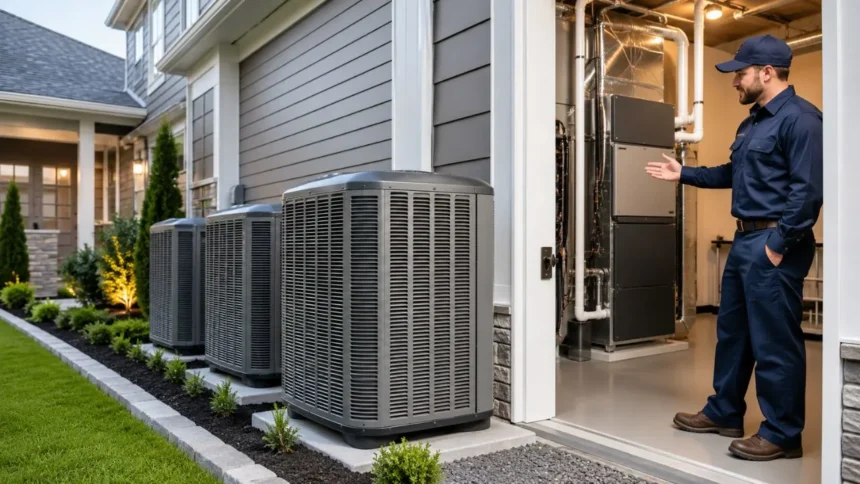
Buying a new heating and air conditioning system is a major home investment, so choosing a dependable brand matters. The best HVAC brands in the United States generally include Trane, Carrier, Lennox, American Standard, Rheem, Ruud, Goodman, Amana, Daikin, Mitsubishi Electric, Bosch, Bryant, and Fujitsu. However, the right choice depends on your climate, home design, budget, efficiency goals, and access to qualified local technicians.
A premium name does not automatically guarantee better comfort or a longer equipment life. An affordable system installed by an experienced HVAC contractor can outperform an expensive unit that is incorrectly sized, poorly charged, or connected to damaged ductwork. That is why homeowners should evaluate both the equipment manufacturer and the company responsible for designing, installing, and maintaining the system.
Different heating and cooling brands are stronger in different areas. Trane and American Standard are popular with buyers focused on durability, while Carrier and Lennox offer advanced comfort controls and high-efficiency options. Rheem, Ruud, Goodman, and Amana appeal to value-conscious homeowners, whereas Mitsubishi Electric, Daikin, Bosch, and Fujitsu are strong choices for inverter heat pumps and ductless mini-split systems.
This guide compares the leading HVAC equipment brands available to U.S. homeowners. It explains their common strengths, ideal buyers, warranty considerations, efficiency features, and possible limitations. It also covers what to look for in an HVAC quote so you can choose a complete home comfort system rather than buying equipment based only on a familiar logo.
Quick Answer: Which HVAC Brands Are Best?
Trane is one of the strongest all-around choices for homeowners who prioritize durable equipment and dependable performance. Carrier is a leading premium option for advanced temperature control, communicating technology, and whole-home comfort. Lennox is attractive for buyers interested in high energy efficiency, quiet operation, and a wide range of air conditioning, heat pump, furnace, and indoor air quality products.
American Standard provides many of the qualities buyers expect from a premium HVAC system while offering a practical balance between performance and price. Rheem and Ruud are dependable mid-range choices that can provide good value when supported by a qualified local installer. Bryant is another strong alternative for homeowners who want proven comfort technology without always choosing the highest-priced premium option.
Goodman is often considered one of the best budget HVAC brands because its systems are widely available and priced competitively. Amana appeals to homeowners looking for value-oriented equipment with attractive registered warranty options on eligible models. York can also be worth considering when a trusted local dealer offers competitive pricing, proper installation, and reliable access to replacement parts.
For heat pumps and ductless systems, Mitsubishi Electric, Daikin, Fujitsu, and Bosch deserve serious consideration. Mitsubishi Electric and Fujitsu are particularly well known for zoned mini-split applications, while Daikin offers both ductless and whole-home solutions. Bosch inverter heat pumps are frequently considered for homeowners who want variable-capacity comfort while retaining a conventional ducted system.
How Should You Judge an HVAC Brand?
Reliability is important, but it should not be judged by the brand name alone. HVAC systems contain compressors, coils, motors, control boards, valves, sensors, and other components that operate under demanding conditions. Even high-quality equipment can develop problems when it is oversized, installed incorrectly, exposed to poor airflow, or operated without regular filter changes and professional maintenance.
Energy efficiency is another major consideration when comparing the best air conditioner and furnace brands. Central air conditioners and heat pumps use SEER2 and EER2 ratings, while heat pump heating performance is also measured with HSPF2. Gas furnace efficiency is shown as AFUE, which indicates how much of the fuel consumed is converted into usable heat over a typical heating season.
Warranty coverage should be reviewed carefully before making a decision. Many manufacturers offer longer parts coverage when eligible equipment is registered within a required period, but labor is frequently limited or excluded. Homeowners should ask for written details covering the compressor, heat exchanger, replacement parts, labor charges, registration deadlines, transferability, and any maintenance requirements that could affect a claim.
Local support can ultimately determine whether a brand is a smart purchase in your area. A manufacturer may produce excellent equipment, but that advantage becomes less meaningful when trained technicians or replacement parts are difficult to find nearby. Before choosing an HVAC system, ask who will service it, how quickly common parts can be obtained, and whether the installing contractor regularly works with that specific product line.
Best Premium HVAC Brands: Trane, Carrier, Lennox and American Standard
Trane is a strong choice for homeowners who want a durable central air conditioner, heat pump, or gas furnace from an established premium brand. Its product range includes straightforward single-stage equipment as well as variable-speed systems designed to deliver more consistent temperatures. Trane systems may cost more than entry-level alternatives, so the overall value depends heavily on receiving a competitive quote from an experienced dealer.
Carrier is another leading premium HVAC brand with options ranging from basic residential equipment to sophisticated communicating systems. Its higher-end products may appeal to buyers who want variable-capacity performance, humidity management, quieter operation, and connected controls. Carrier can be an excellent choice when the homeowner plans to use compatible components as a complete matched system rather than combining unrelated indoor and outdoor equipment.
Lennox is often considered by buyers seeking advanced efficiency and quieter home comfort. The company offers multiple equipment tiers, allowing homeowners to compare basic, mid-range, and premium heating and cooling systems within the same brand. Some proprietary components or advanced controls may cost more to replace, so buyers should ask their Lennox dealer about future repair costs, local parts availability, and available labor protection.
American Standard offers air conditioners, heat pumps, furnaces, air handlers, packaged equipment, and indoor air quality products for different budgets. It is frequently selected by homeowners who want a dependable premium system without automatically choosing the most elaborate model. As with Trane, Carrier, and Lennox, proper sizing and dealer quality will have more influence on real-world performance than purchasing the most expensive efficiency tier.
Best Value HVAC Brands: Rheem, Ruud, Bryant and York
Rheem is a practical option for homeowners who want dependable heating and cooling equipment at a price that may be more accessible than some premium brands. Its residential range includes central air conditioners, heat pumps, gas furnaces, air handlers, and packaged systems. Rheem can provide strong value when the chosen model has the right efficiency level and is installed by a contractor who regularly services the brand.
Ruud is closely associated with Rheem in the residential HVAC market and is commonly offered through a different network of local distributors and contractors. The equipment can be a sensible choice when the Ruud dealer in your area has a strong reputation for installation and after-sales support. Comparing Rheem and Ruud quotes may therefore come down to contractor quality, equipment availability, warranty terms, and total project cost.
Bryant is worth considering for homeowners who want a broad selection of heating and cooling equipment across several price levels. Its line includes traditional single-stage systems and more advanced models designed for improved comfort and efficiency. Bryant may offer an appealing middle ground when a qualified dealer provides a properly matched system at a lower installed price than comparable premium proposals.
York can be a competitive option when supported by a dependable regional contractor and distributor. The brand offers central air conditioners, heat pumps, furnaces, packaged units, and related home comfort products. Homeowners evaluating York should place particular emphasis on the installer’s experience, local service capacity, model-specific warranty coverage, and whether commonly needed parts can be obtained quickly during peak heating or cooling seasons.
Best Budget HVAC Brands: Goodman, Amana and RunTru
Goodman is widely considered when homeowners need a straightforward HVAC replacement without paying for the most advanced controls or premium cabinet features. Its equipment is commonly available, and many contractors are familiar with installing and repairing it. A Goodman system can be a sensible purchase when the quote includes correct load calculations, matched components, appropriate airflow settings, and a clearly explained registered warranty.
The main advantage of Goodman is not that every model is superior to premium equipment. Its advantage is the ability to purchase functional heating and cooling technology at a competitive price. Buyers should avoid choosing a Goodman system solely because it is the lowest bid, as a rushed installation, oversized unit, weak ductwork, or insufficient commissioning can erase the savings through discomfort and higher operating costs.
Amana is another value-oriented choice and shares some product platforms and distribution resources with Goodman. Depending on the model, Amana may provide additional features or warranty benefits that make it attractive to homeowners planning to remain in their homes for many years. Buyers should compare the exact Amana and Goodman model numbers because the benefits can differ even when the equipment appears similar from the outside.
RunTru is positioned as a more affordable residential heating and cooling option within the broader Trane product family. It can suit homeowners who want basic comfort equipment supported by an established distribution system but do not require top-tier communicating controls. The deciding factor should still be the total proposal, including sizing, installation materials, labor coverage, thermostat compatibility, duct modifications, and long-term service support.
Best Heat Pump and Ductless Brands
Mitsubishi Electric is one of the leading choices for ductless mini-split and multi-zone heat pump systems. These systems can work well in home additions, older properties without ducts, converted spaces, garages, upstairs rooms, and houses requiring individual temperature zones. Some Mitsubishi Electric product lines are also designed for effective heating in colder climates, although proper system selection remains essential for low-temperature performance.
Daikin offers an extensive range of ductless, multi-zone, and whole-home heating and cooling products. It can be a strong option for homeowners interested in inverter-driven technology that adjusts output instead of repeatedly switching fully on and off. Daikin also has a broad presence in the U.S. residential market, but warranty coverage, product availability, and contractor expertise should still be confirmed for the exact model being proposed.
Bosch is frequently considered for inverter ducted heat pumps that can work with more traditional central HVAC layouts. Its equipment may appeal to homeowners who want improved temperature stability and quieter operation without installing wall-mounted indoor units throughout the home. Bosch is particularly worth comparing when replacing an older central air conditioner with a heat pump while retaining suitable existing ducts and an approved indoor unit.
Fujitsu GENERAL is another respected name in ductless mini-split heating and cooling. Its systems can provide zoned comfort, allowing homeowners to condition occupied rooms instead of heating or cooling the entire property equally. As with Mitsubishi Electric and Daikin, the quality of the design matters because indoor-unit placement, refrigerant-line lengths, drainage, outdoor-unit location, and correct capacity selection directly influence comfort and reliability.
Which HVAC Brand Is Best for Your Needs?
For maximum durability, Trane and American Standard are reasonable starting points, provided strong local dealer support is available. Buyers should compare similar equipment tiers instead of comparing an entry-level system from one company with a premium variable-speed model from another. A fair comparison should include capacity, efficiency, compressor technology, sound ratings, controls, warranty coverage, installation scope, and expected annual operating costs.
For high efficiency and advanced comfort, Carrier and Lennox deserve consideration. Their variable-speed and communicating systems can maintain more stable indoor temperatures, run at lower output for longer periods, and improve humidity management in suitable climates. These benefits are most noticeable when the home has adequate insulation, sealed ductwork, correct equipment sizing, and controls that have been configured by a trained technician.
For value, Rheem, Ruud, Bryant, Goodman, and Amana may offer a better balance between purchase price and everyday performance. Choosing a mid-range model from one of these brands can be more practical than buying the most basic unit available or stretching the budget for features the household may not use. The money saved can sometimes be better invested in duct sealing, insulation, electrical upgrades, or labor coverage.
For ductless heating, home additions, zoned comfort, and electrification projects, Mitsubishi Electric, Daikin, Fujitsu, and Bosch are strong options to compare. The best heat pump brand will depend on the local climate, design temperature, available backup heat, room layout, and electricity rates. Cold-region homeowners should request documented low-temperature capacity rather than relying only on the system’s nominal size or general marketing claims.
What Should Buyers Know About Efficiency Ratings?
SEER2 measures the seasonal cooling efficiency of central air conditioners and heat pumps under updated testing procedures. A higher rating generally means the system can provide the same amount of cooling while using less electricity under standardized conditions. However, the highest-rated equipment is not automatically the most cost-effective choice because local weather, electricity prices, usage patterns, and installation quality affect actual savings.
EER2 provides additional information about cooling performance under demanding conditions, while HSPF2 measures seasonal heat pump heating efficiency. Homeowners in hot climates may place greater emphasis on cooling performance, whereas those in colder areas should examine low-temperature heating capacity and HSPF2. The correct system should suit the home’s climate zone rather than simply displaying the highest number on a product brochure.
AFUE is used to compare the efficiency of gas and oil furnaces. For example, a higher-AFUE furnace converts more of its fuel into usable heat and loses less energy through the venting process. However, replacing a furnace may require changes to venting, drainage, electrical connections, or the surrounding installation area, so homeowners should compare the complete installed cost rather than the equipment price alone.
ENERGY STAR certification and AHRI-rated matched systems can make equipment comparisons easier. An outdoor condenser, indoor coil, air handler, and furnace must be correctly matched to achieve the published efficiency rating. Buyers should request the AHRI reference information for the exact proposed combination instead of assuming that every indoor unit connected to a high-efficiency outdoor unit will deliver the advertised performance.
The 2026 Refrigerant Transition and Why It Matters
New residential air conditioning and heat pump equipment is moving away from older high-global-warming-potential refrigerants. Many current systems now use lower-GWP options such as R-454B or R-32, depending on the manufacturer and product line. Homeowners may therefore see different refrigerants listed across new proposals, particularly when comparing current equipment with remaining inventory manufactured under earlier requirements.
The new refrigerants are classified differently from older R-410A systems and require appropriate equipment, components, tools, and technician training. Buyers should choose a contractor who understands the manufacturer’s installation requirements and applicable safety procedures. This transition is not a reason to avoid replacing a failing system, but it is a reason to confirm exactly which refrigerant the proposed equipment uses.
Homeowners with an existing R-410A system can generally continue operating and repairing it when service parts and refrigerant are available. A functioning older system does not automatically need to be replaced only because newer equipment uses a different refrigerant. However, if a major repair is required, the remaining system age, repair cost, energy consumption, comfort problems, and future service needs should be evaluated together.
When comparing proposals, ask whether the equipment represents a current product platform and whether the contractor has been trained to install it. Also ask about leak detection components, replacement refrigerant availability, service procedures, and compatibility between indoor and outdoor units. These questions can help buyers avoid purchasing mismatched equipment or receiving an installation from a company that is unprepared for newer refrigerant requirements.
Why Installation Quality Matters More Than Brand Rankings
Correct HVAC sizing begins with a detailed heating and cooling load calculation rather than a simple estimate based only on square footage. The contractor should consider insulation, windows, air leakage, orientation, local climate, number of occupants, ceiling height, and other building characteristics. Oversized equipment may cycle too frequently, create uneven temperatures, reduce humidity control, increase noise, and experience unnecessary component wear.
Airflow must also be measured and adjusted during installation. A powerful air conditioner cannot work efficiently when the return duct is undersized, supply registers are restricted, filters are too limiting, or the blower is incorrectly configured. Low airflow can reduce comfort, increase energy consumption, freeze the indoor coil, and place additional stress on the compressor or heat exchanger.
Refrigerant charging and system commissioning are equally important. The technician should follow manufacturer procedures, confirm operating pressures and temperatures, test drainage, check electrical connections, and verify thermostat operation. Advanced variable-speed equipment may require additional configuration to ensure that the indoor unit, outdoor unit, controls, sensors, and accessories communicate and respond correctly.
Ductwork should be inspected before installing a new central HVAC system. Leaky, damaged, uninsulated, or poorly designed ducts can waste conditioned air and make some rooms uncomfortable regardless of brand. Spending part of the project budget on duct sealing, return-air improvements, insulation, or register balancing can produce a greater comfort improvement than purchasing a more expensive equipment tier.
How to Compare HVAC Quotes Before Buying
Start by requesting detailed written proposals from at least three licensed HVAC contractors. Each quote should list the full model numbers, equipment capacity, efficiency ratings, thermostat, refrigerant, labor, permits, electrical work, drain work, equipment removal, and duct modifications. Avoid proposals that identify only the brand because different models from the same manufacturer can vary significantly in efficiency, sound, controls, and warranty coverage.
Ask every contractor to explain how the equipment size was determined. A replacement system should not automatically match the capacity of the old unit because the previous equipment may have been oversized or the house may have changed. New windows, insulation improvements, room additions, air sealing, roofing changes, and altered ductwork can affect the heating and cooling load.
Compare warranty terms in writing rather than relying on phrases such as “ten-year warranty.” Determine whether the coverage applies to parts, labor, the compressor, the heat exchanger, or complete unit replacement. Confirm who registers the equipment, when registration must be completed, whether the warranty transfers to a future homeowner, and what maintenance records may be required.
Finally, investigate the contractor as carefully as the equipment. Review licensing, insurance, recent customer experiences, technician training, service response policies, and how long the company has installed the proposed brand. A slightly higher quote from a reliable contractor may provide better long-term value than a low bid that excludes permits, commissioning, warranty labor, or necessary duct improvements.
Common Mistakes When Choosing Heating and Cooling Equipment
The first mistake is choosing the lowest price without examining what the proposal includes. A cheap quote may omit a new equipment pad, line-set work, permits, drain protection, electrical upgrades, duct corrections, or thermostat replacement. These omissions can result in unexpected costs or an installation that does not meet the manufacturer’s specifications.
The second mistake is assuming that the highest SEER2 rating always delivers the best financial return. Premium efficiency can be valuable in homes with long cooling seasons and high electricity costs, but the payback may be slower in mild climates or rarely occupied properties. Buyers should compare estimated operating costs with the additional purchase price and expected length of ownership.
The third mistake is focusing only on the outdoor unit. A central heating and cooling system includes indoor equipment, controls, ductwork, electrical components, refrigerant lines, drains, filters, and installation materials. The complete system must be properly matched and commissioned to achieve its rated efficiency, capacity, humidity control, and sound performance.
The fourth mistake is failing to plan for maintenance and repairs. Before buying, ask what filters the system requires, whether annual maintenance is recommended, how much common replacement parts cost, and who provides emergency service. A brand supported by several qualified local companies may be a safer long-term purchase than a less common product with limited regional support.
Final Verdict: What Is the Best HVAC Brand?
There is no single heating and air conditioning brand that is best for every U.S. home. Trane, Carrier, Lennox, and American Standard are strong premium choices, while Rheem, Ruud, Bryant, and York can offer a practical balance of performance and cost. Goodman, Amana, and RunTru may suit tighter budgets when installed by a reliable contractor.
Mitsubishi Electric, Daikin, Bosch, and Fujitsu are particularly relevant for homeowners considering ductless mini-splits, inverter heat pumps, zoned comfort, or a move away from fossil-fuel heating. Their suitability depends on the home’s layout, climate, electrical capacity, ducts, and backup-heating needs. A detailed design is more important than choosing a heat pump based only on its advertised maximum efficiency.
For most buyers, the best HVAC system is a correctly sized mid-range model supported by a skilled local installer and a clearly written warranty. It should use matched indoor and outdoor components, fit the household’s comfort priorities, and provide an efficiency level that makes financial sense. The most advanced model is unnecessary when a simpler system can meet the home’s needs reliably.
Before signing a contract, compare full model numbers, AHRI-rated combinations, contractor credentials, refrigerant type, warranty coverage, labor protection, and installation details. Select the proposal that offers the strongest complete solution rather than the most recognizable brand name. That approach gives you the best chance of receiving reliable comfort, manageable energy costs, and dependable service for years to come.
Frequently Asked Questions
What is the most reliable HVAC brand?
Trane, American Standard, Carrier, and Lennox are commonly considered reliable premium brands. However, proper sizing, installation quality, maintenance, and local parts support have a major effect on equipment life.
Is Carrier or Trane better?
Carrier may appeal more to buyers interested in advanced comfort controls and complete communicating systems. Trane is often selected by homeowners focused on durable construction and straightforward long-term performance.
Is Goodman a good HVAC brand?
Goodman can be a good budget-friendly choice when the equipment is correctly sized and professionally installed. Buyers should compare the exact model, registered warranty, contractor quality, and included labor protection.
Which brand is best for a heat pump?
Mitsubishi Electric, Daikin, Bosch, Carrier, Trane, Lennox, and Fujitsu all offer notable heat pump options. The best choice depends on climate, ductwork, low-temperature capacity, efficiency goals, and local installer expertise.
How long should a heating and air conditioning system last?
Many well-maintained residential HVAC systems can operate for approximately 12 to 20 years. Equipment type, climate, installation quality, usage, maintenance, and exposure to coastal or severe weather can change its lifespan.
:::
A condensed version or a separate brand-comparison table can be prepared for easier website publishing.