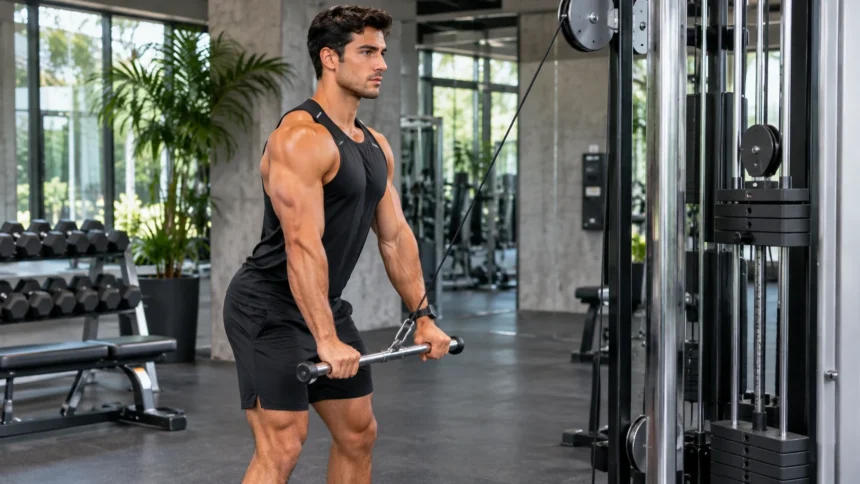
The straight arm pulldown is a cable exercise that strengthens your back, especially the latissimus dorsi muscles, commonly called the lats. It involves pulling a cable attachment downward while keeping your elbows slightly bent and your torso stable. When performed correctly, this movement can improve back strength, muscle control, and pulling technique.
Unlike traditional lat pulldowns, the straight arm version limits elbow movement and places greater emphasis on shoulder extension. This makes it a useful addition to a balanced back workout. Understanding the proper setup, technique, and common mistakes can help you perform the exercise comfortably and effectively.
What Is a Straight Arm Pulldown?
A straight arm pulldown is a strength training exercise performed using a cable machine and a straight bar or rope attachment. The movement involves bringing your arms from an elevated position toward your thighs without actively bending your elbows. It primarily targets the lats while engaging other muscles that stabilize your shoulders and torso.
This exercise is often described as a single-joint movement because most of the visible motion occurs at the shoulder. However, your shoulder blades, abdominal muscles, and other supporting muscles also contribute. Unlike compound back exercises, the movement reduces the involvement of the biceps and helps you focus on controlling your lats.
The straight arm cable pulldown works well for beginners and experienced gym users when the resistance matches their abilities. It can be included in upper-body routines, pull-day sessions, or general strength programs. Learning the correct movement pattern is important because swinging the body or bending the elbows excessively can reduce its effectiveness.
Muscles Worked During the Straight Arm Pulldown
The latissimus dorsi is the primary muscle trained during a straight arm pulldown. These broad muscles extend across the sides of your back and help move your arms downward and backward. Strong lats support many pulling movements, including rows, pull-ups, and other upper-body exercises that require controlled shoulder movement.
The teres major also contributes to the movement by assisting shoulder extension. Additionally, the rear deltoids and long head of the triceps can help stabilize or move the upper arm. The shoulder blade muscles work together to control your shoulder position, while your forearms maintain a secure grip on the attachment.
Your abdominal muscles and spinal stabilizers also play important supporting roles throughout the exercise. They help maintain a steady torso and limit unnecessary movement when pulling against resistance. Although the straight arm pulldown mainly targets your back, proper technique requires several muscle groups to work together for balance and control.
Benefits of Straight Arm Pulldowns for Back Strength
One major benefit of straight arm pulldowns is their ability to train the lats with relatively little elbow flexion. This allows you to concentrate on shoulder movement rather than relying heavily on your biceps. With consistent practice, the exercise can help develop back strength and improve your ability to control your arms during pulling exercises.
Another advantage is the adjustable resistance available on cable machines. Beginners can start with lighter weights, while experienced lifters can gradually increase the challenge as their technique improves. The cable also provides resistance across much of the movement, although the exact tension on your muscles changes with your body position.
Straight arm pulldowns can also improve your awareness of how your lats contribute to upper-body movements. This awareness may help you maintain better control during related exercises, such as rows and traditional pulldowns. However, they work best as part of a balanced strength routine rather than as a replacement for compound back exercises.
How to Set Up a Straight Arm Pulldown Correctly
Begin by adjusting the cable pulley to a high position on a suitable cable machine. Attach a straight bar or rope and select a light resistance that allows smooth movement. Stand facing the machine with enough distance to extend your arms comfortably without allowing the weight stack to pull your body forward.
Position your feet approximately hip-width apart and keep your knees slightly bent. Hinge gently at your hips while maintaining a neutral spine and a stable torso. Hold the attachment with your hands around shoulder-width apart if using a straight bar, and allow your arms to reach forward and upward comfortably.
Before beginning, check that your shoulders feel comfortable and your wrists remain aligned with your forearms. Keep a small, consistent bend in your elbows instead of locking them forcefully. Your starting position should allow a controlled pulling motion without excessive stretching, leaning, or using momentum to move the weight.
How to Do a Straight Arm Pulldown Step by Step
Start in your prepared stance with your arms extended toward the high pulley and your elbows slightly bent. Tighten your abdominal muscles gently to support your torso. Initiate the movement by driving your upper arms downward toward your sides, focusing on moving through your shoulders rather than pulling with your hands.
Continue bringing the attachment toward the front of your thighs while keeping your elbows at approximately the same angle. Avoid leaning backward or pushing your hips forward to complete the repetition. At the bottom, briefly maintain control and notice the contraction in your lats without forcing your shoulders behind your body.
Slowly return the attachment toward its starting position while resisting the cable’s upward pull. Allow your shoulders to move naturally as your arms rise, stopping at a comfortable range. Repeat the movement using the same controlled technique, and reduce the resistance if you cannot maintain stable posture throughout the exercise.
Proper Straight Arm Pulldown Form and Technique
Good straight arm pulldown form begins with a stable body position and controlled shoulder movement. Keep your chest comfortably lifted without exaggerating the arch in your lower back. Your torso should remain nearly stationary throughout each repetition, allowing your back muscles to perform most of the work instead of using body momentum.
Your elbows should remain slightly bent, but they do not need to be completely straight or rigid. A small bend can make the movement more comfortable for your joints. Focus on guiding your upper arms downward in a smooth path while keeping your shoulders relaxed enough to avoid unnecessary tension around your neck.
The correct range of motion depends on your shoulder mobility, attachment, and individual comfort. Most people can bring the attachment near their thighs without forcing their arms farther backward. During the return, avoid reaching beyond a comfortable overhead position, especially if the movement causes pinching or discomfort in your shoulders.
Common Straight Arm Pulldown Mistakes to Avoid
Using excessive weight is one of the most common mistakes during straight arm pulldowns. Heavy resistance can encourage swinging, excessive torso movement, or unwanted elbow bending. These changes shift attention away from the intended shoulder movement and may make it harder to control the exercise throughout the full range of motion.
Another mistake is turning the movement into a traditional pulldown by repeatedly bending and straightening the elbows. While some elbow movement is natural, the exercise should primarily involve movement at the shoulder. Keeping a consistent, comfortable elbow angle helps maintain the intended technique and reduces unnecessary reliance on the elbow flexor muscles.
Many people also rush through repetitions or allow the cable to pull their arms upward too quickly. This reduces control and can make maintaining consistent form difficult. Use a manageable resistance, return slowly, and stop the repetition when your posture begins to change rather than trying to complete additional repetitions with poor technique.
Breathing, Tempo, and Range of Motion
Breathing correctly can help you maintain a steady position during straight arm pulldowns. Exhale as you pull the attachment downward and inhale as you return toward the starting position. Try to keep your breathing natural instead of holding your breath unnecessarily, particularly when learning the movement or using resistance that challenges your coordination.
A controlled tempo makes it easier to recognize whether your muscles are doing the intended work. You might take approximately one to two seconds to pull downward and two to three seconds to return. These timings are guidelines rather than strict requirements, and smooth, comfortable movement is generally more important than following an exact repetition speed.
Range of motion should be based on what your shoulders can comfortably achieve with good control. You do not need to force an extreme overhead stretch or pull the attachment behind your thighs. Gradually improving coordination and comfortable mobility is more useful than chasing the longest possible movement, especially when starting a new exercise.
How Many Sets and Reps Should You Do?
The appropriate number of straight arm pulldown sets and repetitions depends on your training experience and overall workout. Beginners can start with one or two manageable sets of approximately 10 to 15 repetitions. The main goal is to learn proper technique while leaving enough energy to maintain controlled movement from beginning to end.
People with more lifting experience may use two or three sets of around 8 to 15 repetitions as part of a broader back workout. Choose resistance that makes the final repetitions challenging without requiring momentum or uncomfortable movements. Allow adequate recovery between sets, and remember that training quality matters more than completing a specific number.
Straight arm pulldowns can be performed after exercises such as rows or traditional lat pulldowns. Some people prefer using them earlier with light resistance to practice engaging their back muscles. There is no universal workout order, so consider your main training goals, available equipment, and how comfortably you can maintain technique.
Straight Arm Pulldown Variations to Try
The rope straight arm pulldown is a popular variation that allows your hands to move more independently than a fixed straight bar. Some people find this grip more comfortable for their wrists and shoulders. The basic movement remains similar, although the rope may let you adjust your hand position naturally near the bottom.
A resistance band straight arm pulldown offers an alternative when a cable machine is unavailable. Secure the band to a suitable overhead anchor and perform the movement with controlled resistance. Unlike a cable machine, band tension generally increases as the band stretches, which changes how the exercise feels throughout the repetition.
Single-arm cable pulldowns provide another option for people who want to practice controlling each side independently. This variation may help you notice differences in movement coordination between your arms. However, it also requires more attention to torso stability, so begin with light resistance and avoid rotating your body excessively.
Straight Arm Pulldown vs. Lat Pulldown
The main difference between a straight arm pulldown and a traditional lat pulldown is the amount of elbow movement involved. Straight arm pulldowns primarily involve shoulder extension while maintaining a relatively fixed elbow angle. Traditional lat pulldowns combine shoulder movement with significant elbow flexion, allowing several major upper-body muscles to contribute.
Traditional lat pulldowns commonly train the lats, biceps, and other back muscles through a compound pulling movement. Straight arm pulldowns place less demand on the elbow flexors and provide a different way to train the lats. Neither movement is automatically superior because each serves a slightly different purpose within a strength program.
Combining both exercises can help create a varied back workout when the overall training volume is appropriate. Traditional pulldowns can provide a major vertical pulling exercise, while straight arm pulldowns add focused shoulder-extension work. Your individual preferences, equipment access, recovery needs, and training goals should determine which movements deserve priority.
Safety Tips and When to Avoid the Exercise
Start each session with manageable resistance and a comfortable range of motion before attempting more demanding repetitions. A brief general warm-up followed by light practice sets can help you prepare for the movement. Check that the cable attachment is secure, the machine operates smoothly, and your stance gives you enough room to move safely.
Avoid forcing the movement if you experience sharp pain, joint pinching, tingling, or unusual discomfort. Muscle effort is normal during resistance training, but pain is not something you should push through. If you have an existing shoulder injury or another condition affecting upper-body movement, seek guidance from an appropriate healthcare professional before trying the exercise.
Progress gradually by improving technique and control before adding resistance. Increasing the weight too quickly can encourage compensations that make the exercise less useful. Remember that recovery, balanced training, and consistent technique all contribute to strength development, so avoid treating one exercise as the complete solution for building a stronger back.
Conclusion
The straight arm pulldown is a useful exercise for training your lats and developing better control of shoulder extension. It can complement traditional pulldowns, rows, and other back exercises without requiring complex equipment beyond a cable machine. Its effectiveness depends largely on maintaining proper posture, controlled movement, and resistance appropriate for your experience.
To perform the exercise correctly, keep your elbows slightly bent, stabilize your torso, and guide the attachment toward your thighs. Avoid swinging, rushing repetitions, or forcing an uncomfortable range of motion. Paying attention to these basic technique details can make each set more consistent and help you develop confidence with the movement.
Whether you are new to strength training or improving an established workout routine, straight arm pulldowns can be a practical addition to your training. Start with manageable resistance and focus on gradually improving movement quality. Combined with a balanced exercise program and sufficient recovery, they can support long-term back strength and upper-body development.
Frequently Asked Questions
What muscles does a straight arm pulldown work?
The straight arm pulldown primarily targets the latissimus dorsi muscles. It also involves the teres major, rear deltoids, triceps, and core stabilizers, which assist with shoulder movement and body control.
Is a straight arm pulldown better than a lat pulldown?
Neither exercise is universally better. Straight arm pulldowns emphasize shoulder extension with limited elbow bending, while traditional lat pulldowns train multiple muscles through a compound pulling movement.
Should your arms be completely straight during pulldowns?
No, your elbows should maintain a slight, comfortable bend rather than remaining forcefully locked. Keeping the elbow angle relatively consistent allows you to focus on controlled shoulder movement.
Can beginners perform straight arm pulldowns?
Yes, beginners can perform straight arm pulldowns using light resistance and proper technique. Start with a comfortable range of motion, practice controlled repetitions, and increase the challenge gradually.
How often should you do straight arm pulldowns?
You can include straight arm pulldowns in your regular back training sessions while allowing adequate recovery. The appropriate frequency depends on your overall workout volume, experience, and individual recovery needs.