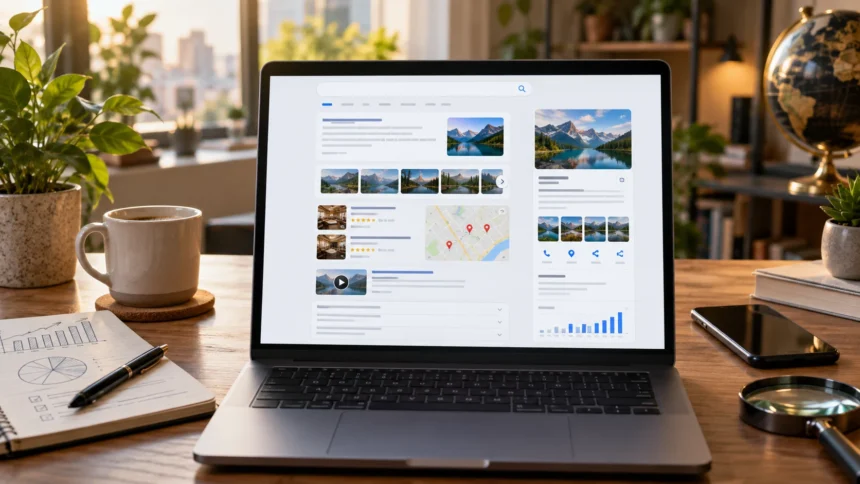
SERP Features Explained: How to Win More Search Space
SERP features can dramatically change how much attention your brand receives in search results, even when your traditional organic ranking stays the same. Modern search pages may include featured snippets, People Also Ask questions, local packs, images, videos, shopping results, reviews, sitelinks, knowledge panels, and AI-generated experiences alongside standard blue links. For SEO teams, this means ranking for one keyword is no longer only about reaching position one. The bigger opportunity is occupying multiple areas of the search results for the same topic. A brand that appears organically, in a video result, within an image pack, and across other enhanced features can become much harder for searchers to overlook. This guide explains the most important SERP features and how to build an SEO strategy that wins more valuable search space.
What Are SERP Features and How Do They Work?
SERP features are enhanced elements that appear on a search engine results page in addition to standard organic listings. Search engines use these features to present information in formats that better match what users appear to need. A person asking a simple question might receive a direct answer, while someone searching for a nearby contractor may see map-based business listings. Product searches can surface shopping information, and tutorial-based queries may contain videos or visual demonstrations. The exact layout depends heavily on search intent. This makes SERP analysis important because two keywords with similar search volume can create completely different visibility opportunities.
Traditional organic listings usually contain a clickable title, URL, and description, although their exact appearance can vary. SERP features add richer information or specialized functionality around those results. A local pack can show businesses on a map, while a featured snippet can extract an answer from a webpage and display it prominently. Image and video modules create visual entry points, and product results can show prices or availability. These elements compete for the searcher’s attention alongside your standard listing. As search pages become richer, SEO success increasingly depends on understanding the full results page rather than monitoring one numerical ranking.
Search engines decide which SERP features appear based partly on the type of information users are likely to find useful. A query such as “pizza near me” clearly contains local intent, while “how to change a tire” may benefit from step-by-step content and video. Queries involving products can generate commercial modules, and searches about recognized organizations or people may produce entity-based information. This means SERP features provide useful clues about search intent. Instead of guessing what format users want, marketers can study what search engines currently surface. Those patterns can guide content strategy, page format, and optimization priorities.
SERP layouts can also vary by device, location, language, and individual query wording. Someone searching on mobile may encounter a different arrangement from a desktop user, especially for local, image, and shopping searches. Geographic location can dramatically alter map results and locally relevant recommendations. Even small changes in wording can transform a primarily informational SERP into a commercial one. SEO platforms can track many of these differences, but manual checks remain useful for high-value keywords. Understanding variability prevents teams from making major decisions based on one screenshot or one ranking report.
For SEO professionals, the most useful mindset is to think in terms of search space rather than a single ranking position. If your company appears in several relevant features, users can encounter the brand multiple times before reaching competing websites. This can increase visibility, familiarity, and potential click opportunities. However, not every feature creates the same business value. A local pack position for an emergency service could generate immediate calls, while an informational snippet might mainly support awareness. The best SERP feature strategy therefore prioritizes features connected to customer intent and business outcomes.
Why Winning More SERP Space Matters for SEO
More SERP space means your brand occupies a larger portion of the page users see when making a search. Consider a company that ranks third organically but also appears in a video result and image pack. That business may attract more attention than the website technically ranking second with only one standard listing. Search visibility is therefore influenced by layout as much as numerical position. The stronger your presence across relevant features, the more difficult it becomes for competitors to dominate the conversation. This is especially valuable for high-intent searches where several brands compete aggressively for each potential customer.
SERP features can also affect organic click-through rates even when rankings do not move. Imagine your page ranking fourth for several months while a new prominent module suddenly appears above the organic results. Your ranking report could look stable even while clicks begin falling. Without reviewing the actual SERP, the traffic decline may be incorrectly blamed on a weak title or an algorithm change. Search features add important context to ranking data. SEO teams should therefore monitor both where pages rank and what surrounds those rankings.
Owning multiple features can increase brand recognition because users repeatedly see the same company associated with a topic. A searcher might first notice your brand in an organic result, then see your video, and later encounter the company again in a local listing. Even if the first interaction does not result in a click, repeated exposure can build familiarity. This is particularly useful during longer buying journeys involving multiple searches and comparisons. Search visibility can influence preference before a user ever reaches the website. More search space therefore supports both immediate traffic and broader brand discovery.
SERP features can also reveal content opportunities competitors have already proven are valuable. If competing brands consistently own video results for a particular topic, visual demonstration may be important to users. If a competitor dominates People Also Ask answers, its content may address important related questions better than yours. A local competitor appearing repeatedly in map results may have stronger location relevance, reviews, or business information. These observations turn the results page into competitive intelligence. You can identify where competitors are visible and determine what type of asset or optimization would help close the gap.
The goal should not be to win every feature available for every keyword. Some results have minimal commercial relevance, while others can influence revenue directly. Prioritize features based on the value of the search query, likelihood of earning the placement, and type of user action associated with it. A SaaS company may prioritize comparisons and videos around bottom-of-funnel software searches. A roofing company may care more about local packs and review visibility. An ecommerce business may focus heavily on product and image results. SERP-space strategy becomes effective when it reflects how customers actually discover and choose the business.
Important SERP Features Every SEO Should Understand
Featured snippets are highly visible answers extracted from webpages and shown prominently for certain queries. They can appear in several formats, including short paragraphs, ordered lists, unordered lists, and tables. Definition-style searches and step-based questions can be particularly suitable for concise answers. Winning a featured snippet can place your content above other traditional organic listings and create strong brand exposure. However, the snippet may also answer a simple question without requiring a visit. The best snippet content therefore provides a clear initial answer while making the full page valuable enough for users who need deeper detail.
People Also Ask sections display related questions that searchers may want to explore after their initial query. Each question can expand to show a short answer and a source, giving websites additional visibility beyond the normal organic ranking. These questions are particularly useful for content research because they reveal related concerns surrounding the main topic. SEO writers can address relevant questions naturally within articles, product guides, or service pages. Not every question needs its own separate URL. The key is determining whether it supports the same intent or represents a genuinely different topic.
Local packs are some of the most commercially valuable SERP features for location-based businesses. They typically display a map with selected businesses, ratings, contact information, opening details, and other local information. Searches involving dentists, roofers, restaurants, lawyers, plumbers, and many other local services frequently depend heavily on map visibility. A business appearing prominently in the local pack can receive calls or visits before users reach traditional organic results. Google Business Profile optimization, reviews, website relevance, and broader local authority all contribute to a strong local SEO strategy. For service businesses, local visibility should usually be treated as a primary search channel rather than an optional extra.
Image packs and video results appear when visual content can answer the query more effectively than text alone. Image-heavy searches can occur around products, plants, destinations, fashion, design, home improvement, medical education, and countless other subjects. Videos often appear around tutorials, reviews, demonstrations, troubleshooting, and complex processes. SEO strategies that rely exclusively on written articles can miss these additional search surfaces. High-quality visual content can complement strong pages and create extra points of discovery. The right format should be chosen because it helps the user understand the subject, not merely because another SERP feature is available.
Other important SERP features can include shopping results, product information, reviews, sitelinks, breadcrumbs, knowledge panels, news-related modules, discussion results, and enhanced organic listings. The specific mix continues changing as search engines refine how results are presented. This is why memorizing one permanent list is less useful than developing a habit of analyzing the SERP for each important keyword. Look at what users are shown before the first organic result, between listings, and near the bottom of the page. Then determine which features could realistically include your brand. Search-result analysis should become part of keyword research rather than something performed only after rankings disappoint.
How to Win Featured Snippets and People Also Ask Visibility
Start snippet optimization by identifying questions where your page already has strong relevance. Pages ranking reasonably well for a query are often better optimization candidates than pages with no meaningful organic visibility. Look for searches involving definitions, steps, comparisons, lists, or concise explanations. Then examine which source currently owns the snippet and what format is being displayed. Do not copy the competitor’s wording. Instead, identify why its structure makes the answer easy to understand and create an accurate response that serves the user more effectively.
For definition-based searches, provide a direct explanation near the beginning of the relevant section. A question such as “What is technical SEO?” should receive a clear definition before the article expands into examples and deeper discussion. Avoid making users read several paragraphs before finding the basic answer. At the same time, do not reduce complex topics to misleading one-line statements simply to appear concise. A useful definition explains the central idea accurately and then gives readers room to continue learning. Clear answers improve usability even when they never become a featured snippet.
List and process queries benefit from logical formatting. If someone searches for steps to perform a task, use an ordered sequence where the order actually matters. If the search asks for examples or options, an unordered list may be more appropriate. Comparisons can benefit from tables when differences need to be evaluated quickly. Headings should describe exactly what the section covers. This makes the page easier for readers to scan and provides clearer information architecture for search systems trying to understand the content.
People Also Ask opportunities can be handled by identifying related questions that genuinely support the page’s main purpose. If you are writing about backlink audits, questions about toxic links, anchor text, lost links, and competitor analysis may belong naturally within the content. Answer those questions clearly where they fit rather than creating a huge unrelated FAQ section simply to target additional phrases. Some questions may deserve separate articles because their search intent is broader. Keyword clustering can help determine which questions belong together. The aim is topical completeness, not maximum question count.
Continue strengthening the overall page instead of obsessing only over one answer block. A perfectly formatted paragraph may still struggle if the page is weak, outdated, poorly linked, or significantly less authoritative than competing results. Improve search intent alignment, supporting detail, internal links, expertise, and page experience at the same time. Monitor whether competing snippet sources change over time and review what might have influenced those changes. Featured snippets are earned dynamically rather than permanently assigned. Treat them as an additional benefit of strong content rather than a substitute for comprehensive SEO.
How to Win Local, Image, Video, and Product Search Space
Local SERP visibility begins with accurate and useful business information. Businesses should maintain their Google Business Profile with correct categories, contact details, operating information, service areas, website links, and other relevant data. Reviews can support both reputation and local conversion because users frequently compare ratings before contacting a business. Local website pages should also explain the services offered within the geographic market. Avoid creating hundreds of cloned city pages with no unique value. Strong local SEO demonstrates a real relationship with the areas the company actually serves.
Local content can strengthen search relevance when it reflects genuine customer needs in a specific market. A roofer might discuss storm-related services in regions where severe weather is common, while a lawyer could create useful resources around services provided in particular cities. Local project examples, testimonials, photos, and service information can increase trust. The goal is not to repeat the city name in every paragraph. Searchers need evidence that the company can genuinely serve them. Location relevance works best when business information, website content, reputation, and real-world operations tell the same story.
Image optimization should focus on useful visual assets rather than uploading generic pictures only to target image search. Product photographs, before-and-after examples, diagrams, travel images, screenshots, and demonstrations can all provide genuine value depending on the topic. Use descriptive alt text where it accurately explains the image, make files technically accessible, and provide useful surrounding context. Large images should also be optimized for performance so they do not create unnecessarily slow pages. Searchers who discover your brand through images should land on a page that clearly explains what they are seeing.
Video SEO can expand visibility for topics where demonstrations, walkthroughs, comparisons, and visual explanations are useful. Begin with queries that consistently display video results rather than producing videos randomly for every article. Create content that answers the search need quickly and clearly, then provide additional detail where appropriate. Use descriptive titles and supporting information so viewers understand what the video covers. Embedding relevant videos within strong webpages can also create a richer user experience. Written and video content should support each other instead of competing internally for attention.
Ecommerce businesses should pay close attention to product-oriented search features because shoppers often see images, prices, merchant information, ratings, and availability before traditional listings. Accurate product information is therefore essential. Product pages should contain clear names, descriptions, images, pricing, availability, specifications, and other useful buyer details. Appropriate structured data and merchant information can support eligibility for richer search experiences, although display is never guaranteed. Ecommerce visibility is increasingly distributed across several search surfaces. Winning search space requires high-quality product information as well as strong traditional SEO.
Use Structured Data and Technical SEO to Support Rich Results
Structured data gives search engines machine-readable information about certain types of content and entities. Depending on the page, appropriate markup can describe products, organizations, local businesses, breadcrumbs, articles, events, and other supported information. Correct implementation can make pages eligible for certain rich search experiences. Eligibility does not guarantee that a rich result will appear because search engines decide when enhanced presentation is appropriate. Structured data should therefore be viewed as a clarity tool rather than a guaranteed ranking shortcut. Its purpose is to describe real information already available to users.
Markup should always match visible page content. Do not create structured data for reviews, prices, events, products, or other information that users cannot actually find on the page. Incorrect or misleading implementation can create technical and quality problems. Validation tools can identify syntax errors, but passing validation does not prove that the underlying information is accurate. Large sites should include structured data within quality-assurance workflows when templates are updated. Maintaining markup is particularly important when product information, availability, events, or other frequently changing details are involved.
Technical crawlability remains more fundamental than rich-result optimization. A page cannot gain useful search visibility if important search systems cannot reliably access, render, and index it. Review robots directives, canonical tags, redirects, status codes, sitemaps, JavaScript rendering, and internal links. Important pages should be reachable through logical navigation instead of existing only inside XML sitemaps. Technical issues can affect entire site sections, making them far more important than optimizing one individual snippet. Solve accessibility first, then pursue additional search appearance opportunities.
Website architecture supports SERP visibility by helping search engines understand relationships among pages. Clear category structures, breadcrumbs, topic hubs, and contextual internal links can make important sections easier to discover. Sitelinks may also reflect how well search systems understand major navigation paths, although site owners cannot simply choose which sitelinks appear. Use descriptive navigation and meaningful anchors instead of vague labels whenever possible. A clean structure benefits users regardless of whether enhanced search features are displayed. Search-space optimization begins with a website that makes sense as a whole.
Page experience should complete the technical strategy because gaining extra visibility only matters if users find the destination helpful. Improve loading speed where significant problems exist, especially on mobile devices. Avoid intrusive overlays that make information difficult to access after a click. Images and videos should enrich the page without creating unnecessary performance issues. Calls to action should match search intent rather than immediately forcing every informational visitor into a sales process. Strong technical SEO supports discovery, while strong experience helps convert that discovery into meaningful engagement.
Run a SERP Feature Gap Analysis Against Competitors
Start a SERP feature gap analysis with the keywords most important to your business. Record which competitors appear organically and which brands occupy additional features such as snippets, local packs, videos, images, and product results. This provides a clearer competitive picture than traditional rank comparisons alone. A competitor ranking below you organically may still own more overall search space through other modules. Categorize features by keyword and business value. The resulting map reveals where your visibility is strong and where competitors dominate attention.
Look carefully at the content format competitors use to earn each feature. A featured snippet may come from a concise definition, while a video result may come from a detailed demonstration. Image-heavy competitors might use original photography rather than stock visuals. Local winners may have stronger reviews, business information, and service-area relevance. Product results may reflect better structured and merchant information. Identifying these differences helps turn competitor observations into actionable improvements rather than simply documenting who currently wins.
Do not automatically copy a competitor’s page structure just because it earned a feature. Search results can change, and a format that works for one query may not satisfy another. Focus on the user’s underlying need and determine whether you can solve it more effectively. If a competitor’s comparison table is useful but shallow, build a more informative comparison with accurate decision criteria. If its video ranks because no strong alternative exists, create a clearer demonstration. Competitive research should establish the minimum expectation, while your goal should be to improve on it.
Prioritize gaps where your website already has some underlying visibility. A page ranking in the top ten but missing a featured snippet may represent a more realistic opportunity than a page ranking fiftieth. Likewise, a business already appearing near the local pack could deserve additional profile, review, and local authority work. Improving existing assets can produce faster returns than creating new formats around keywords where you have little relevance. Assign opportunities according to current ranking, search intent, business value, and implementation effort. This turns feature gaps into a prioritized roadmap.
Repeat the analysis because SERP layouts and competitors change over time. Videos may begin appearing for a query that previously contained only articles, or shopping modules may become more prominent for a product term. A competitor may capture a snippet after updating an article, while another may lose local visibility because its information becomes outdated. Quarterly SERP reviews can reveal these shifts before traffic changes become severe. Competitive monitoring should focus on patterns, not individual daily fluctuations. The goal is maintaining a realistic view of how much valuable search space your brand controls.
Measure SERP Visibility and Build a Strategy That Wins More Space
Traditional rank tracking should remain part of your measurement framework, but it needs additional context. Track which SERP features appear for priority keywords and whether your brand occupies them. Some SEO platforms can report feature ownership alongside standard positions, making broader visibility easier to monitor. Group results by keyword cluster or funnel stage rather than watching hundreds of individual queries without context. A commercial feature win usually deserves more attention than an informational feature with little business relevance. Measurement should help decide where further optimization resources belong.
Organic impressions and clicks provide another layer of context. If rankings remain stable but clicks decline, check whether additional features have appeared above or around your result. If impressions grow without proportional clicks, your site may be gaining visibility in lower positions or within search experiences that answer more questions directly. Avoid assuming every visibility gain must produce the same click pattern. Search interfaces can influence user behavior significantly. Performance analysis becomes more useful when rankings, SERP appearance, impressions, and clicks are reviewed together.
Conversion measurement is essential because different features influence business outcomes in different ways. A local pack can generate calls without a traditional organic website visit, while a video may create awareness that leads to branded search later. Product results can support purchases, and informational snippets may contribute mainly to discovery. Define the action that matters for each search type before judging performance. Lead generation, revenue, demos, bookings, calls, and qualified traffic may all matter more than feature count. Winning more search space is valuable only when it supports meaningful customer behavior.
Build your strategy around a small number of feature types most closely connected to your market. Local businesses may prioritize maps, reviews, and strong organic listings. Publishers may focus on snippets, images, videos, and topical coverage. SaaS companies may benefit from comparison content, videos, branded search visibility, and increasingly AI-assisted search experiences. Ecommerce brands should integrate product, image, review, and organic optimization. Concentrated effort usually produces stronger results than attempting to target every available SERP feature simultaneously.
Ultimately, winning more search space comes from understanding intent and creating content in formats users genuinely value. Technical accessibility, useful information, structured content, authority, multimedia, and strong brand signals work together to create broader visibility. Search features will continue evolving, meaning individual tactics may change over time. The most durable strategy is building pages and assets that deserve to appear wherever searchers expect useful information. Think beyond one ranking position and evaluate the entire search journey. The brands that consistently answer users better across multiple formats will have the strongest opportunities to control valuable SERP real estate.
Frequently Asked Questions
What is a SERP feature?
A SERP feature is an enhanced element that appears on a search engine results page in addition to a traditional organic listing. Examples include featured snippets, People Also Ask, local packs, image results, videos, product results, sitelinks, and rich search experiences.
How can SERP features improve SEO visibility?
SERP features can give your brand additional placements beyond its standard organic ranking. Appearing in several relevant features can increase search real estate, brand exposure, and opportunities for users to interact with your content.
Which SERP features are most valuable?
The most valuable features depend on search intent and your business model. Local packs can be highly valuable for service businesses, while ecommerce companies may prioritize product and image results and publishers may focus more on snippets, videos, and informational visibility.
Do structured data and schema guarantee rich results?
No, implementing valid structured data can make a page eligible for supported rich results but does not guarantee that search engines will display them. The markup should accurately describe visible page content and follow current search guidelines.
How do I find SERP feature opportunities?
Analyze your priority keywords and identify which enhanced features appear consistently, then compare whether competitors currently occupy them. Prioritize opportunities where your website already has relevance and where winning additional search space could support meaningful traffic, leads, or revenue.