

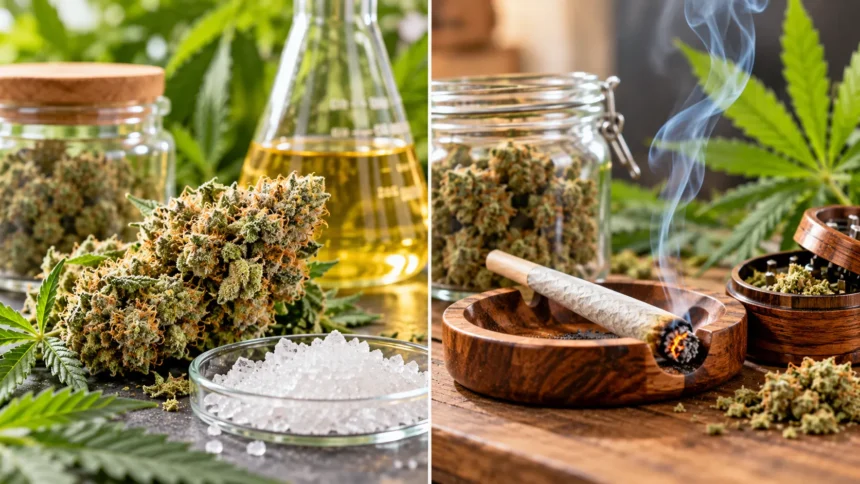
THCA and THC are two closely related compounds found in cannabis plants, but they have important differences in their chemical structures, effects, and biological activities. Although their names sound similar, these cannabinoids interact with the human body differently. Understanding THCA vs THC is important for anyone researching cannabis science, cannabinoid chemistry, health effects, or the regulations surrounding these substances.
One of the main differences between THCA and THC involves their psychoactive properties. THCA is generally considered non-intoxicating in its unconverted form, while delta-9 THC is responsible for many of the mind-altering effects associated with cannabis. Their relationship involves a natural chemical process called decarboxylation, which changes the molecular structure of THCA.
This guide explains the key differences between THCA and THC using clear, science-based information. You will learn about their chemical structures, interactions with the body, potential health risks, research findings, and legal considerations. The goal is to provide an educational comparison that helps readers understand these cannabinoids without confusing preliminary scientific findings with established medical evidence.
What Is THCA and How Does It Work?
THCA stands for tetrahydrocannabinolic acid, a naturally occurring cannabinoid found in cannabis plants. It is a chemical precursor to delta-9 tetrahydrocannabinol, commonly known as THC. THCA is produced through biological processes within the plant and is especially associated with its unprocessed material. Its molecular structure contains an additional chemical group that distinguishes it from THC.
Unlike THC, THCA does not produce the same characteristic intoxicating effects in its original form. This difference is associated with how its molecular structure interacts with receptors in the body’s endocannabinoid system. Scientists continue to investigate its biological properties through laboratory and preclinical studies. However, many claims about THCA’s possible therapeutic value remain unproven in humans.
THCA is scientifically important because it helps researchers understand cannabinoid development and chemical changes within cannabis plants. Its presence can also influence how laboratories evaluate cannabinoid concentrations. Although THCA and THC are related, they should not be treated as interchangeable substances. Their chemical differences affect intoxication potential, laboratory interpretation, and regulatory classification.
What Is THC and Why Is It Psychoactive?
THC, or tetrahydrocannabinol, is a cannabinoid best known for its psychoactive effects. The term usually refers to delta-9 THC, one of the most extensively studied compounds in cannabis. THC interacts with the body’s endocannabinoid system and can influence perception, memory, coordination, and mood. Its effects vary according to individual characteristics and exposure.
The human endocannabinoid system contains receptors involved in regulating several physiological functions. Delta-9 THC can activate cannabinoid CB1 receptors, which are abundant in the brain and central nervous system. This interaction contributes to its intoxicating properties. THC can also affect attention, decision-making, reaction time, and the ability to perform complex tasks safely.
Scientists have investigated THC for several medical applications, and certain regulated cannabinoid medicines are approved for specific conditions. However, this does not mean that all THC-containing products are medically approved or safe. Unregulated products may have inconsistent composition and uncertain risks. Medical applications require appropriate clinical evidence, professional supervision, and compliance with relevant regulations.
THCA vs THC: Key Chemical Structure Differences
The primary chemical difference between THCA and THC involves an additional carboxyl group present in THCA. This structural feature changes the compound’s molecular mass and biological behavior. Although the two substances share a closely related chemical framework, they are not chemically identical. Understanding this distinction helps explain why their effects and laboratory measurements differ.
THCA has the molecular formula C22H30O4, while delta-9 THC has the formula C21H30O2. The difference reflects the presence of the additional carboxyl group in THCA. This group influences how the molecule interacts with biological targets. Consequently, the two cannabinoids demonstrate different levels of activity at certain receptors associated with intoxication.
Their chemical relationship is particularly important in cannabinoid research and laboratory testing. THCA can undergo a chemical transformation known as decarboxylation, producing THC under appropriate conditions. This reaction changes the molecular structure and associated biological effects. Scientists account for these differences when studying cannabis chemistry, evaluating samples, and interpreting cannabinoid content.
How THCA and THC Affect the Human Body Differently
THCA and THC interact differently with the human body because their molecular structures influence receptor activity. THC activates CB1 receptors in the brain, contributing to its psychoactive effects. THCA has substantially different activity at these receptors and is generally regarded as non-intoxicating. However, researchers are still investigating many aspects of its biological behavior.
THC can temporarily affect concentration, short-term memory, coordination, and reaction time. Some individuals may also experience anxiety, confusion, or changes in heart rate. These effects can vary, and younger people are particularly vulnerable to certain cannabis-related harms. The developing brain is an important consideration when evaluating THC exposure and its potential consequences.
THCA research has explored several possible biological effects, but much of the available evidence comes from laboratory or animal studies. These findings cannot establish that THCA provides meaningful medical benefits in humans. More clinical research is necessary to understand its safety profile and biological significance. Neither cannabinoid should be considered risk-free simply because it occurs naturally.
Understanding Decarboxylation and the THCA-to-THC Relationship
Decarboxylation is a chemical reaction that removes a carboxyl group from a molecule. In cannabinoid chemistry, this process explains how THCA can transform into THC. The reaction changes the compound’s molecular structure and its potential biological activity. It is an important concept in laboratory analysis and the scientific study of cannabinoids.
This transformation helps explain why measuring THCA alone does not always provide a complete picture of potential THC content. Laboratories may analyze cannabinoids using methods that distinguish between the original acidic compound and its converted form. Other analytical approaches account for possible chemical transformation. These differences affect how cannabinoid concentrations are reported and interpreted.
Decarboxylation also has regulatory significance because some testing frameworks consider both existing THC and the potential THC associated with THCA. The methods used depend on applicable laws and laboratory standards. Chemical conversion should not be confused with proof of medical effectiveness. Understanding the reaction is primarily useful for explaining cannabinoid chemistry, testing, and safety considerations.
Does THCA Have the Same Psychoactive Effects as THC?
THCA is generally described as non-intoxicating because it does not activate the brain’s CB1 receptors in the same way as delta-9 THC. This distinction is one of the most important differences between the compounds. However, identifying a substance as non-intoxicating does not automatically establish its safety. Toxicological and clinical evidence must also be considered.
THC can cause changes in perception, thinking, attention, and coordination. It can also produce unwanted psychological effects, including anxiety or paranoia in some individuals. These reactions are associated with THC’s activity in the central nervous system. Adolescents face particular concerns because cannabis exposure may affect learning, memory, and mental health during development.
The distinction between THCA and THC becomes more complicated when examining products that contain multiple cannabinoids or uncertain concentrations. A product labeled with one cannabinoid may also contain other biologically active compounds. Without reliable laboratory information, its actual composition may be unclear. Product labels alone cannot establish whether a substance is safe or non-intoxicating.
THCA vs THC: What Does Scientific Research Say?
Scientific research into THC is considerably more extensive than research into THCA. THC has been studied for its neurological effects, potential medical applications, and associated health risks. Certain cannabinoid-based prescription medicines have established uses for specific medical conditions. However, these findings cannot be generalized to every cannabis-derived substance or commercial product.
Research involving THCA has examined possible anti-inflammatory, neuroprotective, and other biological activities. Much of this evidence comes from cell experiments or animal models rather than large human clinical trials. Positive results in preliminary research do not necessarily translate into effective human treatments. Researchers must establish appropriate safety profiles and meaningful clinical outcomes before medical claims can be supported.
Another important consideration is the difference between individual cannabinoid research and studies involving whole cannabis products. Findings associated with THC, CBD, or combinations of compounds cannot automatically be attributed to THCA. Differences in study design and chemical composition also affect interpretation. Reliable conclusions require controlled research, reproducible results, and careful evaluation of potential harms.
Are THCA and THC Legal? Important Regulatory Differences
The legal status of THCA and THC varies considerably between countries, states, and other jurisdictions. Delta-9 THC is subject to controlled-substance regulations in many locations because of its intoxicating properties. THCA may be addressed differently depending on local definitions and testing requirements. Therefore, the chemical distinction between the two does not automatically determine legality.
In the United States, hemp regulations and related laboratory standards have addressed THCA’s potential contribution to total THC content. Different rules may apply to cultivation, processing, commercial products, and possession. Federal and state requirements can also differ, and legislation continues to evolve. A product described as hemp-derived is not necessarily legal in every jurisdiction.
International laws can be even more restrictive, with some countries regulating cannabis compounds broadly regardless of their original chemical form. Rules may also distinguish between approved medicines, research materials, and consumer products. Readers should rely on current official regulations rather than promotional legal claims. Legal classification is a separate issue from medical safety or scientific evidence.
How Are THCA and THC Measured in Laboratory Testing?
Laboratory testing is important for identifying individual cannabinoids and evaluating the chemical composition of cannabis samples. Modern analytical techniques can distinguish THCA from delta-9 THC and other related compounds. This helps researchers understand how cannabinoid concentrations vary between samples. Accurate testing also supports regulatory compliance and scientific interpretation.
High-performance liquid chromatography is one analytical technique used to measure cannabinoids while preserving distinctions between certain acidic and neutral forms. Gas chromatography is another method, although testing conditions can affect the chemical forms detected. Laboratories select validated methods according to their analytical objectives. Sample preparation, equipment calibration, and quality-control procedures are essential for obtaining reliable results.
Some laboratory reports distinguish between measured THC and calculated total potential THC. These values can serve different scientific or regulatory purposes and should not be treated as identical. Results may also include measurement uncertainty and additional cannabinoid information. Understanding these distinctions helps prevent misleading interpretations of laboratory data and product composition.
Potential Side Effects and Health Risks of THCA and THC
THC exposure can cause several short-term side effects, including impaired coordination, reduced concentration, altered perception, and increased heart rate. Some individuals may experience anxiety, panic, or confusion. The severity and duration of these effects vary considerably. Impaired judgment and reaction time also create significant risks during driving and other activities requiring sustained attention.
Frequent cannabis exposure is associated with additional health concerns, including the possibility of developing cannabis use disorder. Adolescents may be particularly vulnerable to effects on memory, learning, and mental health. Research also indicates associations between cannabis exposure and certain psychiatric outcomes, although individual risks vary. These concerns are important when evaluating THC-related safety claims.
The safety profile of THCA is less clearly established because human research remains limited. Its relatively low intoxicating activity does not prove that it is harmless. Potential interactions, impurities, and uncertain product composition introduce additional questions. People experiencing unexpected symptoms after exposure to cannabinoid-containing substances should seek appropriate medical advice.
Common Misconceptions About THCA and THC
One common misconception is that THCA and THC are exactly the same substance. Although they are chemically related, their molecular structures and biological effects differ. Another misunderstanding is that naturally occurring cannabinoids are automatically safe. Natural origin does not eliminate the possibility of adverse reactions, contamination, or interactions with other substances.
Some discussions also suggest that THCA has the same scientifically established medical benefits as THC. Current evidence does not support that conclusion. Research into THCA remains preliminary, and findings from laboratory experiments cannot replace controlled human studies. Readers should distinguish between scientific hypotheses, approved medical treatments, and unsupported commercial claims.
A further misconception is that the absence of immediate intoxication guarantees legal or medical safety. Laws may consider potential THC content, while health risks can involve factors beyond psychoactive effects. Similarly, labels do not always provide complete chemical information. A balanced understanding requires attention to chemistry, independent research, regulatory standards, and public health evidence.
Conclusion
THCA and THC are closely related cannabinoids, but they differ in chemical structure, receptor activity, and psychoactive properties. THCA is generally considered non-intoxicating in its original form, while delta-9 THC is responsible for many cannabis-related mind-altering effects. Their chemical relationship is explained through decarboxylation, an important process in cannabinoid chemistry. Understanding these distinctions helps clarify how the compounds are studied and regulated.
Scientific research into THC is more extensive, including investigations into potential medical uses and recognized health risks. THCA has attracted research interest, but reliable human evidence remains limited. Claims about its therapeutic effectiveness should therefore be evaluated cautiously. Neither compound should be described as universally safe based solely on its natural origin or chemical classification.
The THCA vs THC comparison also highlights the importance of laboratory testing, legal definitions, and accurate scientific communication. Regulations vary across jurisdictions, and product labels may not fully explain cannabinoid composition. Clear information helps readers distinguish established facts from preliminary findings and misleading claims. Understanding the available evidence provides a stronger foundation for evaluating cannabinoid science and related public health issues.
Frequently Asked Questions
What is the main difference between THCA and THC?
THCA is a non-intoxicating cannabinoid precursor, while delta-9 THC produces psychoactive effects through its interaction with brain receptors. Their chemical structures differ because THCA contains an additional carboxyl group.
Does THCA make you feel high like THC?
THCA itself is generally considered non-intoxicating and does not produce the characteristic effects of delta-9 THC. However, chemical conversion and the presence of other cannabinoids can complicate assessments of product effects.
Is THCA stronger than THC?
THCA and THC cannot be meaningfully ranked by intoxicating strength alone because their biological activities differ. Delta-9 THC produces psychoactive effects, while unconverted THCA has substantially different receptor activity.
Is THCA legal in the United States?
THCA’s legal status depends on applicable federal and state laws, product classification, and testing requirements. Regulations can consider potential THC content, so claims of universal legality are unreliable.
Is THCA safer than THC?
THCA is generally non-intoxicating, but this does not establish that it is completely safe. Human research remains limited, and both cannabinoids require careful consideration of potential health risks.