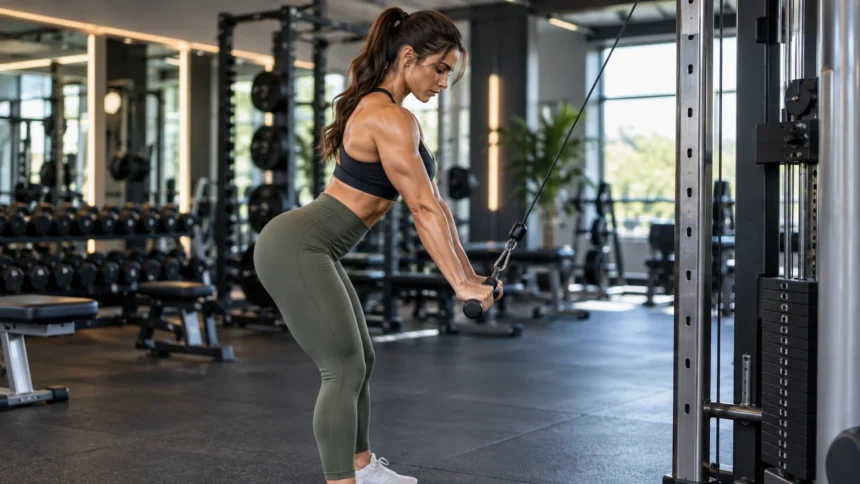
What Is a Straight-Arm Pulldown?
The straight-arm pulldown is a cable exercise that primarily targets the latissimus dorsi, the large muscles running along the sides of your back. Unlike a traditional lat pulldown, your elbows remain mostly straight throughout the movement. This makes the exercise useful for isolating the lats while reducing how much assistance comes from the biceps.
The movement is usually performed at a cable station using a straight bar, rope attachment, or wide handle. You begin with your arms extended overhead, then pull the attachment downward toward your thighs while keeping your torso controlled. The movement mainly occurs at the shoulder joint rather than through bending and straightening the elbows.
Straight-arm pulldowns are commonly included in back, pull, and upper-body workouts. They work well as an accessory exercise after heavier compound movements such as rows or pull-ups. Because the exercise emphasizes controlled shoulder extension, it can also help lifters improve their awareness of how to engage the lats during other pulling movements.
Straight-Arm Pulldown Muscles Worked
The primary muscle worked during the straight-arm pulldown is the latissimus dorsi. These broad back muscles help pull the upper arms downward and backward toward the body. When the movement is performed correctly, you should feel significant tension through the sides of your upper and middle back rather than mainly through your arms.
Other muscles contribute by stabilizing the shoulders, torso, and upper back. The teres major, posterior shoulder muscles, abdominal muscles, and portions of the upper back may assist throughout the exercise. Your triceps can also help maintain elbow position, although they should not become the main muscles driving the movement.
The exercise is especially useful because it trains the lats through shoulder extension without requiring substantial elbow flexion. This can make it easier to focus on back activation if your biceps tend to dominate rows or pulldowns. Developing better awareness of the lats may also improve how effectively you perform other back exercises.
Benefits of Straight-Arm Pulldowns
One major benefit of straight-arm pulldowns is their ability to place focused tension on the lats. Because the elbows remain relatively fixed, the biceps contribute less than they do during many other pulling exercises. This makes the movement useful when you want additional lat training without adding excessive arm fatigue to your workout.
The exercise can also improve your mind-muscle connection with the back. Many beginners struggle to feel their lats working during rows or regular pulldowns because they instinctively pull mostly with their arms. Practicing controlled straight-arm pulldowns can help you understand how shoulder extension feels and how to intentionally engage your back muscles.
Another advantage is that the movement can be adjusted easily by changing the cable weight, attachment, stance, or range of motion. This makes it suitable for beginners as well as experienced lifters. It can also fit into hypertrophy programs, general strength routines, bodybuilding workouts, and accessory sessions without requiring complicated equipment.
How to Perform a Straight-Arm Pulldown Correctly
Start by attaching a straight bar or rope to the high pulley of a cable machine. Stand a short distance away with your feet around shoulder-width apart and your knees slightly bent. Hinge forward gently at the hips while keeping your chest lifted, spine controlled, and arms extended toward the attachment.
Begin with the handle slightly above shoulder level and your elbows softly bent rather than completely locked. Pull the attachment downward in a smooth arc until your hands reach your thighs or upper legs. Think about driving your upper arms toward your sides while keeping your torso stable and avoiding excessive movement through the elbows.
Pause briefly at the bottom and squeeze your lats before returning the attachment upward under control. Allow your arms to rise until you feel a comfortable stretch through the back without losing your position. Repeat the movement using a weight that allows you to maintain steady control throughout every repetition.
How to Keep Proper Form Throughout the Exercise
Maintaining a neutral and stable torso is important during straight-arm pulldowns. Avoid repeatedly rocking forward and backward to generate momentum, since this reduces tension on the target muscles. A small hip hinge is appropriate, but your trunk should remain relatively consistent once you begin the working portion of the set.
Keep your shoulders away from your ears and avoid shrugging excessively as the attachment moves upward. At the bottom of the movement, focus on bringing your arms toward your body rather than simply forcing the bar as low as possible. Your range should be determined by comfortable shoulder movement and your ability to maintain lat tension.
Your elbows should remain slightly bent throughout the repetition. Allowing them to bend significantly turns the exercise into something closer to a pulldown or triceps-driven movement. Using a lighter load often makes it easier to preserve the correct arm position and feel the lats working through a smooth, controlled range.
Common Straight-Arm Pulldown Mistakes
Using too much weight is one of the most common mistakes. When the resistance becomes excessive, people often compensate by bending their elbows, swinging their torso, or using momentum to move the handle. These changes reduce the exercise’s ability to isolate the lats and may make the movement less comfortable around the shoulders or lower back.
Another mistake is turning the movement into a standing crunch. Some lifters excessively round their spine as they pull downward, believing that extra motion will increase the range. Instead, keep your torso controlled and allow the shoulders to perform most of the movement so the back muscles remain responsible for pulling the attachment.
Moving too quickly can also reduce the effectiveness of the exercise. Letting the cable snap upward removes tension from the muscles and makes each repetition less controlled. Use a steady tempo, especially during the return phase, so the lats remain active and you can maintain consistent positioning from the beginning to the end of the set.
Straight Bar vs Rope Straight-Arm Pulldown
A straight bar provides a stable grip and makes it easier to keep both arms moving together. Many lifters prefer it because the fixed position feels simple and controlled. Depending on shoulder mobility and grip width, however, some people may find that the bar limits how naturally their hands and arms can move.
A rope attachment gives the wrists and shoulders more freedom during the exercise. You can separate the ends slightly near the bottom, which may help you achieve a stronger contraction without forcing your hands into one fixed position. The rope can also feel more comfortable for people who experience wrist or shoulder discomfort with a rigid bar.
Neither option is universally better, so the best attachment depends on comfort and training preference. Try both using moderate resistance and compare which variation allows you to feel the lats working most effectively. Consistent technique, controlled movement, and appropriate resistance matter more than choosing a particular attachment simply because someone else prefers it.
How Much Weight Should You Use?
The straight-arm pulldown generally works best with a moderate weight that allows you to maintain good control. Because it is primarily an isolation exercise, there is little benefit in using loads that force you to swing or significantly bend your elbows. Start lighter than you think you need and increase resistance gradually.
Choose a weight that lets you complete each repetition through a comfortable range while maintaining tension in your back. The final few repetitions should feel challenging, but your technique should remain similar to the first repetition. If you must lean, jerk, or shorten the movement dramatically, the resistance is probably too heavy.
Progress does not need to come only from adding weight. You can improve by performing more controlled repetitions, increasing your range slightly, slowing the lowering phase, or developing a stronger contraction at the bottom. These improvements can make the exercise more demanding without sacrificing the technique that makes it useful.
Best Sets, Reps, and Workout Placement
Straight-arm pulldowns are commonly performed for moderate to higher repetitions because they are usually used as an accessory exercise. Sets of around 8 to 15 controlled repetitions can work well for many lifters, although individual programs may use slightly different ranges. The important factor is maintaining good form while approaching meaningful muscular fatigue.
The exercise can be performed near the beginning of a back workout as an activation movement or later after heavier compound exercises. Using it before rows or pulldowns may help some people feel their lats more effectively. Performing it afterward allows you to add targeted back volume without requiring another demanding compound movement.
Two to four working sets are often enough within a balanced back session, depending on your overall training volume. Avoid adding excessive sets simply because the exercise feels easier than heavy rows or pull-ups. Your total weekly workload, recovery, experience level, and goals should guide how much direct lat training you include.
Straight-Arm Pulldown vs Lat Pulldown
The straight-arm pulldown and traditional lat pulldown both train the back, but they use different movement patterns. During a lat pulldown, your elbows bend substantially as you pull the bar toward your upper chest. During a straight-arm pulldown, the elbows remain relatively fixed while the shoulders move the arms downward toward the body.
Lat pulldowns generally allow you to use more resistance because the biceps and additional upper-body muscles contribute more strongly. Straight-arm pulldowns typically use lighter weights and place greater emphasis on isolating the lats. This means the exercises can complement each other rather than needing to compete for a place in your program.
You can use lat pulldowns as a primary vertical pulling exercise and straight-arm pulldowns as a finishing or accessory movement. Combining both can provide different types of tension across the back. The best approach depends on your goals, available equipment, and how many other pulling movements are already included in your training routine.
How Daily Posture and Mobility Can Affect Training
Your movement outside the gym can influence how comfortable your shoulders, hips, and back feel during training. Spending long periods in one position may leave you feeling stiff before a workout, even if nothing is seriously wrong. Short walks, gentle mobility drills, and changing positions during the day can help you arrive at training feeling less restricted.
Desk work is especially common for people who remain seated for several uninterrupted hours. Alternating positions rather than staying still can help you maintain more movement throughout the day. Learning about healthier sitting and standing habits can also help you think beyond the gym and create a more balanced daily movement routine.
Before straight-arm pulldowns, gentle shoulder and upper-back movement may help you prepare for the exercise. Simple arm raises, controlled shoulder circles, or lighter warm-up sets can be enough. You do not need a complicated routine, but giving your body a few minutes to transition from daily activities into resistance training can improve overall comfort.
Straight-Arm Pulldown Variations Worth Trying
Single-arm cable pulldowns allow you to train each side independently. This variation can make it easier to concentrate on one lat at a time and may help you notice differences in control between sides. Use a single handle, maintain a stable torso, and avoid rotating your body simply to create additional range.
Resistance-band straight-arm pulldowns offer a useful alternative when you do not have access to a cable station. Secure the band above your head and perform the same basic shoulder-extension movement while keeping the elbows relatively fixed. Band resistance changes throughout the range, so the exercise may feel different from the consistent pull of a cable machine.
You can also experiment with grip width and body position. A slightly wider straight-bar grip may feel different from a shoulder-width setup, while stepping farther from the cable can alter the direction of resistance. Make small adjustments rather than dramatically changing the movement, and keep whichever variation allows you to train the lats comfortably.
Best Practices for Better Results
Prioritize control over load when using the straight-arm pulldown for back development. Think about moving the upper arms with the lats instead of simply pulling the attachment down with your hands. A deliberate contraction and controlled return usually produce better quality repetitions than using heavy resistance with excessive body movement.
Keep your training balanced by combining straight-arm pulldowns with other back exercises. Rows can emphasize horizontal pulling, while pull-ups and lat pulldowns provide heavier vertical pulling patterns. Including several complementary movements can develop the back more completely than depending on a single isolation exercise for all of your pulling work.
Progress gradually and allow your technique to guide resistance increases. If shoulder, elbow, or back discomfort appears during the movement, stop and reassess your setup, load, and range. Persistent or significant pain deserves professional evaluation rather than forcing yourself through repetitions simply because the exercise is popular or included in your planned workout.
Conclusion
The straight-arm pulldown is a useful cable exercise for targeting the lats with less involvement from the biceps than many traditional pulling movements. Its simple movement pattern makes it suitable for beginners while still providing experienced lifters with valuable isolation work. The key is maintaining a stable torso, softly bent elbows, and consistent tension throughout each repetition.
Use a manageable weight and focus on shoulder extension rather than trying to move the heaviest load possible. Straight bars, ropes, and single-arm handles can all work effectively when the movement feels comfortable. Experimenting with attachment choices can help you find the version that produces the strongest lat engagement while allowing controlled technique.
For best results, include straight-arm pulldowns as part of a broader back-training routine containing rows, vertical pulls, and appropriate recovery. Progress gradually and combine your workouts with regular daily movement. When performed consistently with good form, the exercise can become a valuable tool for building stronger, better-controlled back muscles.
FAQs
What muscles do straight-arm pulldowns work?
Straight-arm pulldowns mainly target the latissimus dorsi. The teres major, upper-back muscles, core, shoulders, and triceps also assist with stabilization and maintaining the correct arm position.
Are straight-arm pulldowns good for building lats?
Yes, they can be useful for adding targeted lat training because the movement minimizes elbow bending. They work especially well alongside heavier exercises such as rows, pull-ups, and standard lat pulldowns.
Should I use a rope or straight bar?
Both attachments can work effectively. A straight bar provides a stable fixed grip, while a rope allows greater freedom at the wrists and shoulders, so choose whichever feels more comfortable.
How heavy should straight-arm pulldowns be?
Use a moderate weight that allows smooth repetitions without swinging, bending your elbows excessively, or shortening the range. Good lat tension and controlled technique are more important than lifting heavy resistance.
Can beginners do straight-arm pulldowns?
Yes. Beginners can use the exercise to learn how to engage the lats, provided they start with light resistance and controlled form. A trainer can help if the movement initially feels difficult to understand.