What Are Hinge Exercises?
Hinge exercises are strength-training movements that involve bending primarily at the hips while maintaining a controlled spinal position. The movement allows your hips to travel backward as your upper body leans forward. Unlike squats, which involve greater knee bending, hinge exercises focus on the muscles around your hips, hamstrings, glutes, and lower back.
The hip hinge is a fundamental movement pattern used in both exercise and everyday activities. You naturally perform similar movements when picking up objects, reaching toward the floor, or bending forward to lift something. Learning proper hinge mechanics can improve movement coordination and help distribute physical demands across your hips and surrounding muscles.
Hinge exercises range from simple bodyweight movements to advanced strength-training variations using dumbbells, kettlebells, or barbells. Beginners can start with unloaded hip hinges before progressing to exercises such as Romanian deadlifts and kettlebell deadlifts. Understanding the movement pattern is essential because good technique makes strength training more effective and helps manage unnecessary strain.
Why Are Hinge Exercises Important for Your Body?
Hinge exercises are important because they strengthen the posterior chain, which includes muscles along the back of your body. These muscles help you stand upright, extend your hips, and perform everyday movements efficiently. Improving posterior chain strength can support activities such as walking, climbing stairs, lifting objects, and participating in recreational sports.
Another important benefit involves improving your ability to control movement through the hips. Many people struggle to distinguish hip bending from spinal bending, especially when learning new exercises. Practicing a controlled hip hinge develops body awareness and helps you understand how your hips, knees, and torso work together during functional movements.
Hip hinge training also supports a balanced strength-training routine. Programs that focus only on squats or exercises targeting the front of the legs may overlook important hip-extension movements. Including hinge exercises helps develop the glutes, hamstrings, and spinal stabilizers while complementing other lower-body exercises and improving overall physical conditioning.
Major Benefits of Hinge Exercises
One of the main benefits of hinge exercises is increased strength in the glutes and hamstrings. These muscles play an important role in producing hip extension and supporting lower-body movements. Regular resistance training can improve muscular strength and endurance, making daily activities and appropriate athletic movements feel more manageable over time.
Hinge exercises can also improve movement coordination and trunk stability. When performing a hip hinge, your abdominal and back muscles work together to control your torso while your hips move. Learning this coordination may improve your ability to handle resistance during lifting tasks and maintain better control through different movement patterns.
Another benefit is the versatility of hinge-based training. The same movement pattern can be performed with bodyweight, resistance bands, dumbbells, kettlebells, or barbells. This flexibility allows individuals to adjust exercise intensity according to their experience, equipment availability, and fitness goals while gradually developing strength and confidence.
Muscles Worked During Hinge Exercises
The gluteus maximus is one of the primary muscles involved in hip hinge movements. It helps extend the hips when returning from a forward-bending position to standing. Strong gluteal muscles contribute to walking, running, stair climbing, and many lower-body strength exercises, making them an important focus of posterior chain training.
The hamstrings also play an important role during hip hinge exercises. Located along the back of the thighs, these muscles help control hip flexion and contribute to hip extension. Movements such as Romanian deadlifts challenge the hamstrings through a controlled range of motion, helping improve strength when performed with appropriate technique.
Other muscles provide support throughout the exercise, including the spinal erectors, abdominal muscles, and upper-back stabilizers. These muscle groups help maintain torso control while resistance is moved. Depending on the specific hinge variation, the forearms, quadriceps, and additional stabilizing muscles may also contribute to the movement and overall exercise performance.
How to Perform a Proper Hip Hinge
To perform a basic hip hinge, begin by standing with your feet approximately hip-width apart. Keep your knees slightly bent and distribute your weight comfortably across your feet. Maintain a natural spinal position while gently engaging your abdominal muscles, preparing your body to move primarily through the hips rather than the lower back.
Slowly push your hips backward as if you were reaching toward an imaginary wall behind you. Allow your torso to lean forward while your knees remain softly bent. Continue moving until you feel comfortable tension through the hamstrings, keeping your head aligned naturally with your torso instead of forcing your neck upward.
Return to standing by pressing through your feet and extending your hips in a controlled manner. Squeeze your glutes naturally as you rise without excessively arching your lower back. Repeat the movement slowly, focusing on balance, controlled breathing, and consistent technique rather than attempting to reach the deepest possible position.
Bodyweight Hip Hinge Exercise for Beginners
The bodyweight hip hinge is an excellent starting exercise for learning proper movement mechanics. It requires no specialized equipment and allows beginners to focus on coordination before introducing resistance. Practicing this variation helps develop awareness of hip movement while strengthening the foundation needed for more challenging exercises.
Begin by standing upright with your hands resting lightly on your hips. Keep your knees slightly bent and move your hips backward while allowing your upper body to lean forward. Maintain a comfortable spinal position and stop when you feel tension in your hamstrings without needing to round your back.
Return to standing by moving your hips forward and engaging your glutes. Start with a manageable number of repetitions, such as five to eight, while prioritizing proper form. As your coordination improves, you can gradually increase repetitions or progress toward resistance-based hinge exercises under appropriate supervision when needed.
Romanian Deadlift for Hamstring and Glute Strength
The Romanian deadlift is a popular hinge exercise that emphasizes the hamstrings and glutes. It involves lowering a weight while pushing the hips backward and maintaining controlled knee movement. Unlike conventional deadlifts, Romanian deadlifts usually begin from a standing position and focus on controlled hip movement throughout the exercise.
Stand with your feet hip-width apart while holding light dumbbells in front of your thighs. Keep your knees slightly bent and slowly move your hips backward as the weights travel close to your legs. Lower the dumbbells only as far as you can comfortably maintain a controlled spinal position without forcing additional flexibility.
To return upright, press through your feet and extend your hips while keeping the weights close to your body. Avoid pulling with your lower back or leaning backward at the top. Begin with light resistance and gradually increase the challenge as your technique and strength improve through consistent practice.
Kettlebell Deadlift for Functional Strength
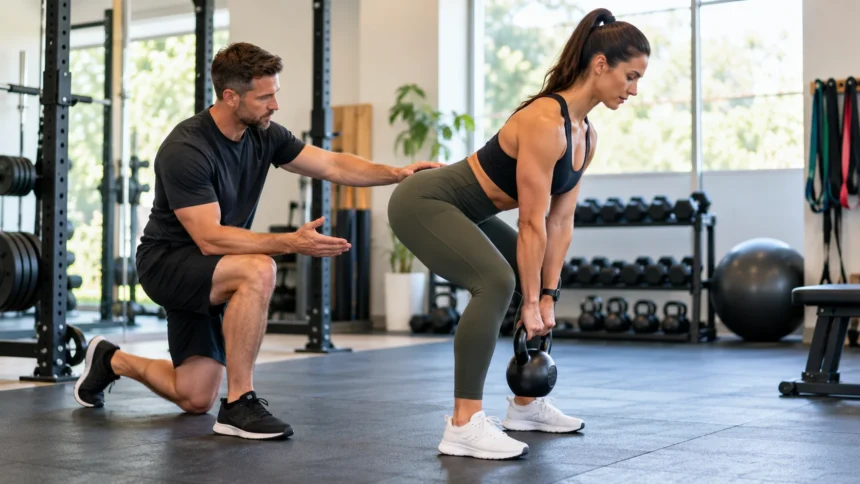
The kettlebell deadlift is another useful hinge exercise for developing lower-body strength and learning resistance training fundamentals. It targets the glutes and hamstrings while requiring coordination between the hips, legs, and trunk. Because the kettlebell can be positioned between the feet, many beginners find this variation easier to learn than certain barbell exercises.
Place a light kettlebell on a stable surface directly between your feet. Stand with your feet approximately hip-width apart, bend your knees as needed, and push your hips backward to reach the handle. Maintain a comfortable spinal position while gripping the kettlebell securely and preparing to lift with controlled movement.
Push through your feet and extend your hips and knees together to stand upright. Keep the kettlebell close to your body and avoid sudden pulling or jerking movements. Lower the weight slowly by reversing the movement, ensuring that your hips and knees work together throughout the exercise.
Good Morning Exercise for Posterior Chain Development
The good morning exercise is a hip hinge variation that helps strengthen the hamstrings, glutes, and muscles supporting the spine. It involves leaning the torso forward while maintaining controlled movement through the hips. This exercise can be performed using bodyweight before progressing to resistance once appropriate technique has been developed.
Begin by standing with your feet approximately shoulder-width apart and your hands resting across your chest. Maintain a slight bend in your knees while slowly pushing your hips backward. Allow your torso to lean forward without forcing your lower back into a rounded or exaggeratedly arched position during the movement.
Return upright by extending your hips and engaging the glutes. Focus on smooth movement and avoid lowering your torso beyond the range you can control. Weighted good mornings require additional technique and should be introduced cautiously, preferably with guidance from a qualified trainer when learning the movement.
Single-Leg Hip Hinge for Balance and Stability
The single-leg hip hinge is a challenging exercise that combines hip strength, balance, and movement coordination. It places greater stability demands on the standing leg while encouraging the hips and trunk to work together. This variation can be useful for individuals who have already developed confidence with basic bilateral hinge exercises.
Begin by standing on one leg while keeping the supporting knee slightly bent. Slowly move your hips backward as your torso leans forward and your opposite leg extends behind you. Keep your hips relatively level and use a wall or stable chair for balance if maintaining control becomes difficult.
Return to standing by extending the hip of your supporting leg. Perform a few controlled repetitions before switching sides, focusing on movement quality rather than depth. Avoid twisting your pelvis excessively or reaching farther than your balance allows, especially when practicing the exercise for the first time.
Dumbbell Hip Hinge Exercises for Strength Training
Dumbbell hinge exercises offer a convenient way to strengthen the posterior chain without requiring large gym equipment. They allow individuals to adjust resistance according to their current strength and training experience. Popular examples include dumbbell Romanian deadlifts, suitcase deadlifts, and supported single-leg Romanian deadlifts.
When performing a dumbbell hip hinge, hold the weights securely and maintain a controlled position throughout the movement. Push your hips backward while allowing the weights to travel naturally near your legs. Keep your knees softly bent and avoid lowering the weights farther than your hip mobility and torso control comfortably allow.
Choose weights that allow you to complete every repetition with consistent technique. Heavy resistance is unnecessary when first learning the exercise and can make movement control more difficult. Increase weight gradually as your strength improves, ensuring that your breathing, posture, and balance remain stable during each training session.
Hip Hinge vs. Squat: Understanding the Difference
Hip hinges and squats are both valuable lower-body movement patterns, but they emphasize different joint movements. During a hip hinge, the hips travel backward while the torso leans forward and the knees bend relatively little. During a squat, the hips and knees generally bend more together as the body lowers toward the ground.
Hinge exercises typically emphasize the glutes, hamstrings, and posterior chain muscles. Squats generally place greater demands on the quadriceps while also activating the glutes and other stabilizers. Both movements involve several muscle groups, and the exact emphasis changes according to exercise technique, body proportions, and resistance placement.
Including both patterns in a training routine can help develop balanced lower-body strength. Hip hinges support movements involving hip extension, while squats strengthen coordinated movement through the hips, knees, and ankles. Learning both exercises improves your movement options and supports a wider range of everyday physical activities.
Common Mistakes to Avoid During Hinge Exercises
One common mistake is bending excessively through the lower back instead of moving primarily through the hips. This can reduce the intended emphasis on the glutes and hamstrings while making resistance harder to control. Practicing unloaded hip hinges and using a mirror or trainer for feedback can help improve movement awareness.
Another mistake involves bending the knees so much that the exercise becomes closer to a squat. Although some knee movement is natural, excessive knee bending can change the exercise mechanics and muscle emphasis. Focus on moving your hips backward while allowing your knees to bend only as much as the selected hinge variation requires.
Using weights that are too heavy is another frequent problem during hinge training. Excessive resistance may encourage jerking, poor balance, or uncontrolled spinal movement, particularly among beginners. Choose manageable weights and prioritize consistent technique before increasing resistance, repetitions, or training intensity.
Best Practices for Performing Hinge Exercises Safely
Start every training session with a short warm-up that prepares your muscles and joints for movement. Gentle walking, unloaded hip hinges, and comfortable lower-body mobility exercises can help you become familiar with the movement pattern. A warm-up should gradually increase activity without causing unnecessary fatigue before the main exercise session begins.
Pay attention to spinal control and avoid forcing your back into an excessively rigid position. A comfortable, controlled spinal posture is generally more useful than trying to maintain an exaggerated arch throughout every repetition. Keep resistance manageable and focus on coordinated movement through your hips, knees, and trunk.
Allow sufficient recovery between challenging strength-training sessions, particularly when introducing new exercises. Muscles adapt to training through a combination of appropriate resistance, rest, and consistent practice. Stop exercising if you experience sharp pain, unusual dizziness, or increasing neurological symptoms, and seek professional advice when necessary.
How to Include Hinge Exercises in Your Workout Routine
Hinge exercises can be included in lower-body workouts, full-body strength sessions, or general fitness programs. Beginners may start with bodyweight hip hinges before moving toward light dumbbell Romanian deadlifts. Choosing one or two hinge variations per session is often enough to practice the movement and develop strength without unnecessary exercise duplication.
A simple beginner routine might include a few sets of controlled bodyweight hinges followed by an appropriate resistance-based variation. For example, one or two sets of six to ten comfortable repetitions may provide a manageable starting point. The ideal training volume depends on exercise difficulty, physical conditioning, and individual recovery needs.
As your technique develops, gradually increase resistance or choose more challenging movement variations. Avoid changing weight, repetitions, and exercise complexity all at once because this can make it harder to monitor progress. Combining hinge exercises with squats, walking, and other strength activities can help support a balanced fitness routine.
How to Improve Your Hip Hinge Mobility
Hip hinge mobility depends on comfortable movement through the hips and adequate control of the surrounding muscles. Limited hamstring flexibility, reduced coordination, or uncertainty about the movement pattern can make hinging feel difficult. Practicing smaller movements before attempting deeper positions may help improve control without forcing uncomfortable ranges.
A wall-assisted hip hinge can be useful when learning how to move the pelvis backward. Stand a short distance in front of a wall with your back facing it, then gently reach your hips toward the surface. Keep your knees slightly bent and use the wall as feedback rather than trying to push your body into a deeper position.
Gentle hip mobility exercises and controlled hamstring movements may also support comfortable hinging. However, stretching aggressively is unnecessary and can aggravate symptoms in some individuals. Gradual movement practice, appropriate strength training, and consistent technique are often more helpful than attempting to achieve maximum flexibility immediately.
Who Can Benefit From Hinge Exercises?
Hinge exercises can benefit people who want to improve lower-body strength, movement coordination, and confidence during everyday activities. Beginners can use simple bodyweight variations to learn controlled bending and lifting mechanics. More experienced individuals may use resistance-based hinges to strengthen the posterior chain and support broader fitness goals.
Athletes often include hip hinge exercises because hip extension contributes to running, jumping, and other sporting movements. Strengthening the glutes and hamstrings may improve their capacity to produce and control force during training. However, athletic performance improvements depend on the overall program rather than a single exercise or movement pattern.
Older adults may also benefit from appropriately modified hip hinge exercises that support functional strength. Learning to control bending and lifting movements can contribute to maintaining everyday independence when exercises match individual abilities. People with osteoporosis, significant back pain, recent injuries, or other medical concerns should seek professional guidance before attempting more demanding variations.
Conclusion
Hinge exercises are an important part of strength training because they target the glutes, hamstrings, and other muscles supporting movement. Learning the hip hinge pattern can improve movement coordination, posterior chain strength, and confidence during everyday physical activities. Bodyweight hinges, Romanian deadlifts, and kettlebell deadlifts provide different options for building these abilities.
Proper technique is essential for getting the most benefit from hinge exercises. Moving primarily through the hips, maintaining torso control, and choosing manageable resistance can help make each repetition more effective. Beginners should develop confidence with basic movements before progressing toward heavier weights or more challenging single-leg exercises.
Consistency and gradual progression are key to developing strength over time. Including hinge exercises alongside squats, walking, and other suitable activities can contribute to a balanced fitness program. With appropriate technique and sensible training habits, hip hinge exercises can support long-term movement quality, functional strength, and overall physical fitness.
Frequently Asked Questions
1. What Are Hinge Exercises Good For?
Hinge exercises strengthen the glutes, hamstrings, and supporting muscles around the hips and back. They also improve movement coordination and help develop strength for everyday activities such as bending and lifting.
2. Are Hip Hinge Exercises Good for Beginners?
Yes, beginners can start with bodyweight hip hinges to learn proper movement mechanics. Once they can perform the exercise comfortably, they may gradually progress to light dumbbells or other suitable resistance.
3. What Is the Difference Between a Hip Hinge and a Deadlift?
A hip hinge is a general movement pattern involving bending primarily at the hips. A deadlift is a strength exercise that uses this pattern along with varying amounts of knee movement and resistance.
4. Can Hinge Exercises Help With Lower Back Strength?
Hinge exercises can strengthen muscles that support the spine, including the spinal erectors and surrounding stabilizers. However, people experiencing persistent back pain should seek professional guidance before starting challenging resistance exercises.
5. How Often Should You Perform Hinge Exercises?
Many people can include hinge exercises in strength training two or three times weekly, depending on intensity and recovery. Beginners should start gradually and allow adequate rest between challenging sessions.