

Back pain can make ordinary activities such as getting out of bed, sitting at a desk, driving, or bending to tie your shoes feel unexpectedly difficult. Gentle movement may help some people feel less stiff, but the right exercise depends on the location, duration, and underlying cause of the discomfort. A pose that feels relaxing for one person may aggravate another person’s symptoms.
Yoga combines controlled movement, breathing, stretching, balance, and muscle engagement. For people with uncomplicated lower back discomfort, an appropriately modified yoga practice may improve spinal mobility, strengthen supporting muscles, and reduce fear around movement. Research suggests that yoga offers a small benefit for low-back pain, although it is not necessarily more effective than other suitable forms of exercise.
The best yoga poses for back pain are therefore not the deepest or most impressive postures. They are slow, comfortable movements that allow you to breathe normally and remain in control. This article focuses on beginner-friendly yoga stretches for the lower back, hips, abdominal muscles, and glutes, along with practical modifications that can make each position more accessible.
Yoga should not be used to self-treat unexplained severe pain, a recent injury, progressive weakness, or symptoms involving bladder or bowel control. Stop any movement that produces sharp pain, numbness, tingling, burning, or increasing pain down the leg. Those symptoms may require assessment by a doctor or physical therapist rather than a general online yoga routine.
Can Yoga Really Help Relieve Back Pain?
Yoga may support back pain relief by combining flexibility exercises with controlled strengthening and relaxation. Some poses gently move the spine, while others strengthen the abdominal, hip, and gluteal muscles that help support it. Breathing slowly may also reduce unnecessary muscle guarding, which is the protective tightening people sometimes develop when they expect a movement to hurt.
Current evidence is most supportive of yoga for persistent or chronic nonspecific low-back pain rather than every form of sudden back pain. Reviews have found small improvements in pain and physical function compared with doing no exercise. However, yoga appears to offer results similar to other appropriate exercise programs, meaning it should be viewed as one useful option rather than a guaranteed cure.
The American College of Physicians includes yoga among several nondrug approaches that may be considered for chronic low-back pain. Other recommended approaches include general exercise, motor-control training, mindfulness-based stress reduction, tai chi, rehabilitation, and cognitive behavioral therapy. The guideline also emphasizes choosing treatments with relatively low risks and working with properly trained providers.
Consistency matters more than intensity. A comfortable ten-minute beginner yoga routine performed regularly may be more helpful than an occasional demanding session that leaves the back irritated. Improvement may happen gradually over several weeks, and the goal should be better movement and function—not forcing the body into a particular shape or expecting one pose to permanently “fix” the spine.
Before Trying Yoga for Lower Back Pain
Begin by considering what kind of back pain you have. Acute pain starts suddenly and may last from several days to a few weeks, while chronic back pain lasts longer than twelve weeks. Back discomfort can arise from muscles, ligaments, spinal joints, discs, nerves, inflammatory conditions, fractures, infections, or pain referred from another part of the body.
Choose a firm but comfortable surface and keep useful yoga props nearby. A folded blanket can cushion the knees, a pillow can support the head or abdomen, and yoga blocks can reduce how far you need to bend. A chair is also valuable for balance and modified stretches, particularly for older adults, beginners, or anyone who feels unsteady when moving close to the floor.
Move slowly enough to notice how the exercise affects your symptoms. Mild muscular stretching or effort may be acceptable, but sharp, electric, stabbing, or rapidly increasing pain is not. Mayo Clinic advises people with back pain to adjust poses that worsen symptoms and notes that physical therapists can teach movement modifications while helping patients remain appropriately active.
People with osteoporosis, recent spinal surgery, fractures, significant disc problems, pregnancy, hypermobility, severe arthritis, or neurological conditions should seek individualized advice before beginning. Deep spinal rounding, strong twisting, and forceful forward bends may be unsuitable for certain conditions. A qualified yoga therapist or physical therapist can select safer movements based on your diagnosis, strength, balance, and medical history.
1. Cat-Cow Pose for Gentle Spinal Mobility
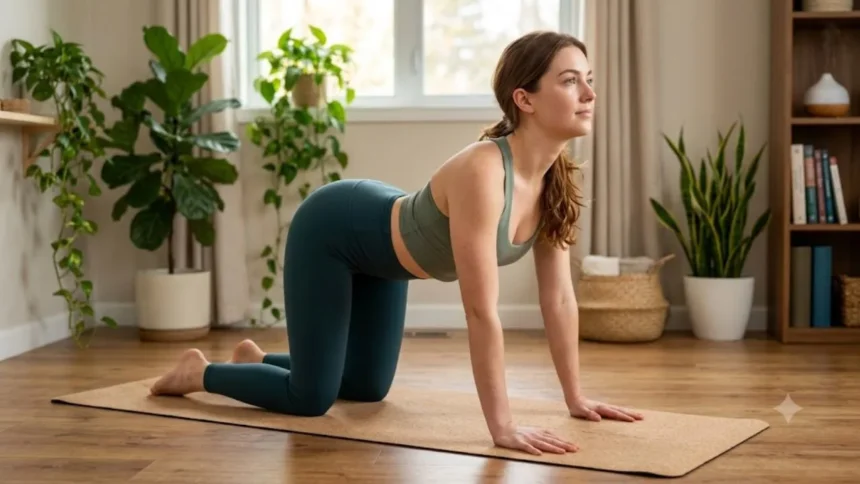
Cat-Cow is a controlled movement between mild spinal rounding and gentle spinal extension. It can be useful for people who feel stiff after sleeping or sitting for long periods because it encourages movement throughout the back without requiring a deep stretch. The pose also helps beginners practice coordinating breathing with motion rather than rushing through repetitions.
Start on your hands and knees with your wrists approximately beneath your shoulders and your knees beneath your hips. As you inhale, gently lift your chest and tailbone while allowing the abdomen to move toward the floor. As you exhale, lightly tighten your abdominal muscles and round your back without forcing your chin against your chest.
Move only through a comfortable range. The goal is not to create the largest possible curve but to explore smooth, pain-free spinal mobility. Try five to eight slow cycles, allowing each inhale and exhale to guide one complete movement. Stop if the pose causes pinching, dizziness, wrist pain, or symptoms that begin travelling into the buttock or leg.
Place a folded blanket under your knees when kneeling feels uncomfortable. If your wrists are sensitive, rest your hands on yoga blocks, make loose fists, or perform the same pelvic movement while seated in a chair. Because back pain has many possible causes, any movement that consistently intensifies symptoms should be modified or replaced.
2. Child’s Pose for Back and Hip Relaxation
Child’s Pose is commonly used as a resting yoga posture because it gently lengthens the back and may relax the muscles around the hips. It can feel especially comfortable after prolonged standing or after exercises that engage the core. However, people whose symptoms worsen during forward bending may need a supported version or may need to avoid it.
Begin on your hands and knees, bring your hips slowly toward your heels, and allow your torso to move forward. Your arms can extend in front of you or rest beside your legs. Keep the knees together for a narrower position or separate them slightly to create more space for the abdomen and chest.
Rest your forehead on the floor, a cushion, a block, or stacked hands rather than leaving your head unsupported. Breathe gently into the sides and back of your rib cage for five to eight slow breaths. Mayo Clinic describes Child’s Pose as a position that stretches the back and muscles around the hips and recommends supporting the forehead when the floor feels too far away.
Do not force your hips to touch your heels. A folded blanket behind the knees or between the thighs and calves can make the pose easier. Skip this position when it causes knee discomfort, strong spinal pain, numbness, or worsening leg symptoms. A comfortable supported posture is more beneficial than an unsupported version held with strain.
3. Sphinx Pose for Mild Back Extension
Sphinx Pose introduces gentle extension through the upper and lower spine while the body remains supported by the forearms. It may feel helpful for people who spend much of the day sitting in a rounded position. Because extension affects different back conditions differently, the movement should remain mild and should never be pushed into compression or sharp discomfort.
Lie on your stomach with your legs extended comfortably behind you. Place your elbows beneath or slightly forward of your shoulders, keeping your forearms on the floor. Gently lengthen your chest forward and upward while allowing the pelvis and legs to remain relaxed against the mat.
Keep your shoulders away from your ears and avoid pressing aggressively through the arms. Imagine creating length through the spine rather than bending as far backward as possible. Hold the position for three to five comfortable breaths, then lower your chest and turn your head to one side before deciding whether to repeat it.
Move your elbows farther forward to reduce the backbend or place a folded blanket beneath the ribs for extra support. Avoid Sphinx Pose when lying on the stomach is unsuitable, during later pregnancy, or when extension sends pain farther down the leg. Yoga postures should be adjusted whenever they make back symptoms worse.
4. Knee-to-Chest Pose for Lower Back Stiffness
The Knee-to-Chest stretch may gently lengthen the lower back and muscles around the hips. It is performed lying down, making it accessible to people who find standing stretches tiring or unstable. The floor also provides feedback that can help you keep the movement controlled instead of pulling the spine into an excessive stretch.
Lie on your back with both knees bent and your feet resting on the floor. Bring one knee toward your chest and hold behind the thigh or over the shin without lifting your head. Keep the other foot planted, relax your shoulders, and breathe comfortably as you hold the position for approximately five to ten seconds.
Lower the leg slowly before repeating on the opposite side. Two or three repetitions per leg may be enough for a gentle routine. Mayo Clinic recommends beginning the knee-to-chest stretch with bent knees and a neutral starting position, pulling one knee toward the chest and returning carefully before changing sides.
Avoid pulling so firmly that your hips lift significantly or your back feels compressed. If holding the shin causes knee discomfort, hold behind the thigh or use a strap. People whose pain worsens with spinal flexion should reduce the range or choose a different exercise. The movement should feel calming rather than like an aggressive attempt to stretch the pain away.
5. Supine Figure-Four Pose for Tight Hips
Tight or sensitive hip muscles can influence how the pelvis and lower back move during walking, sitting, and bending. Supine Figure Four is a gentle hip-opening pose that targets the gluteal and deep hip muscles while keeping the spine supported. It may be useful when back stiffness is accompanied by tightness around the outer hip or buttock.
Lie on your back with both knees bent and place one ankle across the opposite thigh. Keep the crossed foot gently flexed and allow the top knee to move away from your chest. You may remain in this position or lift the supporting leg and hold behind the thigh to increase the stretch slightly.
Keep your head and shoulders relaxed, and avoid pulling the legs forcefully toward you. Hold for three to five slow breaths before returning both feet to the floor and changing sides. A comfortable stretch should be felt around the hip or buttock, not as sharp pain in the knee, groin, lower back, or leg.
Leave the supporting foot on the floor when lifting the leg causes strain. A strap placed behind the supporting thigh can also reduce the need to reach forward. Skip this pose if it reproduces shooting sciatic pain or causes numbness and tingling. Radiating symptoms with weakness or sensory changes should be medically assessed.
6. Bird-Dog Pose for Core and Back Support
Bird-Dog strengthens the deep abdominal muscles, back muscles, glutes, and shoulder stabilizers while teaching the spine to remain controlled as the arms and legs move. This type of core-strengthening exercise may help improve movement confidence and everyday stability. It should feel like steady muscular work rather than a strong stretch through the lower back.
Begin on your hands and knees with a neutral spine. Lightly tighten your abdominal muscles without holding your breath, then slide one foot backward along the floor. When that feels stable, lift the leg slightly while keeping both hip bones facing downward and avoiding a large arch in the lower back.
For a greater challenge, extend the opposite arm forward while the leg reaches backward. Pause for one or two breaths, return slowly, and repeat on the other side. Start with three controlled repetitions per side. The quality of the movement is more important than how high you lift the arm or leg.
Keep both hands down and move only one leg when balance is difficult. You can also lift only an arm or simply practice sliding the toes backward. Mayo Clinic notes that physical therapy for back pain commonly addresses flexibility, abdominal and back strength, posture, and movement modifications, which are key goals of a carefully performed Bird-Dog.
7. Bridge Pose for Glutes and Posterior Strength
Bridge Pose strengthens the gluteal muscles, hamstrings, abdominal muscles, and the muscles supporting the spine. Strong hips can reduce the tendency to rely excessively on the lower back during standing, climbing stairs, or lifting. Bridge is most useful when performed as a controlled strengthening exercise rather than an extreme backbend.
Lie on your back with your knees bent, feet flat, and arms resting beside your body. Position your feet approximately hip-width apart and close enough that you can press through them comfortably. Gently tighten your abdomen and buttocks, then lift your hips until the body forms a smooth line from the shoulders toward the knees.
Keep your weight across the shoulders and feet rather than pressing into the head or neck. Take one to three slow breaths, lower the spine and hips with control, and rest before repeating. Begin with three to five repetitions. Mayo Clinic similarly recommends lifting the hips while keeping the head and shoulders relaxed and gradually increasing repetitions as strength improves.
Lift only a few centimetres when a full Bridge creates pressure in the lower back. Avoid squeezing the buttocks so forcefully that the movement becomes painful or causes cramping. Skip the pose when it worsens spinal stenosis symptoms, creates neck discomfort, or produces leg pain. A physical therapist can determine whether extension-based strengthening is appropriate for your condition.
8. Pelvic Tilts for Better Lower Back Control
Pelvic tilts are small movements that help you recognize and control the position of the pelvis and lower spine. Although they may appear simple, they can be useful for beginners who struggle to engage the abdominal muscles without holding their breath. They also provide a gentle alternative on days when larger yoga poses feel uncomfortable.
Lie on your back with the knees bent and feet supported. Slowly tighten your abdominal muscles and gently flatten the lower back toward the floor. Then release the contraction and allow the spine to return to its natural resting curve without pushing into a large arch.
Hold each position for approximately three to five seconds while breathing normally. Begin with five repetitions and increase gradually when the movement remains comfortable. Mayo Clinic describes a similar lower-back flexibility exercise that alternates between gently lifting and flattening the lower back while using the abdominal muscles.
The movement should remain subtle. Pressing forcefully can create unnecessary tension in the hips, neck, or rib cage. Place a small pillow beneath the head if your chin points upward or your neck feels strained. Pelvic tilts can also be practiced while standing against a wall when getting down to the floor is difficult.
A Gentle 10-Minute Yoga Routine for Back Pain
Begin with one minute of comfortable breathing while lying on your back with your knees bent. Notice whether the back feels supported and whether the pain is local or travelling into another area. Continue only when the resting position feels stable. This initial pause can help you distinguish normal stiffness from symptoms that worsen as soon as you move.
Perform five slow pelvic tilts, followed by one Knee-to-Chest stretch on each side. Roll carefully onto your side and move onto your hands and knees before completing five Cat-Cow cycles. Rest briefly in a supported Child’s Pose when forward bending feels comfortable, keeping the forehead on a cushion rather than reaching toward the floor.
Next, perform three Bird-Dog repetitions on each side, using only the legs or arms when the complete movement is too difficult. Return to your back and complete three to five gentle Bridges. Finish with Supine Figure Four for several breaths on each side, provided the stretch does not reproduce nerve pain or discomfort in the knee.
A routine does not have to include every pose. Select three or four movements that leave you feeling the same or slightly better afterward. Evidence suggests that yoga may provide small improvements in chronic low-back pain and function, but its effects are generally similar to other appropriate exercise. A sustainable routine should therefore suit your body, preferences, and medical needs.
Yoga Poses to Avoid or Modify During Back Pain
Deep standing forward folds may place excessive strain on the back when the hamstrings are tight or when spinal flexion aggravates symptoms. Rather than pulling the head toward the knees, bend the knees and hinge gently from the hips with the hands supported on a chair. Stop when the pose increases pain instead of creating a mild muscular stretch.
Strong twists can also be uncomfortable during a back pain flare. Twisting should come from a controlled movement through the upper back and hips rather than forcing the lower spine. Avoid using the arms to pull yourself deeper into a rotation, particularly when you have osteoporosis, a recent disc injury, or pain that travels into the leg.
Full Wheel, deep Camel Pose, advanced inversions, and forceful backbends are generally poor starting points for someone experiencing active pain. They require considerable mobility, strength, and body awareness. A beginner-friendly back pain routine should prioritize supported positions, small ranges of motion, and stable breathing rather than advanced poses or intense stretching.
There is no universal list of poses that is safe for every diagnosis. Yoga can stretch and strengthen muscles and support posture, but Mayo Clinic advises modifying positions that worsen back symptoms. People beginning exercise because of an injury or ongoing pain should discuss safe activities with a physical therapist or another qualified healthcare professional.
When Back Pain Needs Medical Attention
Arrange a medical assessment when back pain does not begin improving after a few weeks, repeatedly interferes with normal activities, or keeps returning without a clear reason. Persistent discomfort may need a diagnosis and an individualized rehabilitation plan. A clinician can assess strength, reflexes, sensation, spinal movement, hip function, and factors that may be maintaining the symptoms.
Seek prompt care when back pain begins after a fall, collision, or other significant injury. You should also contact a healthcare professional when pain is accompanied by fever, unexplained weight loss, severe night symptoms, numbness, tingling, or increasing weakness in the legs or feet. These features can occasionally indicate a problem requiring further investigation.
Emergency assessment is particularly important when back pain occurs with new difficulty urinating, loss of bladder or bowel control, numbness around the buttocks, genitals, or anus, or severe weakness in one or both legs. These can be warning signs of serious nerve compression, including cauda equina syndrome, which may require urgent treatment.
Do not try to stretch aggressively through these warning signs. Yoga is intended to support appropriate movement and well-being; it cannot diagnose fractures, infections, nerve damage, inflammatory disease, or internal medical conditions. Getting the correct assessment first can make it easier to choose exercises that address the real cause rather than repeatedly aggravating it.
How to Get Better Results From Yoga
Practice at a time when your body feels reasonably comfortable rather than during the most intense part of a pain flare. Many people prefer gentle movement after a warm shower or a short walk because the muscles feel less stiff. Begin with five to ten minutes and increase the duration only when you recover comfortably after each session.
Use your breathing as a guide. If you have to hold your breath, clench your jaw, or brace strongly to stay in a pose, reduce the range or come out of it. Slow breathing does not guarantee pain relief, but it can help you move with less unnecessary tension and recognize when an exercise has become too demanding.
Combine yoga with other supportive habits such as changing positions regularly, walking within your tolerance, improving workstation setup, and following prescribed rehabilitation exercises. Back pain may be influenced by physical activity, work demands, prolonged sitting, sleep, stress, age, and underlying health conditions, so a single pose is rarely the complete solution.
Track function instead of judging progress only by pain intensity. Notice whether you can sit more comfortably, walk farther, sleep better, or perform daily tasks with greater confidence. Yoga research generally shows modest rather than dramatic benefits, so gradual improvements in movement and quality of life may be more realistic than immediate or complete pain elimination.
Final Thoughts on the Best Yoga Poses for Back Pain
The best yoga poses for back pain are gentle movements that match your symptoms and current physical ability. Cat-Cow, supported Child’s Pose, Sphinx, Knee-to-Chest, Figure Four, Bird-Dog, Bridge, and pelvic tilts may improve mobility or supporting strength when performed comfortably. None of these postures should be treated as mandatory.
Yoga is most promising as one part of a broader plan for chronic nonspecific low-back pain. It may produce small improvements in pain and function, but it does not clearly outperform every other appropriate exercise program. Walking, strength training, physical therapy, tai chi, and other forms of movement may be equally or more suitable for some people.
Start slowly, use props, and choose control over depth. Pain that becomes sharper, spreads farther down the leg, or causes numbness or weakness is a signal to stop rather than stretch harder. Working with a qualified instructor or physical therapist can be especially valuable when you have persistent symptoms, limited mobility, or a known spinal condition.
Most importantly, treat yoga as a supportive practice rather than a substitute for necessary medical care. When the movements feel comfortable, a short and consistent routine may help you become stronger, less stiff, and more confident in daily activity. When symptoms worsen or warning signs appear, obtaining an appropriate diagnosis should take priority over continuing the routine.
Frequently Asked Questions
1. Which yoga pose is best for lower back pain?
There is no single best pose for everyone. Cat-Cow, pelvic tilts, Knee-to-Chest, and supported Child’s Pose are gentle starting options, provided they do not increase your symptoms.
2. Can I do yoga during a back pain flare?
Gentle movement may be appropriate for mild, uncomplicated discomfort, but avoid painful stretches and demanding poses. Seek medical advice when the flare follows an injury or includes weakness, numbness, fever, or bladder problems.
3. How often should I practice yoga for back pain?
A brief routine three to five times weekly may be more manageable than occasional intense sessions. Begin with five to ten minutes and increase only when you feel comfortable during and after practice.
4. Can yoga help with sciatica?
Yoga may help some people manage mobility and muscle tension, but certain stretches can worsen nerve symptoms. Pain travelling down the leg with numbness, tingling, or weakness should be assessed professionally.
5. How long does yoga take to improve back pain?
Some people feel less stiff after one session, while meaningful changes in strength and function may take several weeks. Research suggests the average benefit is modest, and results vary according to the cause of pain.