

Virtual Reality vs Augmented Reality: The Ultimate Comparison
Digital experiences are no longer confined to flat screens on everyday electronic hardware devices. Modern visual technologies like Virtual Reality and Augmented Reality are transforming how people interact with information daily. While both fall under the broad category of immersive technology, they serve vastly different practical purposes. Understanding the core differences between these systems helps consumers select the right setup for their lifestyle.
The rapid growth of computing power has accelerated the adoption of these advanced digital platforms globally. Industries ranging from medical education to entertainment are finding creative ways to leverage immersive visual systems. Choosing between fully digital spaces and blended environments depends heavily on your specific goals and preferences. Exploring how these systems function offers clear insight into the future of digital interaction.
Both visual platforms rely on advanced sensors, high resolution displays, and rapid motion tracking capabilities. They process complex spatial data instantly to create smooth visual experiences for everyday tech users. As hardware components become lighter and more affordable, these technologies continue reaching wider audiences worldwide. Exploring their unique capabilities highlights how profoundly they alter our connection to digital media.
Whether you want complete digital escape or practical everyday overlays, each platform brings distinct benefits. Evaluating the underlying tech helps buyers make informed decisions when investing in new hardware devices. The following sections break down both platforms to provide a clear understanding of their features. Read on to discover how these innovative platforms compare across various real world scenarios.
Understanding Virtual Reality and Fully Immersive Digital Environments
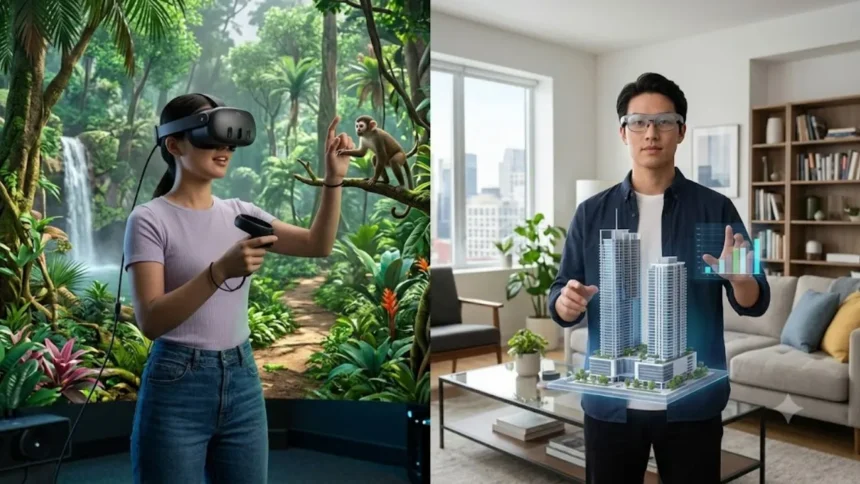
Virtual Reality completely replaces your physical surroundings with a fully computer generated three dimensional space. When a user puts on a dedicated headset, their entire field of vision is covered. This design isolates your senses from the real world, placing you directly inside a digital realm. Modern head tracking systems adjust the display instantly whenever you move your head around naturally.
Sensory isolation is the defining characteristic that separates this technology from other visual media formats. Users experience a strong psychological feeling of true physical presence within the generated digital room. Custom hand controllers allow you to pick up, throw, or manipulate virtual items effortlessly. This seamless interaction makes digital experiences feel remarkably realistic and physically engaging for long sessions.
Operating these immersive platforms usually requires dedicated hardware headsets equipped with specialized motion tracking sensors. Users must clear a safe physical space in their home to avoid bumping into furniture. High resolution displays inside the visor project separate images to each eye, creating realistic depth perception. The combination of spatial audio and visual isolation delivers total immersion for the user.
Popular applications for this technology range from deep video gaming to high risk industrial training. Surgeons practice delicate operations in simulated operating rooms before ever touching a real surgical patient. Flight simulators allow student pilots to master complex landings without facing any physical danger whatsoever. The ability to simulate real environments safely makes this technology an invaluable training tool.
Exploring Augmented Reality and Real World Digital Enhancements
Augmented Reality enhances your existing physical world by layering computer generated graphics onto your live surroundings. Instead of shutting the real world out entirely, this technology enriches what you already see. You can view your actual living room while digital objects sit rendered upon your physical furniture. Users maintain total awareness of their physical environment while viewing these interactive digital elements.
Accessibility remains one of the greatest advantages offered by this real world visual technology platform. Millions of everyday consumers already carry compatible hardware right inside their pockets via modern smartphones. Users simply open a mobile application, point their device camera, and view digital overlays instantly. This low barrier to entry allows people to experience interactive digital media without extra equipment.
Advanced spatial mapping allows digital elements to interact naturally with actual physical surfaces and objects. Smart software identifies floors, walls, and tabletops to place digital items at accurate scale positions. As you move your camera around, the digital object stays locked accurately in place. This realistic blending makes interactive graphics feel like genuine physical additions to your room.
Common uses for this technology include digital retail shopping, interactive mobile gaming, and live navigation. Shoppers can preview how new furniture looks inside their home before making an online purchase decision. Navigation apps overlay walking arrows directly onto the street view to guide pedestrians toward destinations easily. Everyday applications continue expanding as developers create practical visual tools for mobile consumers.
Core Differences Between Immersive Platforms and Everyday Practical Uses
The fundamental difference between these two technologies lies in how they handle your physical surroundings. One platform completely blocks out your environment to create a totally artificial digital room space. The other platform preserves your real world view while adding helpful digital information on top. Understanding this core operational difference helps users choose the best system for their needs.
Hardware requirements also create a clear divide between how consumers access these different digital platforms. Fully immersive setups demand specialized visors, motion controllers, and sometimes powerful desktop computer hardware. On the other hand, real world overlays function smoothly on standard mobile phones and tablets. This key hardware difference affects both the overall setup cost and daily user portability.
Environmental safety and user mobility vary greatly depending on which system you choose to operate. Fully isolated users must remain stationary or move carefully within small, predefined safe room zones. Conversely, users viewing digital overlays can walk around public spaces and interact with people naturally. Maintaining awareness of your actual surroundings makes mobile visual platforms ideal for daily outdoor use.
Selecting the right platform depends entirely on whether you desire total escape or enhanced productivity. Entertainment enthusiasts often prefer the complete immersion provided by isolated digital environments for gaming. Working professionals typically lean toward interactive overlays that deliver real time data while performing tasks. Both technologies continue evolving rapidly to deliver better experiences for users across all fields.
Conclusion and Future Trends in Immersive Visual Technologies
As technology advances, the line separating fully digital spaces and physical reality continues to blur. Modern visual systems are becoming lighter, more powerful, and easier for everyday consumers to operate. The integration of advanced artificial intelligence will make digital interactions even more intuitive over time. Future hardware releases promise deeper immersion, better battery life, and more comfortable wearable designs.
Both platforms will play increasingly major roles in how we work, learn, and communicate daily. Educational institutions are adopting interactive digital tools to make complex subjects easier for students to understand. Businesses utilize digital workspaces to allow remote teams to collaborate seamlessly across international borders. The ongoing evolution of these visual systems guarantees their place in modern technological life.
Ultimately, neither technology is inherently superior, as both serve unique and valuable daily functions. Fully digital environments offer unmatched immersion for gaming, simulations, and virtual exploration activities. Meanwhile, real world digital overlays provide practical tools for shopping, navigation, and quick information access. Understanding your personal usage habits helps you invest in the platform that best fits.
The future of digital media lies in seamless experiences that adapt effortlessly to user needs. As hardware prices decrease, these tools will become standard features in home and workplace settings. Staying informed about technological trends allows consumers to make smart hardware choices going forward. Embrace the ongoing revolution in visual computing and enjoy exploring these exciting digital worlds.
Frequently Asked Questions (FAQs)
Which technology is more accessible: AR or VR?
Augmented Reality is significantly more accessible to everyday consumers because it runs on standard smartphones. Most modern mobile devices have built in cameras and processing power required to display digital graphics. Virtual Reality usually requires purchasing dedicated headsets and extra tracking equipment before you can play.
Can augmented reality and virtual reality be combined into one device?
Yes, modern headsets combine both technologies using high definition passthrough cameras to merge digital and real worlds. This combined experience is commonly referred to as Mixed Reality or Extended Reality in technology circles. Users can switch seamlessly between viewing their physical room and entering fully digital virtual spaces.
Does virtual reality cause motion sickness during long usage sessions?
Motion sickness can occur when your eyes perceive movement inside a digital environment while your physical body sits still. Technology manufacturers minimize this discomfort by increasing screen refresh rates and improving motion tracking accuracy over time. Taking regular breaks and starting with shorter usage sessions helps users adapt comfortably to immersive environments.
Is augmented reality useful for businesses and professional industries?
Businesses rely heavily on digital overlays for remote technical assistance, architectural visualization, and interactive employee training. Mechanics can view repair diagrams superimposed directly onto real engine parts while working hands free in shops. This hands free access to real time information improves workplace accuracy and speeds up complex tasks.
Will virtual reality completely replace traditional computer screens in the future?
While immersive headsets offer massive virtual monitors, traditional flat screens remain more practical for quick daily tasks. Headsets excel at deep focus work, gaming, and 3D design projects that benefit from spatial depth. Both visual formats will likely coexist, with users choosing the best display type for specific activities.