

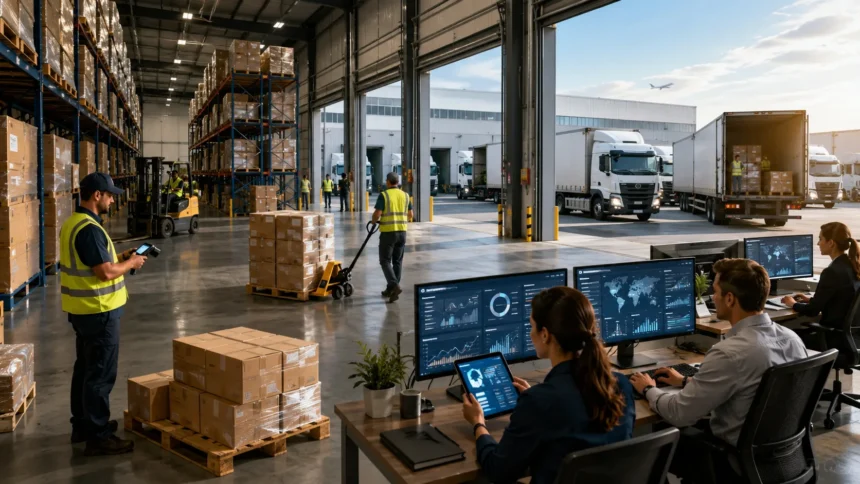
3PL Meaning: How Third-Party Logistics Works
Shipping a few orders from a home office or small warehouse can be manageable when a business is still growing. As order volume increases, however, storing inventory, hiring warehouse workers, choosing carriers, printing labels, packing boxes, managing returns, and keeping customers updated can become a major operational challenge. This is where 3PL, or third-party logistics, becomes valuable. A 3PL provider handles selected logistics operations on behalf of another business, allowing that company to use an established warehouse and fulfillment network instead of building everything internally. For ecommerce and retail businesses, this can make fulfillment easier to scale as customer demand grows.
Third-party logistics can include much more than putting products into boxes. Modern 3PL companies may provide warehousing, inventory management, picking and packing, transportation, order tracking, reverse logistics, freight coordination, kitting, international shipping, and technology integrations. Shopify defines third-party logistics as outsourcing logistics activities such as warehousing, transportation, and order fulfillment to a specialized external provider. Understanding the 3PL meaning is therefore useful for businesses deciding whether to keep fulfillment in-house or outsource part of their supply chain. This guide explains how third-party logistics works, the services 3PL companies provide, major benefits and challenges, 3PL examples, costs, and how to choose the right logistics partner.
What Does 3PL Mean?
3PL stands for third-party logistics, a business model in which a company hires an external logistics provider to perform some or all of its supply chain activities. Instead of operating every warehouse, hiring fulfillment employees, and coordinating every carrier directly, the business can outsource those responsibilities to a specialist. A typical ecommerce 3PL receives inventory from the merchant, stores products in its fulfillment center, receives customer orders electronically, picks the required items, packs them, and arranges shipment. Shopify describes 3PL providers as specialists that manage activities including product storage, inventory tracking, order fulfillment, carrier coordination, and tracking technology.
The “third party” in third-party logistics refers to the logistics company sitting between the business selling the product and the customer receiving it. The seller remains responsible for its products, pricing, marketing, customer relationships, and broader brand strategy, while the 3PL takes responsibility for contracted logistics activities. For example, an online skincare brand might manufacture products through one supplier but store its finished inventory inside a 3PL warehouse. When an order enters the brand’s online store, the warehouse processes the shipment without the skincare company physically touching the package. This allows logistics operations to continue behind the scenes while the brand focuses on other parts of the business.
A 3PL relationship can be relatively narrow or extremely comprehensive depending on what the customer needs. Some providers specialize mainly in transportation, while others offer end-to-end 3PL fulfillment services covering receiving, warehousing, inventory management, order processing, packaging, shipping, and returns. Additional services can include product assembly, custom packaging, subscription-box preparation, labeling, quality checks, and international logistics. Shopify notes that full-service providers may support inventory intelligence, shipping coordination, returns, and multi-location fulfillment alongside traditional warehousing. This flexibility makes third-party logistics applicable to businesses ranging from growing ecommerce companies to multinational manufacturers.
Using a third-party logistics provider does not mean the seller completely abandons control over logistics. Strong 3PL relationships rely on software integration and shared performance data so the business can monitor inventory, orders, shipping status, and fulfillment accuracy. Modern providers commonly connect with ecommerce platforms, order management systems, warehouse management systems, and ERP software. When properly integrated, these systems automatically exchange order and inventory information. A merchant may therefore manage customer orders from its normal ecommerce dashboard while the physical warehouse work happens elsewhere. The customer usually sees the seller’s brand rather than the name of the logistics company processing the shipment.
The easiest way to understand the meaning of 3PL is to think of it as outsourced logistics infrastructure. The business owns or sells the inventory, but a specialist handles agreed parts of moving that inventory through the supply chain. This can reduce the need for internal warehouse space, fulfillment labor, carrier contracts, and logistics technology. However, outsourcing also creates dependence on another company’s performance, making provider selection and service-level agreements extremely important. A 3PL is therefore not merely a shipping company. It can become an operational partner responsible for a significant part of the customer experience between checkout and delivery.
How Does Third-Party Logistics Work?
The 3PL process normally begins when the business sends inventory to one or more fulfillment centers operated by the logistics provider. The provider receives the shipment, verifies quantities, records the inventory, and places products into designated storage locations. Depending on the warehouse, inventory may be stored on pallets, racks, shelves, or bins. The 3PL’s warehouse management system tracks where each SKU is located and how much inventory is available. Shopify explains that warehouse and inventory management are core 3PL services because accurate stock information is necessary for efficient fulfillment. Once receiving is complete, products become available for customer orders.
The next stage begins when a shopper places an order through the merchant’s website, marketplace, or another sales channel. If the systems are integrated correctly, order information automatically flows from the online store or order management system into the 3PL’s fulfillment software. Warehouse staff or automated equipment then receive instructions identifying the products and quantities that need to be picked. Shopify describes this flow as an automatic connection in which an ecommerce order reaches the 3PL system and triggers picking, packing, and shipping without requiring manual entry. Automation reduces delays and helps prevent transcription errors that could occur when orders are transferred manually.
During pick and pack fulfillment, warehouse workers or robotic systems retrieve the correct items from their storage locations. The products are then packed according to the brand’s requirements, which may include standard packaging, branded boxes, marketing inserts, gift messages, protective materials, or special handling instructions. Shipping labels and documentation are generated before the package moves to the outbound area. Some providers can also perform kitting, assembly, labeling, or subscription-box preparation before shipping. The accuracy and consistency of this stage directly affect the customer experience because incorrect products, damaged packaging, or missing items can create returns and customer-service problems.
Once the package is ready, the 3PL hands it to an appropriate shipping carrier. Depending on the provider, this could involve national parcel carriers, regional carriers, freight companies, couriers, or the 3PL’s own delivery network. Large 3PL companies often work with multiple carriers and may automatically choose among them according to delivery speed, destination, price, package size, and service requirements. Shopify notes that carrier relationships can help 3PL providers negotiate preferred shipping rates and offer multiple delivery options. Tracking information then flows back into the merchant’s ecommerce system so customers can receive shipment updates.
The logistics process does not necessarily end when the customer receives the package. Many full-service 3PLs also manage reverse logistics, meaning returns and exchanges. A returned product may be inspected, restocked, refurbished, quarantined, recycled, or disposed of depending on the merchant’s policy and the condition of the item. Shopify identifies return and exchange management as an important full-service 3PL capability. Throughout the process, inventory levels and order status should update automatically. This continuous flow—from receiving inventory to delivery and possible return—is the operational foundation of modern third-party logistics.
Common 3PL Services
Warehousing is one of the most common services provided by third-party logistics companies. Instead of leasing or buying warehouse space, a business pays the 3PL to store inventory inside an existing facility. This model can be useful for businesses whose inventory needs change seasonally because warehouse requirements may increase dramatically during peak periods. Providers may charge storage according to pallets, bins, shelves, cubic space, or another measurement. Multi-location 3PL networks can also distribute inventory across several regions so products are positioned closer to customers. Shopify notes that strategic warehouse placement can reduce shipping distance while helping brands improve delivery speed and cost.
Inventory management is closely connected with warehousing. A 3PL tracks how many units are received, where they are stored, which items are reserved for orders, and how much inventory remains available. Better providers may also provide dashboards showing inventory levels across fulfillment centers, order velocity, low-stock warnings, and other useful information. This visibility helps businesses decide when to reorder products and where additional stock should be placed. Poor inventory accuracy can create overselling, stockouts, unnecessary storage charges, and delayed orders, so companies should evaluate inventory-control processes carefully when comparing providers.
Order fulfillment is another central 3PL service. This includes receiving electronic orders, picking products, packaging them, preparing shipping labels, and handing packages to carriers. Businesses may also request customized packaging, inserts, gift notes, bundles, or other brand-specific requirements. Shopify identifies picking, packing, order management, and shipping coordination among the core functions businesses should evaluate when selecting a 3PL. Fulfillment providers typically charge fees according to order complexity, number of items picked, packaging requirements, and monthly volume. Higher-volume businesses may receive lower per-order rates depending on the provider’s pricing structure.
Transportation and freight management can extend beyond parcel delivery. A transportation-focused 3PL may coordinate less-than-truckload shipping, full-truckload freight, air freight, ocean transportation, or other movement between manufacturers, warehouses, distributors, and customers. Shopify distinguishes transportation-based 3PLs from warehouse-focused fulfillment providers and notes that they may specialize in moving inventory rather than storing or fulfilling individual ecommerce orders. International logistics can also include freight forwarding, customs coordination, and cross-border support depending on the provider. Companies with complex supply chains may combine several transportation and warehousing services under one logistics relationship.
Value-added services allow businesses to outsource additional work that happens before or after ordinary fulfillment. These can include kitting several products into one bundle, assembling components, labeling, quality inspection, preparing retail displays, personalizing packages, managing subscriptions, or handling product returns. Some providers also offer reporting and analytics, freight auditing, inventory forecasting tools, and specialized services for temperature-controlled, oversized, fragile, regulated, or high-value goods. The exact mix varies widely between 3PL companies. Businesses should therefore evaluate specific operational requirements rather than assuming every provider offers the same third-party logistics services.
Types of 3PL Providers
A warehouse-based 3PL specializes primarily in inventory storage and order fulfillment. These providers operate one or more distribution centers where client inventory is received, stored, picked, packed, and shipped. Ecommerce businesses commonly use warehouse-focused 3PLs because they can outsource the entire physical fulfillment process without maintaining their own facilities. Some providers operate only a few regional warehouses, while larger networks provide facilities across several countries or regions. Shopify identifies warehouse providers as one of the most common types of 3PL and emphasizes that distribution-center location can strongly influence shipping speed.
Transportation-based 3PLs focus more heavily on moving goods between locations. They may coordinate parcel shipping, trucking, freight, or other transportation services without necessarily storing inventory long term. Businesses can use these companies to move pallets from factories to warehouses, transport products between distribution centers, or arrange deliveries to retailers and customers. Shopify notes that transportation-focused providers may coordinate options such as less-than-truckload and full-truckload shipping depending on shipment size. This type of 3PL can be particularly valuable for manufacturers, wholesalers, and companies with complex domestic or international freight requirements.
Full-service 3PL companies combine multiple logistics functions into one offering. Their services may cover inbound receiving, warehousing, inventory management, order fulfillment, carrier coordination, returns, reporting, and specialized value-added activities. Multi-location full-service providers can distribute a merchant’s stock across their network and ship each customer order from a strategically located warehouse. Shopify describes full-service providers as capable of handling several parts of fulfillment while offering technology integrations and geographically distributed inventory. This model can simplify vendor management because the business does not need separate companies for every stage of logistics.
Some third-party logistics companies specialize in particular industries or product requirements. A healthcare 3PL may have processes designed for medical or pharmaceutical products, while a food logistics provider may operate temperature-controlled warehouses. Other specialists focus on apparel, electronics, automotive parts, furniture, hazardous materials, high-value goods, or subscription commerce. Industry specialization can matter because handling requirements, inventory rotation, regulations, packaging, security, and shipping methods vary significantly by product category. A provider that performs exceptionally well for lightweight cosmetics may not be the right choice for oversized industrial equipment.
Technology-focused or information-oriented providers add another dimension to 3PL logistics. These companies may provide transportation management systems, shipment optimization, freight auditing, inventory analytics, order visibility, and coordination between multiple logistics partners. Some 3PLs own large physical warehouse networks, while others rely more heavily on technology and contracted carrier relationships. Shopify notes that third-party logistics providers can be categorized by both the services they perform and whether they own the underlying physical infrastructure. Businesses should understand which assets a provider controls directly because ownership models can influence pricing, flexibility, capacity, and accountability.
Benefits of Using a 3PL Provider
One of the biggest 3PL benefits is the ability to scale fulfillment without immediately building additional logistics infrastructure. A growing retailer may suddenly need more storage space, packing stations, warehouse employees, or shipping capacity when order volume increases. Building that capability internally requires capital, management time, recruitment, technology, and ongoing overhead. A 3PL already has facilities and logistics staff in place, allowing businesses to access additional capacity more quickly. Shopify notes that growing brands commonly consider third-party logistics when their existing infrastructure can no longer handle order volume or when they begin running out of storage space.
Third-party logistics can also lower certain shipping and operational costs. Large providers ship significant volumes across many customers, potentially giving them stronger negotiating power with carriers than an individual merchant could achieve independently. A 3PL may also reduce the need for the merchant to lease its own warehouse, purchase packing equipment, maintain warehouse software, and recruit fulfillment employees. Shopify notes that preferred carrier rates and shared infrastructure can help businesses improve fulfillment economics. However, outsourcing is not automatically cheaper for every company, so businesses should compare complete internal logistics costs with all proposed 3PL fees before making a decision.
Faster delivery can be another advantage when the provider operates fulfillment centers near major customer populations. Shipping from a warehouse closer to the buyer generally reduces transportation distance and can make one-day or two-day delivery more achievable. A business shipping every order from one distant warehouse may otherwise pay high rates for expedited delivery. Multi-node fulfillment allows inventory to be distributed across locations according to expected demand. Shopify emphasizes warehouse location and inventory positioning as important factors influencing delivery speed and shipping cost. This becomes particularly valuable for ecommerce businesses competing on customer expectations around fast delivery.
Outsourcing fulfillment can allow internal teams to spend more time on activities closer to the company’s competitive advantage. Founders and employees at growing ecommerce businesses often find themselves packing boxes late into the evening when they could be developing products, improving marketing, building customer relationships, or planning growth. A 3PL does not eliminate every logistics responsibility because inventory planning and provider management remain important, but it can remove a large amount of repetitive physical fulfillment work. Logistics specialists may also bring processes, technology, and operational knowledge that a smaller business would take years to develop independently.
A strong 3PL network can provide additional resilience when demand fluctuates or supply chains encounter disruption. Providers serving multiple customers often maintain relationships with several carriers and may operate warehouses across different regions. This can create more options when a particular carrier, facility, or shipping route experiences capacity constraints. Shopify notes that diversified warehouse and carrier networks can help businesses reduce exposure to fulfillment disruptions, although outsourcing does not eliminate risk entirely. The major advantage is flexibility: companies gain access to logistics resources they might not be able to justify building solely for their own normal order volume.
Challenges and Disadvantages of 3PL Logistics
The most significant disadvantage is reduced direct control over fulfillment operations. When products are stored inside someone else’s warehouse, the merchant cannot simply walk to a shelf, inspect inventory, or pack an unusual order whenever it wants. The 3PL follows its own workflows, operating hours, cutoff times, and procedures. Shopify notes that fixed warehouse processes can affect how quickly unusual requests or last-minute orders can be handled. Businesses should therefore document packaging standards, order priorities, shipping requirements, and exception processes clearly before outsourcing. A misunderstanding that seems minor internally can affect hundreds of customer orders once fulfillment scales.
Dependence on provider performance creates another major risk. Customers normally blame the brand when a package arrives late, contains the wrong item, or is damaged, even though a third-party warehouse handled the order. This means part of the company’s customer experience effectively depends on the 3PL. Order accuracy, receiving speed, inventory accuracy, same-day shipping rates, on-time delivery, and return processing should therefore be tracked through clear service-level agreements. Shopify recommends defining performance commitments and understanding the provider’s response when service levels are missed. Strong reporting and regular performance reviews are essential after the partnership begins.
Integration can create technical complexity. The 3PL needs accurate information about products, inventory, orders, cancellations, returns, and shipment status, while the merchant needs reliable updates from the warehouse. Connecting ecommerce platforms, ERP systems, warehouse management software, order management systems, and marketplaces may require APIs, EDI, file transfers, or prebuilt applications. Shopify warns that migrating to a 3PL is not always plug-and-play and that rebuilding integrations can make switching providers difficult. Technical compatibility should therefore be investigated before signing a long-term contract rather than treated as an implementation detail afterward.
Pricing can also be difficult to compare because 3PL companies often charge several different fees. These may include onboarding, receiving, storage, pick-and-pack charges, packaging materials, shipping, account management, returns, kitting, special projects, and minimum monthly commitments. Shopify identifies warehouse fees, fulfillment fees, shipping costs, setup fees, and minimums among the common components businesses should investigate. A provider with a low base fulfillment price may ultimately cost more once storage and additional service fees are included. Companies should model representative orders and seasonal volumes instead of comparing one headline number.
Switching providers can be disruptive once inventory, integrations, and operating procedures are deeply connected with a 3PL. Products may need to be physically moved to another warehouse while systems are integrated and customer orders continue arriving. Poor transition planning can create stock discrepancies, delayed orders, duplicated inventory records, and additional transportation costs. This makes long-term fit particularly important. Shopify recommends selecting a logistics partner based not only on current needs but also on where the business is likely to be in the next several years. A strong evaluation process at the beginning can therefore prevent an expensive operational migration later.
3PL vs 4PL, Dropshipping and Freight Forwarding
The 3PL vs 4PL distinction mainly concerns the level of supply chain responsibility being outsourced. A 3PL generally performs logistics operations such as warehousing, picking, packing, inventory management, and transportation. A fourth-party logistics provider, or 4PL, takes a broader management role and may coordinate several 3PL companies or logistics vendors on behalf of the customer. Shopify describes a 4PL as a provider that can manage multiple fulfillment partners, negotiate contracts, resolve issues, and coordinate communication across the logistics network. Businesses needing execution may choose 3PL, while those needing end-to-end logistics orchestration may consider 4PL.
Dropshipping is different because the retailer normally does not purchase and store inventory in the same way. In a dropshipping model, a customer places an order with the retailer and the product is fulfilled directly by a supplier. With 3PL fulfillment, the merchant generally owns its inventory and sends that stock to the logistics provider before customer orders occur. Shopify explains that 3PL can provide greater control over packaging, inventory, and delivery while dropshipping can reduce the upfront cost associated with purchasing stock. The models therefore involve different levels of inventory ownership, control, financial risk, and operational responsibility.
Freight forwarding also differs from traditional 3PL fulfillment. A freight forwarder primarily arranges transportation for goods across long distances, often internationally. Forwarders coordinate carriers, routes, shipping documents, and sometimes customs-related processes, but they may not provide ongoing ecommerce warehousing and individual order fulfillment. Shopify distinguishes freight forwarders from broader 3PL providers by noting that forwarders concentrate more heavily on international or long-distance transportation. Some logistics companies offer both forwarding and fulfillment, so businesses should examine the actual service scope rather than assuming company labels always fit neatly into one category.
A parcel carrier also should not automatically be considered a complete 3PL provider. Carriers primarily move packages from an origin to a destination, whereas a full-service 3PL can store the merchant’s inventory and prepare individual orders before handing them to a carrier. Shopify describes the broader logistics ecosystem by noting that a 2PL relationship can involve a transportation provider collecting parcels from the merchant and delivering them to customers, while a 3PL manages inventory and fulfillment as well. This difference becomes clearer when considering who owns the warehouse process and who merely transports the finished package.
Choosing between these models depends on the business problem. A company that already has an efficient warehouse but needs international freight support might use a forwarder. A startup testing product demand without purchasing inventory might choose dropshipping. A scaling ecommerce brand overwhelmed by picking, packing, storage, and parcel shipping may benefit from a 3PL. A global company coordinating multiple logistics providers could require a 4PL. Understanding these differences helps businesses avoid buying a broader or narrower service than they actually need and makes the third-party logistics model easier to place within the overall supply chain.
Examples of How Businesses Use 3PL
An ecommerce apparel brand provides a simple 3PL example. Imagine a clothing company that sells through its own website and initially stores products in a small office. As orders increase, employees spend more time packing boxes than developing new collections or marketing the brand. The company sends its inventory to a third-party fulfillment center and integrates its online store with the provider’s system. When customers purchase shirts, jackets, or accessories, orders automatically reach the warehouse. The 3PL picks the correct sizes and colors, packages them according to brand requirements, ships them, and updates tracking information without the retailer operating its own warehouse.
A subscription business may rely on additional value-added services. Suppose a wellness company sends several individual products to a 3PL and needs those items combined into a monthly subscription box. The logistics provider can perform kitting, place products into branded packaging, insert printed materials, attach shipping labels, and send thousands of boxes according to a scheduled release date. The merchant still controls product selection and customer subscriptions, while the 3PL performs the repetitive physical assembly and shipping work. This arrangement can be far easier to scale than hiring temporary internal workers whenever monthly subscription volume increases.
A manufacturer can use 3PL services differently from a direct-to-consumer brand. An electronics manufacturer may produce goods at one location but need to distribute pallets to retailers, regional warehouses, and wholesale customers across the country. A transportation-focused 3PL can coordinate freight, consolidate shipments, select carriers, and monitor transportation performance. The company may also use a warehousing provider to hold finished inventory closer to important markets. In this example, the 3PL is supporting business-to-business distribution rather than packing individual ecommerce orders. The concept remains the same because an outside specialist performs logistics functions on behalf of the manufacturer.
International expansion creates another common use case. A brand that ships every overseas order from its home country may experience expensive delivery, long transit times, and complicated returns. Working with an international third-party logistics company can allow inventory to be positioned closer to overseas customers. Shopify notes that global 3PL networks can help businesses reduce cross-border complexity and improve fulfillment by operating warehouses in multiple countries. The merchant still needs to consider taxes, import requirements, product regulations, and inventory planning, but regional fulfillment can simplify the customer-facing delivery experience.
Seasonal retailers can benefit because their logistics requirements fluctuate sharply throughout the year. A gift company may process modest order volume through most months but experience a dramatic increase around major holidays. Maintaining enough warehouse space and permanent labor to handle peak demand would leave expensive capacity unused during slower periods. A 3PL serving multiple businesses may have greater ability to allocate shared resources as client demand changes. This does not guarantee unlimited peak capacity, so forecasting and communication remain important. However, outsourcing can provide flexibility that would be difficult for a smaller brand to build independently.
3PL Costs and Pricing
3PL pricing usually combines several fees rather than one simple monthly rate. Receiving fees cover the work required to unload, count, inspect, and enter incoming inventory into the warehouse system. Storage fees then apply while the inventory remains inside the facility. These charges may be calculated by pallet, bin, shelf, cubic foot, or another measurement. Shopify notes that warehousing is commonly charged according to the space used and that merchants should include storage expenses when comparing internal fulfillment with outsourcing. Businesses with slow-moving inventory need to pay particular attention to storage because products can continue generating costs before they are sold.
Pick-and-pack charges apply when customer orders are processed. A provider may charge a base amount for the first item and an additional amount for each extra item in the same order. Packaging materials, custom boxes, special inserts, gift wrapping, kitting, or unusual handling can create additional fees. Higher fulfillment volume may reduce unit costs if the provider offers tiered pricing. Shopify identifies pick-and-pack charges as one of the main ongoing expenses associated with outsourced fulfillment. Companies should therefore provide prospective providers with realistic order profiles, including average items per order and packaging requirements, when requesting quotations.
Shipping is often one of the largest components of total fulfillment cost. Rates depend on package size, weight, destination, delivery speed, carrier, surcharges, and shipping zone. Large 3PL providers may negotiate discounted carrier rates because of their overall shipping volume, potentially producing lower transportation costs than a small merchant could obtain alone. Shopify notes that carrier purchasing power is one of the reasons companies may access more competitive shipping options through a third-party logistics provider. Businesses should still compare actual rates for representative destinations because discounts can vary considerably between providers and service levels.
Other expenses can include setup fees, software integration, account management, minimum monthly spend, inventory counting, returns, special projects, labeling, disposal, long-term storage, and changes to orders after they enter fulfillment. International logistics can introduce customs, duties, brokerage, and additional transportation charges. Shopify emphasizes that 3PL pricing can become complex and recommends requesting a complete breakdown rather than evaluating only one fulfillment fee. Contracts should clearly explain which services are included and how prices can change. Unexpected charges often result from ambiguous assumptions rather than truly hidden fees.
The correct way to determine whether a 3PL saves money is to compare total logistics cost, not simply warehouse rent or the pick fee. Internal fulfillment includes employee wages, management time, payroll costs, rent, utilities, equipment, insurance, packaging, warehouse technology, shipping rates, maintenance, and the opportunity cost of capital tied up in infrastructure. Outsourcing replaces many of these costs with provider fees, although it introduces others. Calculate costs across normal and peak order periods and consider the effect on delivery speed and customer experience. The cheapest provider on a spreadsheet may not produce the lowest total business cost if poor service creates refunds, complaints, and lost customers.
How to Choose the Right 3PL Provider
Begin by defining exactly which logistics activities you want to outsource. Some businesses only need warehouse storage and parcel fulfillment, while others require freight, international shipping, returns, kitting, subscription assembly, retail distribution, or specialized product handling. Create a detailed list of current order volume, SKU count, product dimensions, customer locations, seasonal patterns, shipping speeds, packaging requirements, and expected growth. Shopify recommends evaluating a provider according to where the business is likely to be in the next one to three years rather than selecting entirely around current needs. This reduces the chance of outgrowing the relationship shortly after implementation.
Warehouse locations should be evaluated against the geographic distribution of your customers. A provider with ten warehouses is not automatically better than one with three if those ten facilities are far from the markets where most orders are delivered. Ask which fulfillment centers would actually hold your inventory and what percentage of customers could receive orders within your target delivery window. Shopify emphasizes warehouse proximity as an important factor affecting shipping speed and transportation cost. Businesses should also understand whether spreading inventory across multiple facilities creates additional transfer costs, minimum stock requirements, or more complicated inventory planning.
Technology integration is another critical selection criterion. Confirm whether the 3PL integrates with your ecommerce platform, marketplaces, ERP, order management system, inventory software, and other business applications. Ask whether integration uses a native application, API, EDI, or another method and how quickly inventory and order status update. Shopify specifically recommends confirming that the logistics provider can connect with the merchant’s existing inventory and order-management environment. Request a demonstration of the merchant dashboard as well because your internal team may depend on it every day to check inventory, shipments, exceptions, and performance.
Service-level agreements should define measurable expectations rather than relying on general promises such as “fast fulfillment.” Ask about order accuracy, inventory accuracy, same-day shipping cutoff times, receiving speed, on-time shipment rates, support response times, and procedures for lost or damaged products. Shopify recommends asking providers exactly which service levels they commit to and what corrective action occurs when those standards are missed. References from existing customers in similar industries can provide additional insight into how the company performs during peak seasons or operational disruptions. Contract terms should also explain liability, insurance, termination, and inventory-transfer procedures.
Finally, evaluate the provider as a long-term operational partner rather than just a warehouse vendor. Communication quality can become extremely important when inventory discrepancies, delayed inbound shipments, carrier problems, or urgent customer orders occur. Determine who will manage the account and how escalation works outside normal conditions. Review the company’s financial stability, capacity, security practices, reputation, and ability to support future markets or products. The best 3PL provider is one whose infrastructure, technology, cost structure, service levels, and communication style align with the needs of the business. A slightly higher-priced partner may create greater value if it consistently improves order accuracy, delivery speed, and customer satisfaction.
FAQs About 3PL
What does 3PL stand for?
3PL stands for third-party logistics. It means outsourcing logistics activities such as warehousing, fulfillment, inventory management, and shipping to an external provider.
What does a 3PL company do?
A 3PL can store inventory, pick and pack orders, manage shipping, track inventory, process returns, and provide other logistics services.
How does 3PL fulfillment work?
You send inventory to the 3PL warehouse, customer orders flow into its system, and the provider picks, packs, and ships each order. Tracking and inventory information are then updated electronically.
What is an example of a 3PL?
An ecommerce brand using an outside fulfillment warehouse to store products and ship customer orders is a basic example of a 3PL relationship.
What is the difference between 3PL and 4PL?
A 3PL performs logistics operations, while a 4PL generally manages and coordinates multiple logistics providers across a broader supply chain.
Is 3PL the same as dropshipping?
No. With a 3PL, the retailer generally owns inventory stored by the logistics provider. With dropshipping, the supplier normally holds the inventory and ships directly to the buyer.
What are the main benefits of 3PL?
Benefits can include scalable fulfillment, reduced infrastructure requirements, better carrier access, faster shipping, logistics expertise, and more time for core business activities.
How much does a 3PL cost?
Costs vary but commonly include receiving, storage, pick-and-pack, packaging, shipping, setup, returns, and optional service fees.
When should a business use a 3PL?
A 3PL may be useful when order volume, storage requirements, fulfillment labor, or shipping complexity begins limiting business growth.
Can small businesses use 3PL services?
Yes. Third-party logistics is not limited to large enterprises, although a business should compare provider minimums and fees with its current order volume before outsourcing.