

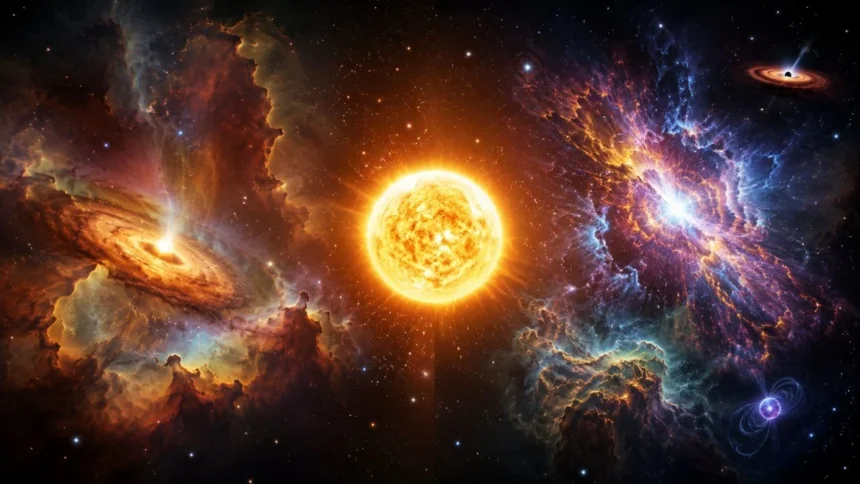
How Are Stars Born? Follow Their Journey From Dust to Death
Look at a clear night sky, and every shining point seems calm and permanent. In reality, stars are active objects that are constantly changing. They form inside cold clouds of gas and dust, spend millions or billions of years producing energy, and eventually reach an ending determined mainly by their original mass.
So, how are stars born in the darkness of space? The process begins when gravity pulls material together inside a molecular cloud. The collapsing material becomes hotter and denser until a young object called a protostar forms. When nuclear fusion begins steadily in its core, the protostar officially becomes a star.
A star spends most of its existence converting hydrogen into helium. Once its fuel starts running out, its internal balance changes. Smaller stars expand, shed their outer layers, and leave white dwarfs behind, while massive stars can explode as supernovae and create neutron stars or black holes.
Understanding the life cycle of a star helps explain much more than the objects visible in the sky. Stars produce and distribute many of the elements found in planets, oceans, living organisms, and the human body. The birth and death of stars are therefore essential parts of the continuing evolution of the universe.
The Star Life Cycle at a Glance
Every star begins inside a large molecular cloud made mainly of hydrogen and helium, with smaller amounts of dust and other material. Colder and denser areas within the cloud may begin collapsing under gravity. As material gathers in one location, the growing concentration develops a stronger gravitational pull and collects even more matter.
The collapsing region eventually forms a protostar surrounded by a rotating disk of gas and dust. The protostar is not yet a fully developed star because its core has not begun stable hydrogen fusion. Most of its early heat comes from gravitational energy released as the material contracts and falls inward.
When the core becomes sufficiently hot and dense, hydrogen nuclei begin combining to form helium. This process, called nuclear fusion, releases enormous amounts of energy. The resulting outward pressure balances the inward force of gravity, allowing the newly formed star to enter the stable main-sequence stage.
What happens later depends mainly on mass. A Sun-like star becomes a red giant and then a white dwarf, while a massive star becomes a supergiant before exploding. Its remaining core may develop into a neutron star or collapse further to create a black hole.
Stellar Nurseries: Where Stars Begin
Stars are born in enormous regions known as molecular clouds. These cold, dark clouds may contain thousands or millions of times the Sun’s mass and can stretch across hundreds of light-years. Because much of their material is cold, particles can gather into dense pockets instead of remaining widely separated throughout space.
Astronomers often call active molecular clouds stellar nurseries because many young stars can form inside them. Famous examples include areas within the Orion Nebula, Carina Nebula, and the Eagle Nebula. The Pillars of Creation are part of a star-forming environment where dense columns contain material associated with developing stars.
A molecular cloud does not transform all its gas into stars at once. Turbulence, magnetic fields, radiation, and movement within the cloud can slow or prevent collapse in many regions. Only pockets that become sufficiently dense and gravitationally unstable have the potential to begin the star formation process.
New star formation may also be influenced by nearby activity. Expanding shock waves, stellar winds, cloud collisions, or supernova explosions can compress existing gas. However, energetic young stars can eventually disperse the surrounding cloud, stopping further formation before all the available material has been converted into stars.
Gravity Starts the Formation Process
Gravity is the main force responsible for bringing a star into existence. When a region inside a molecular cloud becomes denser than its surroundings, its gravitational attraction increases. Gas and dust begin moving toward the centre, adding more mass and strengthening the pull on nearby material.
As the cloud fragment collapses, it usually begins rotating faster. This behaviour is similar to a spinning skater turning more quickly after pulling in their arms. The rotating material flattens into a disk, while most of the available mass continues falling toward the dense centre.
Collapsing material does not fall inward smoothly. Gas particles collide, turbulence develops, and friction converts part of the gravitational energy into heat. The centre therefore becomes progressively hotter and denser, creating the conditions required for the next stage in the life cycle of a star.
Some collapsing clouds divide into several dense cores instead of creating only one object. This is one reason stars commonly form in groups, clusters, or multiple-star systems. Binary systems, in which two stars orbit a shared centre of mass, are therefore a natural outcome of the star formation process.
A Protostar Takes Shape
A protostar is a young developing object formed at the dense centre of a collapsing cloud. It may be surrounded by a thick envelope of material and a rotating disk. Because surrounding dust blocks visible light, protostars can be difficult to observe with ordinary optical telescopes.
During this stage, the protostar continues collecting material through a process called accretion. Gas and dust move inward from the surrounding disk and envelope, gradually increasing the protostar’s mass. Some young objects also release narrow jets of material from their polar regions as they continue developing.
A protostar can become extremely hot, but its main energy source is still gravitational contraction rather than stable hydrogen fusion. The growing object continues shrinking under its own gravity, causing pressure and temperature within the centre to increase over time.
Not every protostar becomes a true star. When an object fails to collect enough mass, its core cannot reach the conditions needed for sustained hydrogen fusion. It may instead become a brown dwarf, an object more massive than a typical planet but less massive than the smallest main-sequence stars.
Nuclear Fusion Creates a Star
The defining moment of stellar birth occurs when stable nuclear fusion starts in the core. Under extreme temperature and pressure, hydrogen nuclei move quickly enough to overcome their electrical repulsion. They combine through a series of reactions that ultimately produce helium and release energy.
This energy moves outward from the core and eventually escapes from the star as heat, visible light, and other forms of radiation. The energy also creates internal pressure that pushes the stellar material outward. At the same time, gravity continues pulling the material toward the centre.
A stable star exists because these opposing forces reach an approximate balance known as hydrostatic equilibrium. Gravity prevents the star from expanding uncontrollably, while pressure generated by fusion prevents immediate collapse. The star may remain in this balanced condition for most of its lifetime.
This stage directly answers the question, how are stars born? A collapsing cloud becomes a protostar, but a functioning star emerges only when sustained fusion begins. Astronomers classify a star converting hydrogen into helium in its core as a main-sequence star.
The Main-Sequence Stage
The main sequence is the longest and most stable stage in the life cycle of a star. Approximately 90 percent of stars belong to this broad category. Although they vary greatly in colour, temperature, luminosity, and size, they all generate energy by converting hydrogen into helium in their cores.
Our Sun is a main-sequence star that formed about 4.6 billion years ago. Its core reaches roughly 15 million degrees Celsius, creating the conditions needed for fusion. The Sun is currently a little less than halfway through its expected life and should remain relatively stable for around another five billion years.
A main-sequence star does not remain completely unchanged. Helium gradually accumulates in its core as hydrogen is consumed. The core’s composition, density, and temperature slowly change, which can influence the star’s size, brightness, and energy output over millions or billions of years.
Eventually, the core no longer contains enough hydrogen to maintain its earlier form of fusion. The balance between gravity and outward pressure begins changing, and the star leaves the main sequence. Its next stages depend heavily on how much mass it possessed when it formed.
Why Stellar Mass Matters
Mass is the most important factor controlling how a star lives and dies. A star with more mass experiences stronger gravity and requires greater internal pressure to avoid collapsing. It must therefore produce energy at a much faster rate than a smaller star.
Massive stars contain more hydrogen, but they use that fuel extremely quickly. Some of the largest stars survive for only a few million years before reaching the end of their main-sequence stage. Their high temperatures and energy output make them bright, powerful, and relatively short-lived.
Lower-mass stars consume fuel much more slowly. Small red dwarfs may continue fusing hydrogen for trillions of years. Because the universe is not old enough for the smallest red dwarfs to complete their predicted lifetimes, astronomers have not yet observed their natural final stages.
The principle can sound surprising: having more fuel does not guarantee a longer life. A massive star is similar to a large engine running at an extremely high rate, while a red dwarf uses its smaller fuel supply efficiently. Mass determines both the speed of ageing and the type of stellar death.
How Sun-Like Stars Age
When a star similar to the Sun runs low on hydrogen in its core, fusion pressure decreases and gravity compresses the central region. Compression raises the core’s temperature, while hydrogen fusion continues in a shell around it. The star’s outer atmosphere begins expanding significantly.
The expanding surface becomes cooler, causing the star to appear redder even though its total energy output may increase. It has now become a red giant. During this stage, the core can become hot enough to fuse helium into carbon and oxygen.
A red giant is much larger than the main-sequence star it once was. When the Sun reaches this stage in roughly five billion years, it will expand enough to engulf Mercury and Venus. Current models indicate that Earth may also be affected or consumed during the Sun’s expansion.
The red giant stage is not stable forever. Pulsations and strong stellar winds gradually remove its outer material. These ejected gases expand into space while the exposed central core remains behind, leading the star toward the final stages of its evolution.
Planetary Nebulae and White Dwarfs
As an ageing Sun-like star ejects its outer atmosphere, the hot remaining core illuminates the surrounding gas. This glowing shell is called a planetary nebula. Despite its name, a planetary nebula has no direct connection with planets; the term came from its planet-like appearance in early telescopes.
Planetary nebulae can display rings, bubbles, lobes, and other complex shapes. Their appearance may be influenced by stellar winds, magnetic fields, rotation, and companion stars. These colourful structures are temporary on astronomical timescales because their gas gradually spreads into interstellar space.
The remaining core becomes a white dwarf. A typical white dwarf is approximately Earth-sized but contains a large fraction of the original star’s mass. It no longer performs normal nuclear fusion and instead shines because it retains heat from its earlier stages.
Over billions of years, the white dwarf slowly releases its remaining heat and becomes fainter. In theory, it would eventually cool into a dark object called a black dwarf. However, the universe has not existed long enough for any white dwarf to cool completely into that predicted state.
How Massive Stars Die
Massive stars follow a more dramatic path after exhausting the hydrogen in their cores. They expand into supergiants and become hot enough to fuse increasingly heavy elements. Helium produces carbon, while later reactions can create oxygen, neon, magnesium, silicon, and other elements.
Different fusion reactions occur in layers around the core, creating a structure sometimes compared to an onion. Each new fuel lasts for less time than the previous one. In a very massive star, the final silicon-fusion stage may continue for only a short period before producing an iron-rich core.
Iron creates a major problem because fusing it into heavier elements does not release the energy needed to support the star. Once the iron core grows beyond what it can support, gravity takes control. The core collapses rapidly, while the outer layers fall inward.
The collapsing material rebounds and helps drive a powerful explosion called a core-collapse supernova. For a brief period, the explosion can become extraordinarily bright and release an immense amount of energy. It also throws newly formed and existing elements far into the surrounding space.
What Is a Supernova?
A supernova is a powerful stellar explosion that can mark the final stage of a massive star. It is not simply a large ordinary flare. The event involves the rapid collapse of the core and the violent ejection of much of the star’s outer material.
The explosion generates a shock wave that moves through the star and into surrounding space. Expanding debris can remain visible for thousands of years as a supernova remnant. These remnants contain hot gas, energetic particles, magnetic fields, and material produced or distributed by the explosion.
Supernovae are important to the chemical development of galaxies. Stars manufacture many elements during their lives, while explosive and neutron-rich processes contribute to the formation and distribution of additional heavy elements. The expanding material can later become part of new molecular clouds, stars, planets, and living systems.
A nearby supernova can also compress surrounding clouds and potentially encourage new star formation. In this way, stellar death can help begin another generation. The process is not a simple straight line but part of an enormous cycle of formation, transformation, and recycling.
Neutron Stars and Pulsars
When a massive star explodes, part of its collapsed core may remain as a neutron star. During the collapse, extreme pressure forces electrons and protons together, producing neutrons. The result is one of the densest known types of objects in the universe.
A neutron star can contain more mass than the Sun inside a sphere only around the size of a city. Its gravity, density, magnetic field, and rotation can be extreme. Even a small amount of neutron-star material would weigh enormously under conditions found on Earth.
Some neutron stars rotate rapidly and release beams of radiation from regions near their magnetic poles. When these beams sweep across Earth, astronomers detect regular pulses, similar to light from a rotating lighthouse. Such an object is known as a pulsar.
Other neutron stars, called magnetars, possess exceptionally strong magnetic fields. Astronomers study neutron stars through radio waves, X-rays, gamma rays, and gravitational effects because most are far too dim to observe with the unaided eye or an ordinary backyard telescope.
How Black Holes Form
A black hole may form when the remaining core of an exploded massive star is too heavy to become a stable neutron star. Gravity continues compressing the core until it collapses beyond the point where known forms of pressure can stop it.
The black hole is surrounded by a boundary called the event horizon. After matter or light crosses this boundary, it cannot escape and communicate with the outside universe. This does not mean the black hole pulls in everything around it from unlimited distances.
From far away, a black hole’s gravity behaves according to its mass, much like the gravity of any other object. Matter must pass sufficiently close to be captured. Gas orbiting nearby may form a hot accretion disk and release powerful radiation before crossing the event horizon.
Not all stars become black holes. The Sun does not possess enough mass and will end as a white dwarf. Black holes are associated with the collapse of much more massive stellar cores, although supermassive black holes found in galactic centres have more complicated formation histories.
Star Death Creates New Stars
A dying star does not simply disappear without influencing its surroundings. Red giants return gas and dust through stellar winds and planetary nebulae, while massive stars eject material through stronger winds and supernova explosions. This material enters the interstellar environment.
Future molecular clouds may contain matter released by several generations of earlier stars. Gravity can eventually pull part of this recycled material together, beginning another period of star formation. New stars are therefore linked chemically and physically to stars that lived before them.
The material around a young star can flatten into a protoplanetary disk. Dust particles collide and join together, gradually forming larger bodies that may develop into asteroids, moons, and planets. The elements needed for rocky worlds are available because earlier stars produced and dispersed them.
Carbon, oxygen, silicon, calcium, iron, and many other elements connected with Earth and life have cosmic origins. Learning how are stars born also reveals why stellar death matters: without repeated generations of stars, the universe would not contain the same range of planets, chemistry, and biological building blocks.
How Astronomers Study Star Birth
Star formation often occurs behind thick clouds of dust that block visible light. Infrared telescopes are especially useful because longer infrared wavelengths can pass through some dusty regions more effectively. This allows astronomers to examine protostars and structures hidden inside stellar nurseries.
The James Webb Space Telescope observes star-forming regions at infrared wavelengths. Its sensitivity helps researchers study faint protostellar cores, surrounding disks, jets, and the influence of young stars on nearby gas. These observations improve models of how stars and planetary systems develop.
Radio telescopes also detect cold molecular gas and identify the chemical composition and movement of star-forming clouds. Optical telescopes observe regions where young stars have cleared away enough material to become visible. X-ray observatories can detect energetic activity produced by some young stars.
By combining information from different wavelengths, astronomers create a more complete picture. No single telescope can reveal every stage or physical process. Infrared, optical, radio, ultraviolet, and X-ray observations each provide a different view of how stars are formed.
How Astronomers Study Star Death
Scientists study ageing stars by measuring their brightness, colour, temperature, composition, movement, and distance. A star’s spectrum reveals which elements are present in its atmosphere, while changes in brightness may show pulsations, eruptions, eclipses, or interactions with a companion.
Planetary nebulae allow researchers to examine material removed from Sun-like stars. White dwarfs provide information about the final cores of those stars. Because white dwarfs cool over time, astronomers can also use their temperatures to study the ages and development of stellar populations.
Supernova observations reveal how massive stars explode and distribute material. Astronomers continue following the expanding remnants long after the initial flash fades. Neutrinos and gravitational waves can provide additional information about violent events that are difficult to understand through visible light alone.
Neutron stars and black holes are often identified through their effects on nearby matter. Pulses of radio waves, powerful X-rays, orbital movements, gravitational lensing, and gravitational waves can expose compact objects that would otherwise remain invisible or extremely difficult to detect directly.
Common Star Life Cycle Myths
One common myth is that every star eventually explodes. Only stars with enough mass experience core-collapse supernovae. Sun-like stars have quieter endings in which they expand, lose their outer layers, and leave white dwarfs behind.
Another misconception is that every dead star becomes a black hole. The final remnant depends on the original star’s mass and the mass remaining after material has been ejected. Possible outcomes include white dwarfs, neutron stars, and stellar-mass black holes.
A shooting star is also not a real star. It is a small piece of rock or dust entering a planet’s atmosphere and producing a streak of light. Actual stars are distant objects that cannot move across Earth’s sky in the same rapid way.
Finally, stars are not burning in the same way as wood or fuel on Earth. Ordinary fire is a chemical reaction involving atoms and electrons. Stellar energy comes mainly from nuclear fusion, which changes atomic nuclei and releases far more energy than chemical combustion.
FAQs About How Stars Are Born
People commonly search for simple explanations of stellar nurseries, nuclear fusion, supernovae, and black holes. The most important idea is that a star’s life is controlled mainly by gravity, fusion, and its mass.
All normal stars begin with collapsing material inside a cloud of gas and dust. However, their final paths can be very different because a small red dwarf and a massive blue star use fuel at dramatically different rates.
It is also important to separate a star itself from the material surrounding it. A nebula may create stars, contain young stars, or consist of material expelled by an ageing or exploding star.
The following answers address five common questions about the star formation process and stellar death. Each answer focuses on the essential facts without requiring advanced knowledge of physics.
How long does it take for a star to be born?
The process can take hundreds of thousands to millions of years. The exact period depends on the cloud’s density, temperature, movement, and the amount of material collected by the protostar.
Are stars still being born today?
Yes. Stars continue forming inside molecular clouds throughout the Milky Way and other galaxies. Telescopes regularly observe protostars, young stellar clusters, and active stellar nurseries.
What is the first stage of a star?
The process begins inside a molecular cloud or stellar nebula. A dense region collapses under gravity and develops into a protostar before stable hydrogen fusion creates a main-sequence star.
How long do stars live?
Massive stars may live for only a few million years, while stars similar to the Sun survive for billions of years. The smallest red dwarfs may continue shining for trillions of years.
What happens when a star dies?
A Sun-like star becomes a red giant, planetary nebula, and white dwarf. A massive star may explode as a supernova and leave behind either a neutron star or black hole.
Conclusion: The Continuing Cycle of Stars
The answer to how are stars born begins with cold gas and dust inside a molecular cloud. Gravity concentrates this material into a protostar, and rising pressure and temperature eventually trigger nuclear fusion. Once hydrogen fusion becomes stable, a new main-sequence star has formed.
Most of the star’s lifetime is spent balancing gravity against the pressure created by fusion. Its mass determines how brightly it shines, how quickly it consumes fuel, how long it survives, and which elements it can produce before reaching its final stages.
Smaller and medium-sized stars end as white dwarfs after passing through red giant and planetary-nebula stages. Massive stars build heavier elements, collapse, and explode as supernovae, potentially leaving neutron stars or black holes behind.
Stellar death also prepares the universe for new beginnings. Material released by older stars becomes part of future clouds, stars, planets, and living systems. Every generation continues a cosmic cycle in which destruction supplies the ingredients for creation.