
What Is DNA and How Does It Work?
DNA is one of the most important molecules in biology because it carries much of the information living organisms need to grow, develop, reproduce, and function. Almost every cell in the human body contains DNA, and the instructions stored inside it help determine how different cells perform their specialized roles.
The term DNA stands for deoxyribonucleic acid. You can think of it as a biological information system written in a chemical code. That code contains instructions used by cells to produce proteins and functional RNA molecules, regulate biological processes, and maintain the complex systems that keep an organism alive.
DNA is also responsible for transmitting genetic information from parents to offspring. This explains why children often share physical and biological characteristics with their parents while still being genetically unique. The particular combination of DNA inherited from each parent contributes to natural variation among individuals.
Understanding how DNA works helps explain genetics, inheritance, mutations, evolution, health, and even modern biotechnology. From genetic testing to gene editing, DNA research continues to change how scientists study life and investigate some of the most fundamental questions in biology.
What Is DNA in Simple Terms?
DNA is a long molecule that stores biological instructions. In humans and many other organisms, most DNA is located inside the nucleus of cells. A smaller amount of DNA is also found inside structures called mitochondria, which help cells generate usable energy.
DNA contains information in a sequence of chemical building blocks. Cells read parts of this sequence when they need to produce particular molecules or regulate specific biological activities. Different sections of DNA therefore act as instructions that contribute to the structure and function of living organisms.
Every person’s DNA is highly similar to that of other humans, yet small differences exist throughout the genome. These genetic variations contribute to differences in traits such as eye color, hair characteristics, blood groups, and many other biological features.
DNA does not operate independently like a computer program controlling everything about a person. Genes interact with other genes, cellular systems, development, lifestyle, and environmental factors. DNA provides essential biological information, but the final outcome of many traits depends on several influences working together.
Where Is DNA Found in the Human Body?
DNA is found in nearly every cell of the human body. Most of it is packaged inside the cell nucleus, where it is organized into structures called chromosomes. The nucleus provides a protected environment that helps cells store and manage their genetic material.
Human red blood cells are a notable exception because mature red blood cells do not contain a nucleus and therefore lack nuclear DNA. Other specialized cells may also contain different amounts of DNA depending on their structure and biological function.
A small amount of genetic material is located inside mitochondria. This is known as mitochondrial DNA, or mtDNA. Unlike most nuclear DNA, mitochondrial DNA is generally inherited through the maternal line because mitochondria in an embryo typically come from the egg cell.
Different tissues contain nearly the same genetic blueprint, but cells do not use every gene at the same time. A muscle cell activates a different combination of genes than a skin cell or nerve cell, allowing cells with similar DNA to develop completely different structures and functions.
What Does DNA Look Like?
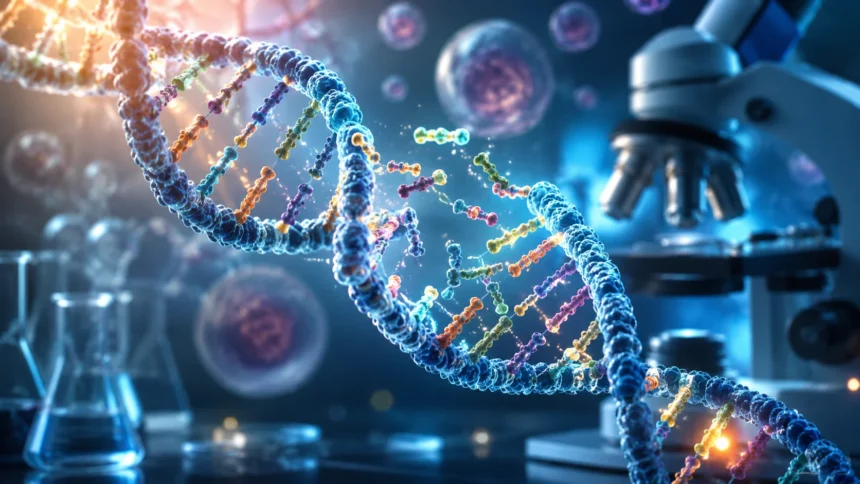
DNA is famous for its double-helix shape, which resembles a twisted ladder. The sides of this molecular ladder are formed by alternating sugar and phosphate molecules, while pairs of chemical bases form the steps connecting the two strands.
The double-helix model helped scientists understand how genetic information could be stored and copied. Its structure allows DNA to remain relatively stable while also making it possible for the molecule to separate temporarily when cells need to copy or use genetic information.
DNA molecules are extraordinarily long compared with the cells containing them. To fit inside a cell nucleus, DNA wraps around proteins called histones and becomes tightly organized into chromatin. During certain stages of cell division, this material becomes even more condensed into visible chromosomes.
Although diagrams often show DNA as a simple colorful spiral, the molecule exists within an extremely complex cellular environment. Its shape, packaging, chemical modifications, and interactions with proteins all influence how genetic information becomes accessible to cells.
The Four DNA Bases: A, T, C, and G
DNA stores information using four chemical bases known as adenine, thymine, cytosine, and guanine. Scientists usually shorten these names to the letters A, T, C, and G. The order of these bases forms the genetic code contained within DNA sequences.
The bases pair with one another according to specific rules. Adenine normally pairs with thymine, while cytosine pairs with guanine. These complementary base pairs help hold the two DNA strands together and play an essential role when DNA is copied.
A useful way to imagine DNA is as an enormous book written with only four letters. Individual letters alone provide little meaning, but their sequence creates biological information that cells can interpret and use for specific purposes.
Small differences in DNA sequences can produce genetic variation between individuals. A single changed base may sometimes have little effect, while other changes can influence the function of a gene or protein depending on where the change occurs.
What Are Genes and How Are They Related to DNA?
Genes are specific regions of DNA containing information used to produce functional biological products, often proteins or RNA molecules. DNA therefore represents the larger store of genetic information, while genes are particular sections within that information.
Humans have thousands of genes spread across their chromosomes. Each gene has a particular location, but many traits are influenced by multiple genes rather than being controlled by a single genetic instruction.
Cells regulate when genes are turned on or off through a process called gene expression. This regulation helps explain how different cell types develop. For example, genes important for muscle function may be highly active in muscle cells but much less active in other tissues.
Genes also interact with one another and with environmental conditions. This is why traits such as height, metabolism, and many aspects of health cannot usually be explained by one gene alone. Genetics often involves networks of interacting biological influences.
What Are Chromosomes?
Chromosomes are structures made from DNA and associated proteins. They help package genetic material into a compact form so that enormous DNA molecules can fit inside the microscopic nucleus of a cell.
Most human body cells typically contain 46 chromosomes arranged into 23 pairs. One chromosome from each pair generally comes from the biological mother, while the other comes from the biological father.
Twenty-two of these chromosome pairs are known as autosomes. The remaining pair consists of sex chromosomes, which contribute to patterns of biological sex development along with other genetic, hormonal, and physiological processes.
Chromosomes are especially important during cell division because they help ensure that genetic material is distributed correctly between newly formed cells. Errors in chromosome number or structure can sometimes contribute to developmental or medical conditions.
How Does DNA Store Genetic Information?
DNA stores information through the specific order of its bases. Just as changing the order of letters can change the meaning of a word, changing the sequence of DNA bases can alter the biological information available to a cell.
Some DNA sequences provide instructions for making proteins, while others help regulate when particular genes are active. Still other regions contribute to chromosome structure or perform functions scientists continue to investigate.
The complete collection of an organism’s DNA is known as its genome. The human genome contains billions of DNA base pairs arranged across chromosomes, creating an enormous biological information system.
Only a portion of the human genome directly codes for proteins. Large regions contain regulatory sequences and other elements that help control how DNA is organized, expressed, and maintained within cells.
How Does DNA Make Proteins?
DNA helps direct protein production through a two-stage process involving transcription and translation. Proteins are essential because they perform many structural, chemical, signaling, transport, and defense functions throughout living organisms.
During transcription, information from a gene is copied into a molecule called messenger RNA, or mRNA. This allows the genetic instructions to leave the nucleus without requiring the original DNA molecule to move.
The mRNA then travels to structures called ribosomes, where translation occurs. Ribosomes read the RNA sequence and assemble amino acids in a particular order, eventually forming a protein.
The new protein then folds into a specific three-dimensional structure that helps determine its function. In this way, information stored in DNA can ultimately influence everything from cellular metabolism to muscle structure and immune responses.
What Is RNA and Why Is It Important?
RNA, or ribonucleic acid, is another important molecule involved in the use and regulation of genetic information. While DNA primarily acts as a long-term information store, RNA performs many more temporary and specialized roles within cells.
Messenger RNA carries genetic instructions from DNA to ribosomes. Transfer RNA helps deliver amino acids during protein production, while ribosomal RNA forms an important structural and functional part of ribosomes.
Scientists have also discovered many additional types of RNA that regulate gene activity and other cellular processes. This has shown that RNA is far more than simply a messenger between DNA and proteins.
DNA and RNA therefore work together as part of a complex biological information system. Understanding their relationship is fundamental to genetics, molecular biology, medicine, biotechnology, and research into how cells function.
How Does DNA Replication Work?
Before many cells divide, they must copy their DNA so each new cell receives genetic information. This copying process is called DNA replication and is essential for growth, development, tissue repair, and normal cellular maintenance.
During replication, the two strands of the DNA double helix separate. Each original strand then serves as a template for building a new complementary strand based on the standard A-T and C-G pairing rules.
Several enzymes help coordinate this process. Some unwind DNA, while others build new DNA strands, correct errors, or reconnect sections of the molecule. Together, these molecular systems make DNA replication remarkably accurate.
Replication is not completely error-free, however. Occasional mistakes can create mutations. Cells have repair mechanisms that correct many errors, but some changes remain and become permanent parts of the DNA sequence.
How Is DNA Passed From Parents to Children?
Humans inherit DNA through reproductive cells called sperm and eggs. These cells contain half the usual number of chromosomes, allowing an embryo to receive one set from each biological parent when fertilization occurs.
As a result, a child receives roughly half of their nuclear DNA from their biological mother and half from their biological father. The exact combination differs from one child to another because chromosomes are shuffled during the formation of reproductive cells.
This genetic reshuffling is one reason siblings can look and behave differently despite having the same parents. Each sibling receives a distinct combination of inherited genetic variants, except identical twins, who begin with nearly identical nuclear DNA.
Inheritance can follow many patterns. Some traits are influenced by individual genes, while others depend on dozens or even thousands of genetic variants combined with environmental factors and developmental processes.
Why Do Family Members Share Similar Traits?
Family members often resemble one another because they share portions of their DNA. Genetic variants inherited from common relatives can influence characteristics such as facial features, hair texture, skin pigmentation, blood type, and certain aspects of metabolism.
Not every characteristic is directly inherited in a simple way. Many traits are polygenic, meaning they are influenced by multiple genes. Height, for example, involves numerous genetic variants as well as factors such as nutrition and health.
Environmental influences also help create differences within families. Siblings may share many genes but experience different diets, lifestyles, illnesses, social environments, and other conditions that influence how certain traits develop.
This combination of shared genetics and individual experience explains why relatives can look similar without being identical. Biology is usually shaped by interactions among genes, development, environment, and random variation.
What Are DNA Mutations?
A DNA mutation is a change in the sequence of genetic material. Mutations can occur naturally during DNA replication or develop after exposure to certain environmental factors that damage DNA.
Some mutations involve only one DNA base, while others affect larger sections of genetic material. Mutations can also involve duplications, deletions, insertions, or rearrangements of DNA sequences.
Many mutations have no noticeable effect. Others can change the structure or activity of proteins, influence gene regulation, or contribute to particular genetic disorders or diseases.
Mutations are not always harmful. Some are neutral, while others may occasionally provide an advantage under certain environmental conditions. Over many generations, useful genetic variations can contribute to evolution through natural selection.
How Does DNA Repair Itself?
DNA is exposed to potential damage every day from normal cellular metabolism and environmental factors. Fortunately, cells contain multiple DNA repair systems designed to identify and correct many types of genetic damage.
Different repair mechanisms specialize in different problems. Some correct mismatched bases introduced during replication, while others repair damaged DNA caused by radiation, reactive chemicals, or breaks in DNA strands.
These repair processes are important because accumulated DNA damage can interfere with normal cell function. Efficient repair helps preserve genome stability and reduces the likelihood that harmful mutations will remain.
DNA repair is not perfect, however. Some damage escapes correction or is repaired incorrectly. Researchers study these failures because problems in DNA repair pathways are connected to aging, inherited disorders, and certain forms of cancer.
What Is the Human Genome?
The human genome is the complete set of DNA found within human cells. It contains the biological information needed to build, maintain, and regulate the human body throughout development and life.
Most of this genetic information is stored across 23 pairs of nuclear chromosomes. A much smaller amount exists within mitochondria, creating the mitochondrial genome.
Genome research has allowed scientists to examine genetic variation on an enormous scale. Instead of studying one gene at a time, researchers can now investigate millions of DNA differences across individuals and populations.
Genomics is helping scientists study inherited conditions, evolution, ancestry, gene regulation, and disease biology. It is also contributing to precision medicine, where genetic information can sometimes help guide prevention, diagnosis, or treatment decisions.
How Similar Is Human DNA?
Human beings are genetically extremely similar to one another because we belong to the same species and share a relatively recent common evolutionary history. Most DNA sequences are nearly identical across people.
Small genetic differences still exist throughout the genome. These variations contribute to biological diversity and can influence visible characteristics, metabolism, immune responses, and susceptibility to some diseases.
Individual genetic variation does not divide humans neatly into fixed biological categories. Human populations have mixed and migrated throughout history, creating overlapping patterns of genetic variation across geographic regions.
Studying human DNA can therefore reveal both our shared biological heritage and the diversity produced by mutation, inheritance, migration, recombination, and evolutionary history.
How Does DNA Influence Health?
DNA can influence health by affecting proteins, biological pathways, metabolism, immune responses, and other cellular functions. Certain genetic variants are strongly associated with specific inherited conditions, while others have smaller effects on disease risk.
Many common health conditions are influenced by multiple genes combined with lifestyle and environmental factors. Having a genetic variant associated with increased risk does not necessarily mean a person will develop the condition.
Doctors may sometimes recommend genetic testing when an inherited disorder is suspected or when family history suggests elevated risk. Genetic information can also help guide treatment decisions in some areas of modern medicine.
Because genetic results can be complex, they should be interpreted carefully. Healthcare professionals and genetic counselors can help explain what a test does and does not reveal about an individual’s health.
What Is Epigenetics?
Epigenetics refers to biological mechanisms that influence gene activity without necessarily changing the underlying sequence of DNA. These mechanisms help cells decide which genes should be more or less active.
One example is DNA methylation, where chemical groups attach to particular regions of DNA. Cells can also modify the proteins around which DNA is packaged, changing how easily certain genetic regions can be accessed.
Epigenetic regulation is especially important during development. A nerve cell and a liver cell contain largely the same DNA, yet they behave differently because different genes are active in each cell type.
Environmental factors can sometimes influence epigenetic patterns, but these relationships are complex. Epigenetics does not mean experiences simply rewrite DNA; instead, it describes additional layers of biological regulation affecting gene activity.
How DNA Connects to Evolution
DNA provides a molecular record of evolutionary relationships. By comparing genetic sequences among species, scientists can identify similarities that help reveal how different organisms are related through common ancestry.
Mutations introduce new genetic variation into populations. If certain variants improve survival or reproductive success in a particular environment, natural selection may gradually make those variants more common.
Other processes, including genetic drift, migration, and recombination, also change the genetic makeup of populations. Evolution therefore depends on both genetic variation and changes in how that variation is distributed across generations.
DNA analysis has transformed evolutionary biology because researchers can now compare organisms at the molecular level. Genetic evidence helps reconstruct evolutionary trees and provides insights into the history of life on Earth.
How Scientists Study DNA Today
Modern laboratories use powerful technologies to analyze DNA. DNA sequencing allows researchers to determine the precise order of genetic bases within a sample, providing detailed information about genes and genetic variation.
Polymerase chain reaction, commonly called PCR, allows scientists to make many copies of specific DNA regions. This technique is widely used in research, medical testing, forensic science, and other biological applications.
Genome sequencing has become increasingly powerful, allowing researchers to study entire genomes rather than isolated genes. Computational biology and bioinformatics are then used to analyze the enormous datasets produced by these technologies.
Scientists can now investigate genetic information faster and at much greater scale than earlier generations of researchers. These advances are helping reveal how genes function, how diseases develop, and how organisms evolved.
What Is Gene Editing?
Gene editing refers to technologies that allow scientists to make targeted changes to DNA. Researchers can sometimes remove, replace, disable, or modify particular genetic sequences depending on the technology and biological system involved.
CRISPR-based approaches have become especially important because they can target DNA with remarkable precision compared with many older methods. Scientists use them to study gene functions and investigate potential medical and agricultural applications.
Gene editing has significant potential, but it also creates ethical and safety considerations. Changes made to ordinary body cells differ from modifications to reproductive cells or embryos that could potentially affect future generations.
For this reason, gene-editing research is closely discussed within scientific, medical, regulatory, and ethical communities. Responsible development requires careful evaluation of benefits, risks, accuracy, fairness, and long-term consequences.
Why DNA Matters in Everyday Life
DNA may seem like an abstract scientific concept, but it influences many aspects of everyday biology. Growth, digestion, immunity, reproduction, metabolism, and tissue repair all depend partly on genetic instructions used by cells.
DNA also appears in healthcare through genetic testing, cancer research, prenatal screening, rare disease diagnosis, and personalized medicine. In some circumstances, understanding a person’s genetics can provide valuable information about medical care.
Forensic scientists can analyze DNA samples to help identify individuals or establish biological relationships. DNA testing is also used in ancestry research, though ancestry estimates should be understood as statistical interpretations rather than perfect historical records.
Agriculture and conservation rely on DNA research as well. Scientists use genetics to improve crops, protect endangered species, understand biodiversity, and investigate how organisms respond to environmental change.
Common Misconceptions About DNA
One common misconception is that a single gene determines most human traits. In reality, many characteristics depend on interactions among numerous genes, environmental factors, development, and biological chance.
Another misunderstanding is that DNA determines a person’s complete future. Genetic information can influence biological tendencies and risks, but it rarely provides absolute predictions about complex traits, behavior, or health.
People may also assume that every section of DNA has a simple known function. Modern genomics shows that the genome contains coding, regulatory, structural, repetitive, and other regions whose roles vary widely and are still being investigated.
Finally, having a mutation does not automatically mean something is wrong. Every person carries genetic variants and mutations. Most have little noticeable effect, while some contribute to normal human diversity.
Final Thoughts: Why Understanding DNA Matters
DNA is the molecular foundation of genetics and one of the key information systems of life. Its sequence stores instructions that cells use to build proteins, regulate biological processes, grow, reproduce, and maintain living organisms.
Its structure allows genetic information to be copied and passed between cells and generations. Through inheritance, recombination, and mutation, DNA creates both biological continuity and the variation that makes individuals unique.
Understanding DNA also connects many major areas of science, including genetics, medicine, evolution, biotechnology, molecular biology, and ecology. Modern research continues revealing new details about how the genome is organized and regulated.
Learning how DNA works makes biology easier to understand because it shows how information at the molecular level can influence entire organisms. From a single genetic sequence to the diversity of life on Earth, DNA plays a central role in how living things develop and change.
Frequently Asked Questions
What is DNA in simple words?
DNA is the molecule that stores much of an organism’s genetic information. Cells use the instructions contained in DNA to make proteins and regulate biological functions.
What are the four letters of DNA?
The four DNA bases are adenine, thymine, cytosine, and guanine, represented by A, T, C, and G. Their specific order forms genetic information.
How does DNA determine traits?
DNA contains genes that influence biological characteristics by helping control proteins and cellular processes. Many traits are shaped by multiple genes together with environmental factors.
Where does your DNA come from?
Most nuclear DNA is inherited approximately equally from a person’s biological mother and father. Mitochondrial DNA is generally inherited through the maternal line.
Can DNA change during your lifetime?
Yes. Mutations can occur when cells copy DNA or when genetic material is damaged. Cells repair many of these changes, but some mutations can remain permanently.