

Lateral Movement: How It Works, Risks & How to Stop It
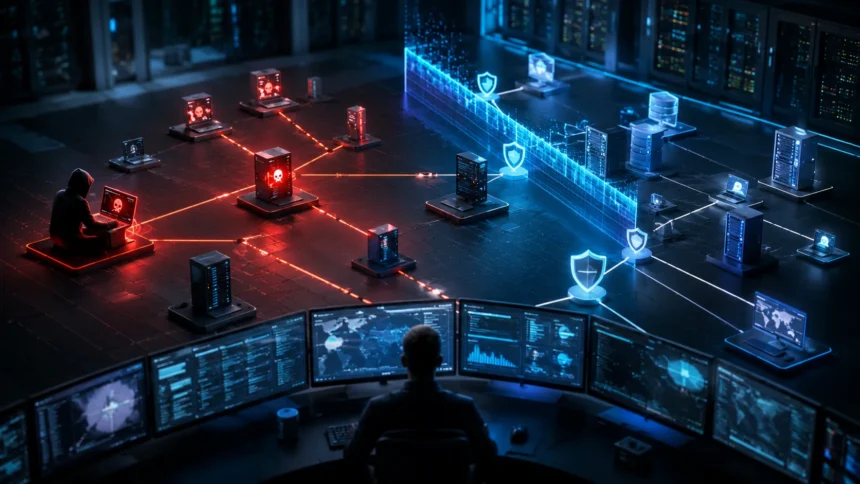
Lateral movement is a cybersecurity technique attackers use to move from one compromised account, device, or system to other parts of a network. Instead of remaining on the first machine they access, attackers attempt to expand their reach until they find valuable data, privileged accounts, critical servers, or other high-value assets.
This stage of a cyberattack can be particularly dangerous because the initial compromise may appear relatively minor. A stolen employee password or infected workstation can become the starting point for a much broader intrusion if the attacker finds trusted connections, reusable credentials, excessive permissions, or poorly segmented systems.
Modern organizations face additional challenges because infrastructure now extends across traditional networks, cloud environments, remote endpoints, SaaS platforms, and hybrid identity systems. Attackers may therefore move between devices, user accounts, applications, and cloud resources rather than following one simple path through a physical network.
Understanding how lateral movement works helps security teams recognize suspicious behavior earlier and reduce the damage caused by a breach. Strong identity controls, network segmentation, endpoint monitoring, least privilege, multifactor authentication, and rapid incident response can make it significantly harder for attackers to move freely.
What Is Lateral Movement in Cybersecurity?
Lateral movement refers to the process of moving from one compromised resource to another after initial access has already been achieved. The attacker may begin with a single employee account, endpoint, application, or exposed service and then search for additional systems that provide greater access.
The goal is usually not movement for its own sake. Attackers move laterally because the first compromised system rarely contains everything they want. They may be searching for administrator credentials, customer information, financial data, intellectual property, databases, backups, cloud consoles, or systems that can help them maintain persistence.
Lateral movement can involve legitimate administrative technologies because attackers often prefer tools already trusted within an environment. Remote management services, shared credentials, authentication protocols, file-sharing systems, and enterprise administration software can all become part of an attack path when access controls are weak.
For defenders, this means malicious behavior may initially resemble normal IT activity. Effective lateral movement detection therefore requires context, including who normally accesses a system, from where, at what time, through which protocol, and whether the sequence of activity matches expected business behavior.
Why Attackers Use Lateral Movement
An attacker who compromises a normal employee account may have only limited permissions. That account might provide access to email and a workstation but not sensitive databases or administrative systems, so the attacker needs to find a path toward more valuable resources.
Lateral movement also allows attackers to increase persistence. If defenders remove malware from the original device but the attacker has already compromised several other accounts or systems, removing the initial infection may not eliminate the broader intrusion.
Another goal is privilege escalation. Attackers often search for credentials, sessions, misconfigurations, and trusted relationships that can provide higher permissions. Moving from a standard user account to an administrator-level identity can significantly expand what an attacker can access.
In ransomware incidents, lateral movement can be particularly important because attackers may attempt to reach many endpoints and servers before disruptive activity begins. The wider the attacker can spread, the greater the potential operational impact once files, services, or backups are targeted.
How Lateral Movement Usually Begins
Lateral movement generally starts after an attacker gains an initial foothold. That foothold might come from phishing, stolen credentials, malware, exploitation of an exposed vulnerability, compromised third-party access, or another form of unauthorized entry.
Once inside, the attacker typically tries to understand the surrounding environment. They may look for accessible systems, user relationships, administrative privileges, shared resources, cloud services, or signs that a compromised account has access to additional areas.
Credentials are often central to this process. Weak passwords, reused passwords, cached credentials, excessive service-account permissions, and poorly protected administrator accounts can create paths that allow one compromised identity to unlock several additional resources.
This is why preventing initial compromise is only one part of cybersecurity. Organizations must also assume that a user or endpoint could eventually be breached and design controls that limit what an attacker can reach afterward.
Common Lateral Movement Techniques
Attackers may abuse legitimate remote-access services when compromised credentials provide permission to use them. Technologies such as remote desktop tools, remote administration platforms, file-sharing services, and system-management interfaces can become attractive because organizations already depend on them.
Credential-based techniques are also common. Instead of exploiting a new software vulnerability on every machine, an attacker may attempt to reuse credentials, tokens, or authentication material obtained from a previously compromised system.
Another approach involves exploiting trust relationships between systems. A server that is allowed to communicate freely with many other internal resources can become a valuable stepping stone if it is compromised, particularly when internal traffic receives less scrutiny than internet-facing traffic.
Attackers may also move through cloud identities and applications. In hybrid environments, a compromised account can sometimes provide access to SaaS platforms, cloud storage, administrative portals, virtual machines, or connected applications without requiring traditional host-to-host movement.
Credential Theft and Lateral Movement
Credentials are among the most valuable assets during an intrusion because they can make malicious access appear legitimate. A valid username and password may allow an attacker to pass authentication checks without exploiting software vulnerabilities.
Attackers often look for credentials stored insecurely on endpoints, within configuration files, in browser sessions, or through compromised accounts. Administrator credentials are especially valuable because they may provide access to multiple devices or management tools.
Password reuse significantly increases the risk. If the same privileged credentials work across several servers or workstations, compromising one device can create an efficient path toward many others.
Organizations can reduce this risk through credential protection, unique administrator accounts, multifactor authentication, privileged access management, strong password policies, secure service-account practices, and controls that prevent high-value credentials from being unnecessarily exposed on lower-trust systems.
Pass-the-Hash and Related Credential Abuse
Pass-the-hash is a well-known example of credential abuse in which authentication material may be reused without requiring an attacker to know the original plaintext password. The concept demonstrates why protecting authentication secrets is just as important as protecting passwords themselves.
Similar risks can involve stolen tickets, tokens, cookies, or active sessions. Modern environments use many forms of authentication, and attackers may attempt to abuse whichever form provides them with continued access.
These techniques become more dangerous when privileged accounts authenticate broadly across many devices. Every additional endpoint that handles powerful credentials can become another place where those credentials or related authentication material might be exposed.
Defenders should reduce credential exposure, limit privileged logons, protect authentication systems, monitor unusual identity activity, and invalidate compromised sessions quickly. Strong identity hygiene can make many forms of credential-based lateral movement substantially harder.
Remote Services and Network Movement
Remote services are essential for legitimate administration, but they can also provide pathways between systems. It includes, Desktop Protocol, file-sharing services, secure remote administration, and enterprise management tools may all be abused when attackers obtain sufficient permissions.
The security issue is not simply that these services exist. The greater concern is when they are available broadly across the network without appropriate access controls, monitoring, segmentation, or authentication requirements.
Administrative protocols should generally be accessible only to the systems and users that genuinely need them. Restricting management traffic can dramatically reduce the number of possible paths available after an endpoint becomes compromised.
Monitoring remote connections also helps reveal abnormal behavior. A normal employee workstation suddenly initiating administrative connections to multiple servers, for example, may deserve investigation even when the underlying protocol itself is legitimate.
Lateral Movement vs Privilege Escalation
Lateral movement and privilege escalation are closely related but describe different objectives. Privilege escalation means gaining greater permissions, while lateral movement means expanding access to additional systems, accounts, or resources.
An attacker might escalate privileges on one compromised workstation before attempting to move elsewhere. Alternatively, they may move laterally using an ordinary account and later discover a system where higher-level credentials become available.
The two processes often reinforce each other. Greater privileges can unlock more movement opportunities, while movement to a new system may provide access to stronger credentials that enable further privilege escalation.
Security teams should therefore investigate attack sequences rather than viewing suspicious events in isolation. An unusual login, permission change, remote connection, and credential alert may together reveal a much larger intrusion path.
Lateral Movement vs Initial Access
Initial access describes how an attacker first enters an environment. Phishing, stolen passwords, exposed remote services, malicious downloads, software vulnerabilities, and compromised vendors are common examples of initial access methods.
Lateral movement occurs after that entry. The attacker already has some access and is now attempting to extend their reach to systems that were not part of the original compromise.
This distinction matters because security controls that prevent initial access are not always effective against internal movement. A firewall protecting internet-facing systems, for example, may do little to stop communication between two internal devices that are allowed to trust each other.
A mature security strategy therefore uses defense in depth. Email security, endpoint protection, identity controls, network segmentation, monitoring, Zero Trust principles, and incident response should work together so one successful entry point does not automatically lead to a major breach.
Why Lateral Movement Is So Dangerous
The biggest danger is that lateral movement turns a local compromise into an organization-wide incident. A single infected laptop may initially represent limited exposure, but movement into file servers, identity infrastructure, cloud services, or production systems can multiply the impact.
It can also make attackers harder to remove. Once several accounts and systems are compromised, incident responders must determine how far the attacker traveled rather than simply cleaning the first infected device.
Lateral movement increases the risk of data theft because it gives attackers opportunities to locate information that was not available from the original endpoint. Sensitive databases, intellectual property, customer records, financial documents, and internal communications can all become potential targets.
The technique can also enable ransomware, destructive attacks, and business disruption. If attackers reach critical administrative systems or backups, they may be able to affect many devices simultaneously and make recovery significantly more difficult.
Common Signs of Lateral Movement
Unusual authentication activity is one of the most valuable warning signs. Security teams should investigate logins occurring from unexpected devices, unusual geographic locations, unfamiliar network segments, or at times when the user normally does not work.
Another warning sign is a sudden increase in remote connections. One endpoint attempting to reach several servers or workstations through administrative protocols can indicate automated discovery or movement, particularly when the behavior is unusual for that user.
Changes in privilege may also be significant. New administrator memberships, unexpected service-account activity, unusual authentication failures followed by successful logins, or access to highly sensitive systems can all deserve further investigation.
No single alert automatically proves lateral movement. Effective detection relies on combining endpoint telemetry, network activity, identity logs, authentication events, cloud logs, and behavioral context to identify suspicious sequences that would otherwise look ordinary.
How EDR Helps Detect Lateral Movement
Endpoint Detection and Response, or EDR, provides visibility into behavior occurring on laptops, workstations, and servers. It can help defenders detect unusual process activity, suspicious credential access, unexpected administrative tools, and abnormal remote connections.
EDR is particularly valuable because lateral movement frequently involves legitimate operating-system features. Traditional antivirus software may not consider a trusted administrative utility malicious, while behavioral monitoring can identify when that utility is being used in an unusual context.
Centralized endpoint data also allows security teams to connect activity across multiple machines. An investigation can show whether the same account, process, or network destination appeared on several endpoints during the same period.
However, EDR works best as part of a broader strategy. Identity monitoring, network visibility, SIEM correlation, vulnerability management, and segmentation provide additional context that endpoint telemetry alone may not reveal.
Use Network Segmentation to Limit Movement
Network segmentation divides an environment into smaller security zones instead of allowing every device to communicate freely with every other device. Proper segmentation reduces the number of systems an attacker can reach after compromising one endpoint.
For example, ordinary employee workstations generally do not need unrestricted access to database servers, backup infrastructure, or domain administration systems. Firewall rules and access controls can restrict those connections to specific approved services.
Microsegmentation applies the same concept more precisely by controlling communication between individual workloads, applications, or devices. This approach is particularly useful in cloud and data-center environments where traditional network boundaries may be less clear.
Segmentation does not prevent every compromise, but it reduces the blast radius. Even if an attacker gains access to one segment, reaching another becomes more difficult and may generate additional security alerts.
Apply Zero Trust Principles
A Zero Trust security model assumes that location alone should not make a user or device trustworthy. Being inside the corporate network should not automatically grant broad access to applications, servers, or sensitive data.
Instead, access decisions can consider identity, device health, authentication strength, location, application sensitivity, and other contextual signals. Users receive the specific access needed for their responsibilities rather than broad network-level trust.
This approach directly reduces lateral movement opportunities because compromising one account does not necessarily provide unrestricted access to everything that account can technically reach from the network.
Zero Trust is not one product that can simply be installed. It is an architectural approach built through identity security, least privilege, segmentation, continuous verification, strong authentication, device management, and detailed monitoring.
Enforce Least Privilege Access
Least privilege means giving users, applications, and services only the permissions they genuinely require. Excessive access creates unnecessary attack paths that become especially dangerous when an account is compromised.
Administrator accounts should be separated from everyday user accounts whenever practical. Employees who browse the web and read email usually do not need the same credentials used for managing servers or sensitive infrastructure.
Service accounts also deserve close attention because they may remain active for years and sometimes have permissions far beyond their current business purpose. Regular access reviews can identify outdated accounts and unnecessary privileges.
Reducing privileges does more than prevent unauthorized changes. It also limits the number of systems an attacker can access, making lateral movement slower, noisier, and easier for defenders to detect.
Strengthen Identity Security With MFA
Multifactor authentication adds another verification requirement beyond a password. If an attacker steals only the password, MFA can prevent that credential from immediately providing access to additional systems.
MFA is especially important for administrator accounts, remote access, cloud platforms, email, identity providers, and other high-value services. Stronger authentication around these systems can interrupt attack paths before they reach critical infrastructure.
Organizations should also consider phishing-resistant authentication methods where appropriate. Some older forms of MFA remain vulnerable to social engineering, repeated prompts, or interception, so authentication strength matters as much as simply enabling a second factor.
Identity monitoring should complement MFA. Impossible travel, unusual devices, repeated authentication failures, unexpected privilege use, and suspicious session activity can provide early warning that an account is being misused.
Protect Privileged Accounts
Privileged accounts can dramatically expand an attacker’s reach, which makes privileged access management an important defense against lateral movement. These identities should be protected more carefully than ordinary user accounts.
Administrative credentials should not be used for routine activities such as email, general web browsing, or everyday productivity tasks. Separating administrative and standard user activity reduces the opportunities for powerful credentials to be exposed.
Just-in-time access can reduce risk further by granting elevated permissions only when they are required and removing them afterward. This is safer than leaving administrator privileges permanently assigned to large numbers of accounts.
Organizations should also monitor privileged sessions closely. A highly privileged account accessing unusual servers, operating at an unexpected time, or performing unfamiliar actions should trigger greater scrutiny than normal low-risk activity.
Patch Vulnerabilities and Reduce Attack Paths
Although lateral movement frequently involves credentials, software vulnerabilities can also help attackers expand access. Systems running outdated operating systems, applications, or network services may provide additional opportunities after the initial compromise.
A strong vulnerability management program identifies missing patches, prioritizes weaknesses based on actual risk, and ensures critical systems receive attention before attackers can use them as stepping stones.
Removing obsolete services can be just as important as installing updates. Every unnecessary protocol, legacy application, or exposed management interface increases the potential attack surface available inside the network.
Asset inventory is therefore essential. Security teams cannot properly protect or patch systems they do not know exist, making accurate visibility into endpoints, servers, applications, and cloud workloads a foundational control.
Monitor East-West Network Traffic
Traditional cybersecurity often focuses heavily on north-south traffic moving between the internet and an organization. Lateral movement, however, frequently occurs through east-west traffic moving between internal devices and workloads.
Monitoring internal communication helps identify behavior that perimeter controls may miss. Unexpected connections between user workstations, unusual server-to-server traffic, or sudden increases in administrative protocols can all provide useful clues.
Network Detection and Response tools can help establish normal communication patterns and highlight deviations. When combined with identity and endpoint data, network telemetry can reveal sequences that are difficult to recognize from individual logs.
Visibility should focus on meaningful risk rather than collecting data without context. Security teams need clear baselines, prioritized detections, and investigation workflows so important anomalies do not disappear inside an overwhelming number of alerts.
Secure Remote Access
Remote work has increased the importance of secure remote-access controls. VPNs, remote desktop services, virtual desktops, remote support platforms, and cloud management tools can all become valuable targets for attackers.
Organizations should require strong authentication, restrict remote administrative access, keep remote-access software updated, and remove services that are no longer needed. Exposing management interfaces directly to the internet should be avoided whenever safer architectures are available.
Access should also be limited according to role. An employee who needs access to one business application does not necessarily need broad connectivity to internal servers or management networks.
Security teams should monitor remote sessions for unusual behavior, including unexpected devices, abnormal locations, unusual times, and connections to resources the user does not normally access.
How SIEM Can Reveal Attack Paths
A Security Information and Event Management platform, or SIEM, can bring together logs from identity providers, endpoints, servers, firewalls, cloud services, and business applications.
This centralization is valuable because lateral movement usually creates signals across several technologies rather than one obvious alert. A suspicious login followed by a remote connection and privilege change may become meaningful only when the events are viewed together.
Correlation rules and behavioral analytics can help identify these sequences. Teams can also create detections around unusual authentication patterns, unexpected administrative access, rapid movement between systems, and sensitive-resource access.
SIEM effectiveness depends heavily on data quality. Collecting the right logs, maintaining accurate timestamps, preserving useful context, and regularly tuning detections are essential if defenders want to identify lateral movement quickly.
What to Do If Lateral Movement Is Detected
The first priority is containment. Security teams may need to isolate compromised endpoints, disable affected accounts, block suspicious network connections, and restrict access to critical systems while the investigation continues.
Containment should be coordinated carefully because attackers may already control several resources. Taking action on only the first visible system can leave other compromised accounts or devices active inside the environment.
Investigators should determine the scope of compromise by reviewing authentication history, endpoint activity, network connections, privileged account usage, cloud sessions, and access to sensitive systems. The goal is to reconstruct how the attacker entered and where they traveled.
After containment and eradication, credentials may need to be reset, sessions revoked, systems rebuilt, vulnerabilities patched, persistence removed, and security rules strengthened. Lessons from the incident should then be converted into lasting improvements rather than treating recovery as the final step.
How to Stop Lateral Movement Before It Spreads
The strongest defense combines multiple controls rather than depending on one security product. Start by limiting privileges, segmenting the network, protecting administrator accounts, strengthening authentication, and reducing unnecessary connections between systems.
Next, improve visibility. Endpoint detection, identity monitoring, network telemetry, cloud logging, and SIEM correlation can reveal suspicious movement earlier and shorten the time attackers remain undetected.
Regularly test access relationships as well. Ask whether ordinary users can reach sensitive servers, whether administrative credentials appear on lower-trust machines, and whether service accounts have permissions they no longer require.
Finally, practice incident response. Teams that already know how to isolate endpoints, revoke sessions, disable accounts, preserve evidence, and communicate during an attack can contain lateral movement attacks much faster when a real incident occurs.
Final Thoughts on Lateral Movement
Lateral movement is one of the most important stages to understand in modern cyberattacks because it explains how a relatively small compromise can evolve into a major breach. The attacker uses existing trust, credentials, remote services, and weaknesses to move toward more valuable systems.
The most effective defense is to make every step harder. Least privilege reduces available permissions, segmentation restricts connectivity, MFA protects identities, EDR improves endpoint visibility, and Zero Trust reduces automatic confidence based solely on network location.
Detection matters just as much as prevention. Organizations should monitor authentication behavior, internal network traffic, privileged access, endpoint activity, and cloud sessions so suspicious movement can be identified before attackers reach critical assets.
Security teams should ultimately design environments with the expectation that initial compromise is possible. When systems are segmented, identities are protected, privileges are tightly controlled, and suspicious behavior is visible, lateral movement becomes far more difficult and easier to contain.
Frequently Asked Questions About Lateral Movement
What is lateral movement in cybersecurity?
Lateral movement is the process attackers use to move from one compromised system or account to other resources within an environment. The goal is often to reach sensitive data or higher privileges.
What is an example of lateral movement?
A common example is an attacker compromising an employee workstation and then using stolen credentials to access another authorized internal system. The movement expands the attacker’s reach beyond the original device.
How can lateral movement be detected?
Security teams can monitor unusual logins, remote connections, privilege changes, internal network traffic, endpoint behavior, and unexpected access to sensitive systems using EDR, SIEM, and identity monitoring.
How does network segmentation stop lateral movement?
Network segmentation limits which devices and systems can communicate with one another. If one endpoint is compromised, segmentation reduces the number of other resources the attacker can reach directly.
What is the best way to prevent lateral movement?
Use multiple controls together, including least privilege, MFA, network segmentation, Zero Trust, privileged access management, endpoint monitoring, secure remote access, patching, and strong incident response.