

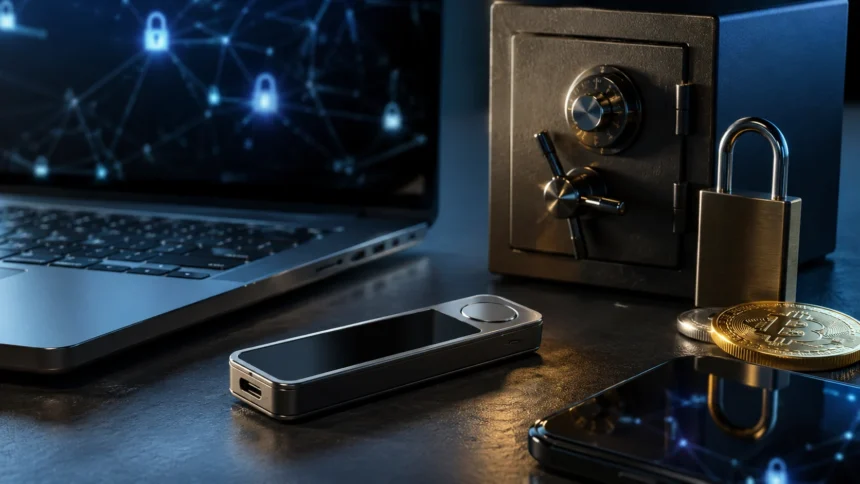
Cold Wallet Security Explained: How Safe Is Offline Crypto Storage?
If you own cryptocurrency for the long term, protecting access to it is just as important as deciding what to buy. Exchanges, mobile wallets, browser extensions, and other online services make cryptocurrency convenient to use, but convenience can increase exposure to phishing, malware, account compromise, and other online threats. This is why many cryptocurrency holders eventually ask, are cold wallets safe for cryptocurrency storage? In general, cold storage is considered one of the stronger ways to protect private keys because those keys are kept away from continuously internet-connected environments.
A cold wallet is a cryptocurrency wallet designed to keep the private keys required to authorize transactions offline. The cryptocurrency itself is not physically stored inside the wallet. Coins and tokens remain recorded on their respective blockchains, while the wallet protects the credentials that allow the owner to control them. This distinction is important because losing the physical device does not necessarily mean losing the cryptocurrency if the wallet has been backed up correctly. Conversely, someone who obtains the recovery phrase may be able to access the assets even without possessing the original device.
Cold wallets can significantly reduce certain cybersecurity risks because attackers cannot simply reach an offline private key through an internet connection. Hardware wallets are the most familiar form of modern cold storage, although other offline key-management methods also exist. A hardware wallet can create and protect private keys within a dedicated device and sign transactions without exposing those keys directly to the connected computer. This separation provides an important security layer, particularly when compared with private keys stored entirely on a general-purpose computer or smartphone.
However, cold wallet security is not automatic. Moving cryptocurrency offline changes the kinds of risks a user faces rather than eliminating risk altogether. An attacker may not be able to remotely extract a properly protected private key, but they may still trick the owner into revealing a recovery phrase, approving a malicious transaction, installing fraudulent software, or sending cryptocurrency to the wrong address. Physical theft, fire, water damage, forgotten passphrases, poorly stored backups, and inheritance problems can also lead to permanent losses.
The most accurate answer is therefore that cold wallets can be highly secure when they are set up, backed up, and used correctly. They are particularly attractive for cryptocurrency that does not need to be moved frequently. Their biggest advantage is reducing exposure to online key theft, while their biggest challenge is transferring much of the responsibility for security to the owner. Understanding that trade-off is essential before deciding whether cold cryptocurrency storage is suitable for your needs.
What Is a Cold Wallet and How Does It Work?
A cold wallet is essentially a method of keeping cryptocurrency private keys offline. Every blockchain wallet involves cryptographic keys that authorize transactions. The public address can be shared so other people can send assets to the wallet, while the private key must remain secret because it provides control over those assets. Cold storage isolates this sensitive information from ordinary internet-connected environments, making remote theft substantially more difficult than it would be if private keys were constantly accessible through an online application.
Most people encounter cold storage through a crypto hardware wallet. These small physical devices are specifically designed for managing private keys and signing transactions. During setup, the wallet generates the cryptographic information needed to control blockchain addresses and provides a recovery backup, often represented by a sequence of words. The private keys remain protected by the wallet rather than being stored openly on the user’s laptop or phone. When a transaction needs approval, the hardware wallet performs the signing process within its protected environment.
It is important to understand that connecting a hardware wallet to a computer does not necessarily mean the private key itself becomes exposed to the internet. The computer can prepare transaction information and send it to the wallet, while the device signs the transaction internally. The signed transaction can then be broadcast to the blockchain. This design allows cryptocurrency owners to use their assets while preserving separation between private keys and the general-purpose computer, which may have a much larger attack surface.
Some cold-storage arrangements go further by using air-gapped wallets, where transaction information is transferred without directly connecting the signing device to an internet-connected computer. Depending on the system, QR codes, removable media, or other methods may be used to move transaction data. Air-gapping can reduce certain communication risks, although it also adds complexity. Greater technical complexity is not automatically safer if the owner does not fully understand the process and accidentally creates new opportunities for mistakes.
The fundamental security idea is straightforward: sensitive signing keys are safer when unnecessary exposure is minimized. Cold storage achieves this by separating the key from everyday internet activity. Yet the wallet remains only one part of a larger security system. Recovery backups, software installation, transaction verification, physical security, passwords or PINs, and the user’s behavior all contribute to the final level of protection. A secure device cannot compensate for a recovery phrase willingly entered into a fraudulent website.
Are Cold Wallets Really Safer Than Hot Wallets?
In many situations, cold wallets provide stronger protection against remote attacks than hot wallets because hot wallets operate on internet-connected devices. Mobile applications, desktop wallets, and browser-extension wallets may need private keys or signing functionality available within environments that regularly interact with websites, applications, downloads, messages, and networks. Modern software wallets can still use strong security measures, but internet connectivity creates a larger collection of potential attack paths that cold storage is designed to reduce.
Imagine malware compromises a laptop containing a software wallet. Depending on the wallet’s architecture and the nature of the compromise, an attacker might attempt to steal credentials, manipulate transactions, monitor clipboard contents, or deceive the user through fraudulent interfaces. With a properly used hardware wallet, the private key remains isolated from the compromised computer. The attacker may still attempt to manipulate what the user sees, but extracting the key itself becomes substantially more difficult.
That does not mean every cold wallet is automatically safer than every hot wallet in every circumstance. Security depends on implementation and user behavior. A carefully protected hot wallet containing a modest spending balance may be more sensible than a poorly configured cold wallet whose recovery phrase is photographed and uploaded to cloud storage. Likewise, someone who repeatedly approves unknown smart-contract transactions from a hardware wallet may expose assets despite having excellent private-key isolation.
Hot wallets also provide advantages in convenience. Someone who frequently trades, uses decentralized applications, makes payments, or moves assets may find constant hardware-wallet confirmation inconvenient. This is why many experienced users separate funds according to purpose. A smaller amount intended for regular activity can remain in a hot wallet, while longer-term holdings stay in cold storage. This approach resembles keeping spending money accessible while storing larger reserves in a more protected location.
For long-term cryptocurrency holdings, the balance generally favors cold storage because everyday accessibility is less important than reducing attack exposure. For frequent transactions, a combination of hot and cold storage may provide a more practical balance. The question therefore should not simply be cold wallet vs hot wallet: which is better? A better question is which wallet should protect which assets based on how frequently they need to be accessed and what risks the owner is prepared to manage.
Why Cold Wallets Are Considered Secure for Cryptocurrency
The biggest security advantage of a cold wallet is the isolation of private keys. Remote attackers constantly search for credentials exposed through phishing sites, malicious browser extensions, infected applications, compromised computers, and fraudulent downloads. If the private key remains securely inside an offline or isolated signing device, many of these attacks cannot simply retrieve it. The attacker must instead find another path, such as deceiving the user into revealing recovery information or authorizing a harmful transaction.
Dedicated hardware also reduces dependence on the security of a general-purpose computer. A laptop has an operating system, web browser, email client, communication software, downloaded files, browser extensions, and numerous other applications. Every component can potentially create vulnerabilities. A hardware wallet has a much narrower purpose: protecting cryptographic secrets and signing transactions. Reducing functionality can help reduce the number of ways sensitive information becomes exposed, although the quality of individual wallet designs still matters.
Another advantage is transaction verification on the hardware device. Good security practice involves reviewing important transaction details on the trusted device rather than relying solely on information displayed on a computer screen. Malware may attempt to replace a copied cryptocurrency address with an attacker’s address or manipulate what appears in an application. Checking the destination address and other relevant details before approval adds another barrier against this kind of manipulation.
Cold wallets also give users direct control over their private keys. Cryptocurrency stored through a custodial service generally depends on that organization to safeguard assets and maintain withdrawals. Self-custody removes that particular counterparty dependency because the owner controls the keys. However, eliminating custodial risk introduces personal responsibility. There may be no conventional password-reset process capable of restoring access when critical recovery information is permanently lost.
The resulting security model is powerful but unforgiving. Instead of trusting an exchange account, email account, and password-recovery system, the owner protects cryptographic credentials directly. This is why offline crypto storage is often described as highly secure but not necessarily effortless. The technology can provide strong defenses against online theft, but successful self-custody depends on disciplined backup management, careful transaction verification, and an understanding that blockchain transfers are generally difficult or impossible to reverse.
What Are the Biggest Risks of Using a Cold Wallet?
The most important cold-wallet risk is usually not someone breaking the encryption of the device. It is compromise of the seed phrase or recovery phrase. This backup can recreate access to the wallet, which means anyone who obtains it may be able to control the associated cryptocurrency. Storing a seed phrase in email, cloud notes, photographs, messaging applications, passwordless documents, or other online locations can undermine the entire purpose of cold storage because the backup becomes remotely accessible.
Phishing is another major threat. Criminals may impersonate wallet manufacturers, customer-support agents, exchanges, security teams, or popular cryptocurrency services. A message might claim that the wallet needs verification, migration, synchronization, or emergency recovery. The victim is then directed to a fraudulent website that asks for the recovery phrase. Hardware wallets cannot protect cryptocurrency after the owner voluntarily provides the master recovery information to an attacker, which is why legitimate support processes should never require users to disclose their secret recovery phrase.
Physical loss and damage are also important considerations. Hardware devices can be lost, stolen, destroyed in fires, damaged by water, or simply stop functioning. A properly protected recovery backup allows the wallet to be restored on a compatible replacement, meaning the device itself should not be treated as the only copy of access information. On the other hand, keeping multiple backups carelessly can increase the number of places where an attacker might discover them. Backup resilience and backup confidentiality therefore need to be balanced carefully.
Users can also lose cryptocurrency through transaction mistakes. Blockchain transfers may be irreversible, so sending funds to an incorrect address or using an incompatible network can have serious consequences. Cold storage does not change this fundamental characteristic. Before moving large amounts, users should carefully verify addresses, networks, transaction details, and supported assets. A small test transaction can sometimes help confirm that the receiving setup is working as expected before a significantly larger transfer is made.
Another risk involves excessive complexity. Advanced methods involving multiple backups, passphrases, multisignature configurations, geographic distribution, and specialized hardware can create impressive security on paper. Yet every additional component introduces another process the owner must remember and maintain. A security system that is too complicated to use reliably can become its own vulnerability. The strongest setup is usually one that protects against realistic threats while remaining understandable enough for the owner to operate and recover correctly.
Can a Cold Wallet Be Hacked?
The phrase “Can a cold wallet be hacked?” requires some nuance because different kinds of compromise are often grouped under the word hacking. A well-designed hardware wallet makes direct remote extraction of private keys substantially more difficult because those keys are not ordinarily exposed to the internet-connected computer. However, no physical or digital security product should be assumed to be completely invulnerable under every possible attack scenario.
Attackers may target the surrounding environment instead of attacking the cryptography directly. They may distribute fraudulent wallet applications, create convincing phishing websites, compromise a user’s computer, replace destination addresses, or manipulate transaction instructions. The hardware device may continue protecting its private key perfectly while the owner is deceived into signing a malicious transaction. This is why reviewing transaction information matters just as much as owning the physical device.
Physical access can create another category of threats. Sophisticated attackers may attempt to tamper with devices, exploit weaknesses in hardware, or obtain sensitive information through physical attacks. The practical likelihood varies depending on the device, threat model, and value being protected. Most ordinary users are more likely to encounter phishing, scams, poor backups, or user mistakes than an advanced laboratory attack, but physical security should still be considered when protecting significant holdings.
Supply-chain manipulation is another reason users should think carefully about where devices come from. A compromised device or fraudulent setup process might attempt to trick the owner into using recovery information already known to an attacker. A new hardware wallet should normally generate its recovery information during a trusted initialization process rather than arriving with a pre-written seed phrase that the purchaser is instructed to use. Suspicious packaging or unexpected setup instructions should be treated cautiously.
So while cold-wallet hacking is theoretically possible in certain contexts, “hacking the wallet” is often not how real cryptocurrency losses occur. Attackers usually look for easier weaknesses involving people, backups, computers, or transaction approval. Security therefore requires a layered mindset. The hardware wallet protects one extremely important component—the private key—but the owner must still protect the processes surrounding that key.
Why Your Recovery Phrase Matters More Than the Device
The recovery phrase is one of the most important elements of a self-custody wallet because it can often recreate the cryptographic keys controlling the funds. This means the phrase is not simply a password for the physical device. It can represent the underlying backup to the wallet itself. Someone who steals the hardware wallet but cannot unlock it may face significant barriers, while someone who obtains the recovery phrase may not need the original hardware device at all.
This is why taking a screenshot of a recovery phrase can create unnecessary risk. Screenshots may be backed up automatically, synchronized with cloud services, copied between devices, included in system backups, or exposed through account compromise. Typing the phrase into an ordinary website or computer also moves it from an offline environment into one that may be monitored. The safest mindset is to treat recovery words like physical master keys that should remain offline unless they are genuinely required for a legitimate wallet recovery procedure.
Physical backups create their own considerations. Paper is simple and accessible but can deteriorate, burn, become wet, fade, or be accidentally discarded. More durable backup materials may provide greater resistance to environmental damage, but physical durability does not protect against theft. Whatever method is used, the backup should be stored somewhere that protects it from both accidental destruction and unauthorized access. The right solution depends on individual circumstances and threat concerns.
Some wallets also support an additional passphrase that creates another layer beyond the standard recovery words. This feature can strengthen certain security models because the recovery phrase alone may not reveal the intended wallet without the additional passphrase. However, passphrases can also introduce serious recovery risk. If the owner forgets the exact passphrase, there may be no organization capable of restoring access. Such features should therefore be used only when their implications are fully understood.
The broader lesson is that buying a high-quality hardware wallet solves only part of the self-custody problem. If the device is carefully protected but the recovery phrase is stored in an easily compromised location, the overall system remains weak. Crypto seed phrase security should receive at least as much attention as the hardware itself because the backup may ultimately represent the most powerful route to recovering—or stealing—the wallet.
How to Use a Cold Wallet Safely
Start by obtaining wallet hardware through a trustworthy channel and carefully examining the setup process. A new wallet should allow the owner to initialize it securely rather than relying on recovery words supplied by another person. Never use a recovery phrase that arrives preprinted on a card or is sent through email, chat, or another external method. If setup instructions unexpectedly ask for secret recovery information on a website, stop and verify what is happening before proceeding.
Next, secure the recovery phrase completely offline. Do not photograph it, email it to yourself, place it in cloud storage, or paste it into an ordinary online document. Create a physical backup appropriate to the amount and importance of the assets being protected, and consider risks such as fire, water, theft, and unauthorized household access. The backup should be recoverable when genuinely needed but difficult for anyone else to discover or use.
Always verify cryptocurrency addresses carefully when sending funds. Malware can sometimes change addresses copied to a computer’s clipboard, and phishing interfaces can display fraudulent information. Compare the address shown on the hardware wallet itself with the intended destination rather than blindly trusting the computer screen. For important transfers, carefully review the network and asset being used as well. Similar-looking addresses and multiple blockchain networks make rushed transactions unnecessarily risky.
Keep the wallet’s software and firmware under controlled management. Updates may contain security improvements or compatibility changes, but update prompts themselves can be imitated by scammers. Use official wallet software and trusted update mechanisms rather than following links from unexpected emails, advertisements, direct messages, or search-result promotions. A sense of urgency—particularly claims that assets will disappear unless recovery words are entered immediately—is a common warning sign.
Finally, practice recovery planning before it becomes an emergency. Owners should understand what happens if the hardware wallet disappears, stops working, or needs replacement. They should also consider how legitimate heirs could access cryptocurrency if the owner dies or becomes incapacitated without simply exposing recovery information during normal life. Cold storage best practices involve not only preventing theft today but also ensuring authorized recovery remains possible years later.
Should You Keep All Your Cryptocurrency in Cold Storage?
Cold storage can be excellent for long-term holdings, but keeping every cryptocurrency asset in a cold wallet may not be practical for everyone. Users who interact frequently with decentralized applications, make regular payments, trade actively, or move cryptocurrency between services may find repeated cold-wallet approvals inconvenient. Constantly moving long-term reserves simply to perform everyday activities may also create unnecessary transaction exposure.
A common security concept is separating assets according to function. A hot wallet can contain the smaller amount needed for regular blockchain activity, while a cold wallet protects assets intended to remain untouched for longer periods. This limits the potential damage if the online wallet becomes compromised. Instead of exposing an entire portfolio whenever interacting with a new application, only the amount required for regular use remains readily accessible.
This separation can be especially useful with decentralized finance and Web3 applications. Connecting wallets to unfamiliar websites, signing smart-contract permissions, and approving token interactions can create risks that are different from simple long-term storage. Keeping a main reserve wallet separate from an active application wallet can reduce unnecessary interaction between valuable holdings and experimental online services. The cold wallet effectively becomes a vault rather than an everyday transaction account.
The appropriate split depends on personal needs rather than a universal percentage. Someone holding cryptocurrency purely for long-term purposes may rarely need a hot wallet, while someone regularly using blockchain applications may need a more active setup. The important principle is avoiding unnecessary exposure. Assets that do not need immediate access generally do not need to remain continuously available through an internet-connected wallet.
Cold storage should therefore be viewed as part of an overall cryptocurrency security strategy, not necessarily the only wallet a person can use. Different tools solve different problems. A secure setup may involve multiple wallets with clearly separated purposes so that compromise of one environment does not automatically expose everything. Simplicity remains important, however, because maintaining too many wallets and backups can create mistakes of its own.
Are Hardware Wallets and Cold Wallets the Same Thing?
The terms hardware wallet and cold wallet are often used interchangeably, but they do not mean exactly the same thing. A hardware wallet describes a physical device designed to manage cryptocurrency keys and sign transactions. Cold storage describes the broader security practice of keeping private keys offline. Hardware wallets are therefore one of the most practical and popular methods of implementing cold storage, but cold storage itself is a broader concept.
Historically, people have used offline computers, paper-based key storage, and other techniques to keep cryptocurrency keys disconnected from online systems. Some of these methods can technically qualify as cold storage but may introduce significant operational challenges. For example, manually creating and protecting raw private keys can lead to mistakes during key generation, backup, import, or transaction signing. Hardware wallets were developed partly to make secure key management more accessible.
A modern hardware wallet can also interact with an internet-connected computer or phone without directly exposing its private key. This sometimes causes confusion because users assume that plugging a device into a computer automatically turns it into a hot wallet. The important distinction is where the sensitive key exists and how transactions are signed. If the key remains isolated within the device and is not exported to the connected computer, the security model remains fundamentally different from a software wallet storing its keys directly on that computer.
Some users prefer air-gapped hardware wallets, which reduce or eliminate direct electronic connections with online computers during signing. This can add another layer of isolation, but air-gapping should not become a substitute for careful transaction verification. A malicious transaction can still be transferred through an offline channel and signed if the user does not understand what is being approved. Security depends on both isolation and informed authorization.
For most people researching cold cryptocurrency storage, a reputable hardware wallet will be the most familiar implementation. The important point is not the terminology itself but the security objective: private keys should be generated, stored, and used in ways that minimize unnecessary exposure. Understanding this principle makes it easier to evaluate different wallet technologies without relying entirely on marketing labels such as “cold,” “offline,” or “air-gapped.”
What Happens If You Lose a Cold Wallet?
Losing a hardware wallet does not automatically mean losing the cryptocurrency associated with it. The blockchain does not store cryptocurrency inside the physical device. Instead, the device protects the private keys used to authorize transactions. If the owner has a correct and secure recovery backup, they can generally restore access through an appropriate compatible wallet following the relevant recovery procedure. This is one reason recovery phrases are so important.
The situation becomes much more serious if both the device and all valid recovery information are lost. Self-custody systems generally do not provide a central company capable of resetting the private key after identity verification. If there is no remaining method of reconstructing the keys, the cryptocurrency may become permanently inaccessible. The blockchain can continue showing the balance at the address even though nobody is capable of moving it.
Physical theft creates a different concern. Hardware wallets normally use security measures such as PINs or other protections designed to prevent straightforward access by someone who finds the device. However, users should not assume physical loss is harmless, especially when significant value is involved. If a device is believed to be stolen and the owner has securely recovered access elsewhere, moving funds to a newly secured wallet may be considered depending on the circumstances and wallet architecture.
Backup planning should therefore begin before cryptocurrency is deposited rather than after the wallet is lost. Owners should ask themselves whether they could recover successfully if the device disappeared today. Where is the backup? Is it readable? Is it protected from theft? Does the owner remember any additional passphrase? Could someone else understand legitimate recovery instructions if necessary? These questions expose weaknesses before they become expensive emergencies.
A strong crypto wallet backup strategy balances two opposite risks: unauthorized people gaining access and the legitimate owner losing access. Maximizing secrecy without planning for recovery can be as dangerous as keeping backups everywhere. Cold-wallet security is therefore not simply about making theft difficult. It is about making unauthorized access difficult while ensuring authorized recovery remains reliable.
Can Cold Wallets Protect Against Exchange Hacks?
Moving cryptocurrency from a custodial exchange to a self-custody cold wallet changes who controls the private keys. When assets remain with an exchange, the customer generally relies on the platform’s custody infrastructure and withdrawal systems. If assets are withdrawn to a personally controlled wallet, the owner becomes responsible for protecting the keys. A compromise of the exchange after that withdrawal would not automatically provide the attacker with the private keys protected inside the user’s cold wallet.
This is one reason cold storage appeals to people concerned about exchange risk. Exchange accounts can potentially be affected by account takeovers, platform insolvency, withdrawal restrictions, operational failures, or large cybersecurity incidents. Self-custody removes some of these dependencies because blockchain access no longer relies on the exchange account. However, it does not remove the market risk of the cryptocurrency itself, nor does it guarantee that the user will manage custody correctly.
Moving assets away from an exchange also means giving up some conveniences. Centralized platforms may offer password recovery, account monitoring, customer support, and established processes for certain access problems. Self-custody places much more responsibility directly on the individual. If the owner reveals the recovery phrase to a scammer or permanently loses the required credentials, there may be no support department capable of reversing the outcome.
Users should also recognize that withdrawing cryptocurrency introduces a transaction step that must be performed correctly. The receiving address, blockchain network, and asset all need verification. Sending assets through the wrong network or to an incorrect address can create serious problems. Before transferring a large balance into cold storage, understanding the withdrawal and recovery procedures is more important than simply purchasing a device.
Cold storage therefore reduces a specific category of custodial and online-key risks rather than eliminating every risk associated with cryptocurrency. The owner trades dependence on a third-party custodian for greater personal responsibility. Whether that trade-off is worthwhile depends on the user’s knowledge, goals, and ability to maintain secure backups. For many long-term holders, that control is precisely why self-custody cold wallets are attractive.
Advanced Cold Wallet Security: Passphrases and Multisig
People protecting substantial cryptocurrency holdings sometimes consider additional security layers beyond a standard hardware wallet and recovery phrase. One option is a wallet passphrase, which can create a separate wallet derived from the underlying recovery information. When implemented correctly, this can reduce the usefulness of a stolen recovery phrase if the attacker does not also possess the additional secret. However, it creates another credential that must be remembered exactly.
Passphrase mistakes can be unforgiving. Unlike a website password, there may be no “forgot passphrase” button. Entering a different passphrase can generate a completely different wallet, which may make the intended funds appear missing even though nothing happened to the blockchain assets. Users considering this technique need to understand recovery thoroughly and decide whether the added security benefit outweighs the additional possibility of locking themselves out.
Another advanced technique is multisignature or multisig custody. Instead of allowing a single private key to authorize transactions, a multisignature setup can require multiple keys. For example, a configuration might require two out of three separate keys to approve spending. This reduces dependence on one device or one backup because compromising a single key may not provide sufficient authority to move the assets.
Multisig can also support geographic and organizational separation. Different keys can be protected in separate locations so that one burglary, fire, or device failure does not compromise the entire wallet. Businesses and sophisticated individuals may find this particularly useful. At the same time, multisig creates more operational complexity, including wallet coordination, key management, recovery planning, software compatibility, and inheritance considerations.
Advanced security should therefore solve a clearly identified problem rather than simply make a setup look sophisticated. For modest holdings, a carefully managed hardware wallet and strong offline recovery strategy may be easier to use safely than an elaborate architecture. For larger or institutional holdings, additional controls can become more valuable. Cryptocurrency storage security should always match both the value being protected and the user’s ability to operate the system correctly.
Common Cold Wallet Mistakes to Avoid
One of the worst mistakes is entering recovery words into a website because someone claims the wallet must be “verified.” Recovery phrases do not need to be provided to customer support, random websites, giveaway pages, or people contacting users through direct messages. A request for recovery words should be treated as an extremely serious warning. Scammers often create urgency specifically to stop victims from thinking carefully before revealing information.
Another mistake is storing seed phrases digitally for convenience. A photo on a smartphone may feel private, but devices synchronize data, applications access files, cloud accounts become compromised, and backups can persist long after the owner forgets about them. The security benefit of keeping keys offline becomes much weaker when the recovery mechanism is placed in an online environment. Recovery information deserves the same—or greater—protection as the hardware wallet itself.
Users also make mistakes when rushing transactions. Cryptocurrency addresses can be long and difficult to read, making it tempting to check only the first or last few characters. While partial checking is better than none, high-value transfers deserve careful verification through the trusted device. Selecting the wrong network, destination, or token can also create problems. Slowing down for important transactions is a simple security measure that costs very little.
Ignoring firmware and software authenticity creates another vulnerability. Users may search online for a wallet application and click sponsored or fraudulent results without noticing the difference. Fake applications can imitate trusted interfaces and attempt to steal recovery information. Wallet software should be obtained through known official channels, and unexpected communications claiming urgent security updates should be approached cautiously.
Finally, some owners never test whether they actually understand recovery. They store a recovery phrase somewhere and assume everything will work years later. Problems may appear when words were copied incorrectly, instructions were lost, additional passphrases were forgotten, or family members have no idea what to do after the owner’s death. Security planning should consider the full lifecycle of the wallet, including setup, ordinary use, device replacement, emergencies, and legitimate inheritance.
Who Should Consider Using a Cold Wallet?
Cold wallets are particularly useful for people who hold cryptocurrency over longer periods and do not need immediate access to the entire balance. If assets will remain untouched for months or years, keeping private keys continuously available on an internet-connected device may provide little benefit. Cold storage can reduce that exposure while still allowing the owner to access the assets when genuinely necessary.
They may also appeal to people who want self-custody of cryptocurrency rather than depending entirely on an exchange or other custodian. Self-custody provides direct control, but it should be approached as a responsibility rather than simply a feature. The owner needs to understand key security, recovery, phishing, transaction verification, and backup management before moving meaningful amounts into the wallet.
Beginners can use cold wallets successfully, but they should not rush the process. It is worth learning how cryptocurrency addresses, blockchain networks, recovery phrases, and transaction confirmations work before transferring a significant balance. Practicing with a small amount can make the workflow more familiar. A person who does not understand how to restore a wallet is not yet fully prepared for long-term self-custody, regardless of how expensive the hardware device may be.
Cold storage may be less convenient for cryptocurrency that is moved several times per day. Traders or active decentralized-application users may prefer keeping an operational balance in a hot wallet while protecting reserves separately. This reduces friction without placing all assets inside the environment receiving the greatest online exposure. Wallet separation can therefore improve both usability and risk management.
Ultimately, anyone considering a cold wallet should evaluate both security needs and personal capability. The technology is most useful when the owner values reduced online exposure and is comfortable taking responsibility for recovery. Buying a cold wallet does not automatically make cryptocurrency safe. Learning to operate it securely is what turns the device into an effective protection mechanism.
Conclusion: Are Cold Wallets Safe for Cryptocurrency Storage?
So, are cold wallets safe for cryptocurrency storage? In general, yes. Keeping private keys offline can provide strong protection against many remote attacks and is widely regarded as an effective approach for securing cryptocurrency that does not need constant access. Hardware wallets make this model more practical by isolating signing keys while still allowing users to authorize blockchain transactions when necessary.
However, a cold wallet is not a magic shield. Cryptocurrency can still be lost through stolen recovery phrases, phishing, fraudulent wallet software, malicious transactions, incorrect addresses, physical damage, poor backups, forgotten passphrases, and other forms of human error. The security advantage comes from reducing online key exposure, not from eliminating every route through which an owner can lose control of assets.
The recovery phrase deserves particular attention because it can be more powerful than possession of the physical device itself. Keeping the hardware wallet offline while storing a photograph of the seed phrase in cloud storage defeats much of the security strategy. Recovery information should remain private, protected, and recoverable without being unnecessarily exposed to internet-connected services.
For many cryptocurrency holders, a combination of storage methods can provide a practical balance. Assets intended for long-term holding can remain in cold storage, while a smaller hot wallet can handle regular transactions or decentralized applications. Separating these roles limits the amount exposed during everyday online activity without making every cryptocurrency transaction inconvenient.
Cold wallets are therefore best understood as powerful security tools that still require responsible users. When private keys remain isolated, recovery backups are carefully protected, transactions are verified, and phishing attempts are treated cautiously, cold cryptocurrency storage can be one of the strongest options available for self-custody. The safest wallet is ultimately not only the one with strong technology, but the one whose owner understands how to protect and recover it correctly.
Frequently Asked Questions About Cold Wallets
Are cold wallets 100% safe?
No cryptocurrency wallet is 100% risk-free. Cold wallets greatly reduce online exposure of private keys, but seed-phrase theft, phishing, physical loss, malicious transactions, and user mistakes can still result in lost cryptocurrency.
Can cryptocurrency be stolen from a cold wallet?
Yes, particularly if an attacker obtains the recovery phrase or tricks the owner into approving a malicious transaction. Proper cold storage makes remote private-key theft much more difficult, but the surrounding security practices still matter.
What happens if my cold wallet breaks?
If the wallet was backed up correctly, a damaged hardware device does not normally mean the cryptocurrency is lost. The recovery information can typically be used with an appropriate replacement wallet to restore access.
Is a cold wallet safer than keeping crypto on an exchange?
A properly managed cold wallet removes dependence on an exchange for custody and keeps private keys under the owner’s control. However, self-custody also makes the owner responsible for backups, recovery, transaction accuracy, and security.
Should beginners use a cold wallet?
Beginners can use cold wallets, especially for long-term cryptocurrency storage, but they should first understand seed phrases, addresses, networks, backups, and recovery. Practicing with a small amount can help reduce expensive mistakes.