

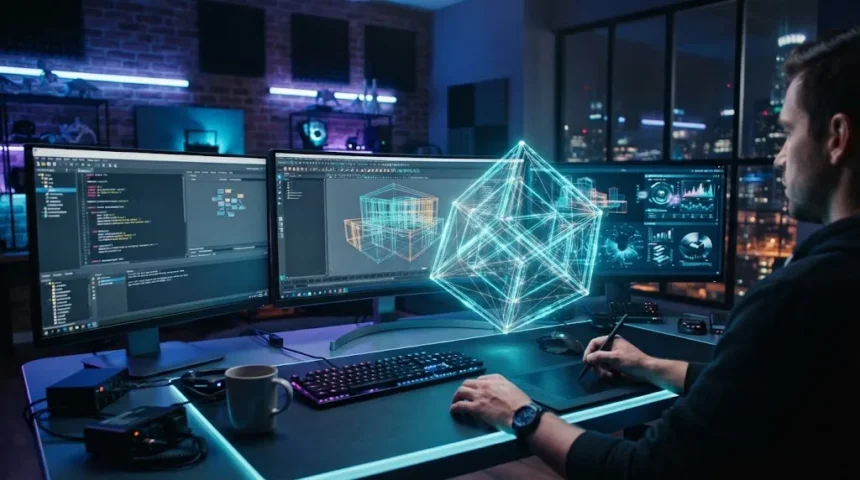
What Is 3D? Meaning, Examples & How It Works
3D means three-dimensional, describing an object, image, environment, or digital model that has three dimensions: width, height, and depth. Unlike a flat 2D image, which has only width and height, a 3D object appears to occupy space and can usually be viewed from different angles. Everyday objects such as cars, buildings, furniture, people, and smartphones are three-dimensional because they extend in multiple directions. In digital technology, 3D graphics simulate this depth mathematically so computers can create realistic objects, environments, animations, games, engineering designs, and visual effects. Understanding 3D makes many modern technologies easier to understand because three-dimensional modeling is used across entertainment, manufacturing, architecture, medicine, education, and product development.
Three-dimensional technology can represent real objects or create things that do not physically exist. A designer may build a 3D model of a new chair before manufacturing it, while a game developer can create an imaginary city containing buildings, vehicles, and characters. A 3D printer can turn certain digital models into physical objects, while 3D scanning can perform the opposite process by capturing the shape of an existing object digitally. Movies can also use stereoscopic techniques to create an illusion of depth for viewers. This guide explains what 3D means, how it works, the difference between 2D and 3D, common examples, 3D graphics, modeling, animation, printing, scanning, gaming, and the major benefits and limitations of three-dimensional technology.
What Does 3D Mean?
The term 3D is short for three-dimensional and refers to something that has width, height, and depth. These dimensions allow an object to occupy space rather than appearing completely flat. A cardboard box, for example, has a measurable width from side to side, height from bottom to top, and depth from front to back. A simple drawing of that box on paper is technically two-dimensional because the paper itself presents the visual information across width and height. Artists can create the illusion of depth through perspective, but a real box physically extends through all three dimensions.
In mathematics and computing, 3D space is often represented using three coordinate axes called X, Y, and Z. The X-axis commonly represents horizontal position, the Y-axis represents vertical position, and the Z-axis represents depth, although exact conventions can vary between software systems. A point in 3D space therefore requires three values to define its position. An object is created by arranging many points, edges, surfaces, or volumes within that coordinate system. Computers use these mathematical relationships to determine where an object exists and how it should appear when viewed from a particular camera angle.
Three-dimensional objects can usually be observed from multiple perspectives. Looking at a chair from the front reveals different information than looking at it from the side, back, top, or underneath. A 2D photograph captures only one visual projection of that chair, while a complete 3D model can contain enough geometry to show the object from many directions. This ability makes 3D especially useful for product design, engineering, architecture, and gaming. Users can rotate a model digitally to inspect areas that would not be visible in one flat picture.
The word 3D can also describe an illusion of depth rather than a physically three-dimensional object. A 3D movie still plays on a relatively flat screen, but separate images are presented to the viewer’s left and right eyes so the brain perceives depth. Video games also display three-dimensional environments on flat monitors by using perspective calculations, lighting, shadows, and motion. The screen remains two-dimensional physically, but the rendered scene behaves like a virtual 3D space. Context therefore determines whether 3D refers to physical geometry, digital modeling, or perceived visual depth.
A simple way to remember 3D meaning is that it adds depth to width and height. A square is 2D because it has width and height, while a cube is 3D because it also extends backward and forward. A circle becomes a sphere when represented as a three-dimensional volume. These comparisons make the concept easy to visualize. Whether used for real objects, computer graphics, movies, or engineering models, 3D describes information that includes enough spatial depth to represent or simulate a three-dimensional world.
2D vs 3D: What Is the Difference?
The main difference between 2D and 3D is the number of dimensions represented. A 2D object has width and height, while a 3D object has width, height, and depth. A rectangle drawn on a page is two-dimensional, while a physical box is three-dimensional. Similarly, a photograph presents a flat image of a person, while a 3D scan can represent the person’s shape from many angles. Adding depth changes how objects can be viewed, measured, manipulated, and understood, which is why 3D technology is valuable in many technical fields.
Two-dimensional graphics are often simpler to create and process because they require fewer calculations. Websites, logos, illustrations, diagrams, and many user interfaces use 2D graphics effectively because depth is unnecessary for their purpose. A weather icon does not need to exist as a complete 3D object to communicate whether it will rain. Flat graphics are also easier to render on lower-powered devices. This simplicity explains why 2D remains extremely important even though modern computers can create sophisticated three-dimensional environments.
Three-dimensional graphics become useful when spatial relationships matter. An architect needs to understand how rooms connect within a building, while a mechanical engineer needs to see how components fit together inside a machine. A game developer may need players to walk around objects and view them from different directions. A medical specialist may examine a 3D representation of anatomy to understand the location of structures relative to one another. The additional depth information makes 3D valuable when flat drawings would hide important relationships.
The visual style can also differ. Traditional 2D animation often uses drawings, shapes, or sprites that move across a flat plane, while 3D animation creates digital objects that can be moved through virtual space. A 3D character can be rotated around its body, illuminated from different directions, and viewed through a virtual camera. However, visual style does not always reveal the underlying technique. Artists can render 3D models to look like hand-drawn 2D illustrations, and 2D artwork can use perspective to look convincingly three-dimensional.
Neither 2D nor 3D is universally better. The correct format depends on what information needs to be communicated and how much complexity is justified. A simple chart may be clearer in 2D, while a building walkthrough benefits strongly from 3D. Product catalogs can combine flat photographs with interactive three-dimensional models. Many digital experiences use both approaches at once, such as a 3D game containing 2D menus and icons. The technologies complement each other rather than functioning as replacements.
How Does 3D Technology Work?
Three-dimensional computer graphics begin by representing objects mathematically inside a virtual coordinate system. Designers create points called vertices and connect them using edges and polygonal surfaces. Many 3D objects are constructed from triangles or other polygons because graphics hardware can process these shapes efficiently. A simple cube requires relatively few surfaces, while a detailed human face can contain thousands or millions of polygons. Together, these polygons form a digital mesh that defines the object’s shape. The computer then calculates how that mesh should look from the viewer’s position.
After geometry is created, materials and textures give surfaces their visual appearance. Geometry defines the shape of a wooden table, while textures can provide visible wood grain, scratches, color variation, and other details. Materials tell the rendering software how light should interact with the surface. A polished metal surface reflects light differently from rough concrete or transparent glass. Modern rendering systems can simulate properties such as reflectivity, transparency, roughness, and subsurface scattering. These calculations help transform basic geometry into visually convincing objects.
Lighting is another essential part of 3D graphics. Virtual lights can imitate sunlight, lamps, spotlights, glowing screens, or other illumination sources. The renderer calculates which surfaces receive light, which areas remain in shadow, and how light reflects between objects depending on the technique being used. Realistic lighting contributes heavily to the perception of depth because the human visual system uses highlights and shadows to understand shape. Even simple 3D models can look more believable when lighting is designed carefully.
A virtual camera determines the viewer’s perspective. The software calculates how objects should appear based on their location relative to the camera, similar to how a real camera captures the physical world. Objects farther away generally appear smaller because perspective projection recreates the geometric effect of distance. The camera can move, rotate, zoom, or change lens-like properties. Movies and games use these camera controls to guide attention and create different visual experiences. The same scene can feel completely different depending on the camera position.
Rendering converts the 3D scene into the final 2D image shown on a monitor. The computer calculates geometry, materials, lighting, shadows, reflections, and camera perspective before deciding the color of each screen pixel. Games need to perform this process many times every second to create smooth interaction, while animated movies can spend much longer calculating each frame for maximum quality. Real-time rendering prioritizes speed, while offline rendering can prioritize realism. Advances in GPUs and rendering software have significantly improved both approaches.
What Is 3D Modeling?
3D modeling is the process of creating a digital representation of a three-dimensional object or environment. Designers use specialized software to build shapes, surfaces, and details within a virtual space. Models can represent simple items such as cups and boxes or highly complex subjects such as cars, buildings, aircraft, human bodies, and entire cities. The modeling approach depends on the intended use. A game asset needs efficient geometry for real-time rendering, while an engineering model may require highly precise dimensions and manufacturing information.
Polygonal modeling is one of the most common techniques used in animation, games, and visual effects. Artists manipulate vertices, edges, and faces to construct a mesh representing the desired shape. They may begin with simple primitives such as cubes, cylinders, or spheres and gradually add detail. Tools allow surfaces to be extruded, cut, smoothed, or reshaped. Complex organic models can contain enormous numbers of polygons. Artists frequently balance geometric detail with performance requirements so the model remains efficient enough for its intended application.
Digital sculpting provides another modeling method, especially for characters, creatures, and organic objects. Instead of adjusting individual polygons constantly, artists use virtual brushes that behave somewhat like sculpting clay. They can push, pull, smooth, carve, and add surface details directly to the model. This approach can create extremely detailed forms such as wrinkles, skin texture, muscles, or rock surfaces. High-resolution sculpted models are often simplified afterward for animation or gaming while retaining detailed appearance through texture maps.
Computer-aided design, commonly called CAD, focuses more heavily on precise engineering geometry. Product designers, architects, mechanical engineers, and manufacturers use CAD software to create parts with exact dimensions and relationships. A machine component may need holes, surfaces, and tolerances positioned with great accuracy so it can be manufactured correctly. CAD models can also contain information about materials, assemblies, and measurements. This makes them different from artistic models whose primary purpose may be visual appearance rather than physical manufacturing accuracy.
Modern 3D modeling increasingly combines manual design with scanning, procedural generation, and artificial intelligence. A designer might scan a real object, clean the resulting geometry, and then modify it digitally. Procedural tools can generate large environments such as forests or cities according to rules instead of requiring every object to be placed manually. AI-assisted tools can accelerate repetitive tasks or help create starting geometry from other inputs. These technologies make 3D creation faster while still requiring human judgment for quality and design decisions.
3D Graphics in Games and Animation
Video games depend heavily on 3D graphics because players need to explore environments interactively. Developers create characters, buildings, landscapes, vehicles, weapons, furniture, and other assets as digital models. A game engine then combines these objects with lighting, physics, animation, sound, and gameplay logic. Unlike a movie where every camera movement is predetermined, a game often needs to render scenes according to the player’s actions. This means the computer must calculate 3D graphics in real time while maintaining a smooth frame rate.
Game assets are often optimized carefully because dozens or thousands may appear on the screen simultaneously. Highly detailed models can require more GPU processing, memory, and storage. Developers therefore create different levels of detail so distant objects use simpler geometry while nearby objects display more complexity. Textures and normal maps can simulate fine surface detail without adding excessive polygons. These techniques help modern games create visually rich worlds while maintaining acceptable performance on consumer hardware.
3D animation works by changing an object’s position, rotation, shape, or internal structure over time. Character models commonly use a digital skeleton called a rig. Animators move the bones within this rig, and the surrounding mesh deforms accordingly. This makes it possible to create walking, facial expressions, gestures, and other complex movements without reshaping the entire character manually for every frame. Motion capture can also record real human movement and apply the results to digital characters.
Animated films use many of the same core concepts as games but often prioritize image quality over real-time speed. Since filmmakers know exactly which frames need to appear, computers can spend much longer rendering realistic lighting, hair, fabric, reflections, smoke, water, and other complex effects. Large productions may distribute rendering work across many computers. The resulting frames are then assembled into sequences that play smoothly as video. Viewers see only the final images, not the underlying 3D models or rendering calculations.
Three-dimensional animation is also used outside entertainment. Businesses create product demonstrations, engineers visualize machinery, medical educators explain anatomy, and architects show clients how buildings will appear before construction begins. Training simulations can recreate hazardous environments without exposing learners to real danger. These applications demonstrate that 3D animation is not merely a visual entertainment technology. It is a general communication tool for explaining objects, movement, and spatial relationships that can be difficult to understand through static drawings alone.
3D Movies and Stereoscopic Vision
Three-dimensional movies create the illusion that objects have depth and may appear to extend in front of or behind the screen. The effect usually relies on stereoscopic vision, which takes advantage of the fact that human eyes view the world from slightly different positions. The brain combines these two perspectives to estimate depth. A 3D movie provides a slightly different image to each eye, recreating part of this natural visual process. Special glasses ensure the appropriate image reaches each eye separately.
Several technologies can separate the left-eye and right-eye images. Polarized 3D systems use glasses with different filters for each eye, while active-shutter systems can alternate images rapidly and synchronize electronic glasses with the display. Other approaches have also been developed for cinemas, televisions, headsets, and specialized screens. Regardless of method, the objective is to provide slightly different viewpoints so the brain interprets the scene as having depth. Without appropriate separation, the two images would simply overlap and look blurry.
Stereoscopic 3D should not be confused with ordinary three-dimensional computer graphics. A movie can be created entirely from 3D digital models but shown as a normal 2D presentation. Conversely, footage captured with stereoscopic cameras can create a 3D viewing effect even when the subject is completely real. The first use of 3D describes how content is constructed, while the second describes how depth is presented to the viewer. The two techniques are often combined, especially in animated and visual-effects-heavy films.
Comfort depends heavily on how stereoscopic depth is designed. Excessive separation between the left and right images can cause eye strain or discomfort for some viewers. Fast motion, poor alignment, or extreme depth effects can also make the experience unpleasant. Filmmakers therefore need to manage stereoscopic composition carefully rather than simply maximizing depth. The most effective 3D often uses subtle depth to support storytelling instead of constantly pushing objects dramatically toward the audience.
Virtual reality takes stereoscopic viewing further by presenting separate images continuously to each eye while tracking the user’s head movement. When the viewer turns their head, the virtual camera changes accordingly, creating the impression of existing inside the environment. Wide fields of view and responsive tracking increase immersion significantly. VR therefore combines 3D modeling, stereoscopic displays, real-time rendering, and motion tracking. It provides one of the clearest modern examples of digital technology using several 3D concepts simultaneously.
What Is 3D Printing?
3D printing is a manufacturing process that creates physical objects from digital three-dimensional models, usually by building material layer by layer. The process is also called additive manufacturing because material is added rather than removed from a larger block. A designer creates or obtains a 3D model, prepares it using specialized software, and sends the instructions to a compatible printer. The machine then produces the object according to the model’s shape. Different printing technologies use plastics, resins, metals, ceramics, concrete, and other materials depending on the application.
Before printing, software usually converts the 3D model into many thin horizontal layers. This preparation stage is commonly called slicing. The software determines how the printer should create each layer, including movement paths, material quantity, support structures, and other settings. Thinner layers can create smoother surfaces but may increase printing time significantly. The best settings depend on object geometry, printer technology, desired strength, surface quality, and material characteristics. Preparing a model correctly is therefore an important part of successful 3D printing.
Consumer 3D printers commonly use thermoplastic filament that is heated and deposited through a nozzle. The printer moves the nozzle across a build surface, placing material in one layer before moving upward and adding the next. Resin printers use light to cure liquid material into solid shapes with high detail, while industrial metal systems can use lasers or other energy sources to fuse powdered materials. These technologies follow different physical processes but share the principle of creating an object from digital geometry.
One advantage of 3D printing is the ability to manufacture complex shapes without creating expensive specialized tooling first. Engineers can produce prototypes quickly, test how parts fit together, and modify the design digitally before manufacturing another version. Customized medical devices, architectural models, replacement parts, manufacturing fixtures, and educational objects are common applications. Small production runs can also become economical because each object can be different without completely changing the manufacturing line.
Three-dimensional printing still has limitations. Production can be slow for large quantities, material properties may differ from conventionally manufactured parts, and printed surfaces can require additional finishing. Some objects need support structures that must be removed after printing. Machine cost and operating complexity vary significantly across technologies. 3D printing is therefore most valuable where customization, rapid prototyping, complex geometry, or low-volume production provides enough benefit to justify the process rather than automatically replacing every traditional manufacturing method.
What Is 3D Scanning?
3D scanning captures the shape and sometimes the appearance of a real-world object so it can be represented digitally. Instead of creating geometry manually from the beginning, scanning systems measure points on the object’s surface and use that information to construct a three-dimensional model. The result may initially appear as a point cloud containing millions of measured coordinates. Software can then convert these points into surfaces or polygonal meshes. Scanning is useful when accurately reproducing an existing object would be difficult through manual measurement alone.
Several scanning technologies exist. Laser scanners project light onto an object and measure how the reflected signal behaves, while structured-light systems project known patterns and analyze how those patterns deform across the surface. Photogrammetry creates 3D geometry by comparing many photographs taken from different angles. Depth cameras and specialized sensors can also estimate distance across a scene. Each approach offers different tradeoffs involving accuracy, speed, equipment cost, object size, and environmental conditions.
Manufacturing companies use 3D scanning for quality inspection and reverse engineering. A finished component can be scanned and compared with the original CAD model to determine whether its dimensions remain within acceptable tolerances. Engineers can also scan an older part for which original design files no longer exist and use the data as a starting point for redesign. This can reduce manual measurement effort significantly. High-precision industrial scanners can capture extremely small deviations when accuracy requirements are demanding.
Healthcare, entertainment, archaeology, and retail also use three-dimensional scanning. Medical professionals can capture body shapes for certain customized devices, while visual-effects teams scan actors, props, and environments for digital productions. Museums and researchers can create digital records of artifacts that may be fragile or difficult to transport. Retail applications can use scanning for virtual fitting or product visualization. The same core technology adapts well because many industries need accurate digital representations of physical objects.
Scan quality depends on the object and environment. Highly reflective, transparent, dark, moving, or extremely detailed surfaces can be difficult for certain scanners to capture accurately. Occluded areas may require additional scans from different angles. Data also needs cleaning because raw measurements can contain noise, missing areas, and unwanted background geometry. 3D scanning can greatly accelerate model creation, but producing a clean, usable result still often requires technical processing and human review.
Common 3D Examples in Everyday Life
Modern video games are one of the most familiar everyday examples of 3D technology. Players explore virtual environments where objects have position, scale, rotation, lighting, and depth. A character can walk around a building, view a vehicle from several angles, or move through a landscape that changes perspective naturally. Even though the scene appears on a flat monitor, the underlying game world exists mathematically in three-dimensional coordinates. Graphics hardware continuously renders that virtual space according to the player’s current viewpoint.
Product design provides another common example. Before manufacturing a smartphone, appliance, vehicle component, or piece of furniture, designers can create a detailed 3D model. Engineers inspect dimensions, simulate assemblies, evaluate clearances, and communicate the design with manufacturing teams. Marketing departments can even create realistic product images from the same models before physical production is complete. One 3D model can therefore support design, engineering, manufacturing, documentation, and advertising throughout the product lifecycle.
Architecture uses 3D extensively because buildings are inherently spatial. Architects can transform floor plans into detailed models showing walls, windows, furniture, lighting, landscaping, and surrounding structures. Clients can explore virtual walkthroughs and understand room proportions more easily than they might from traditional drawings alone. Engineers can also coordinate structural, electrical, plumbing, and mechanical systems within a shared three-dimensional environment. Detecting conflicts digitally can reduce expensive changes during physical construction.
Navigation and mapping increasingly incorporate three-dimensional information. Digital maps can represent terrain elevation, buildings, landmarks, and streets with spatial depth. Drivers may see 3D representations of complicated intersections, while city planners use geographic models to study development. Drones and aerial imaging can contribute data used to construct detailed terrain models. These applications make geographic information more intuitive because users can understand elevation and physical structures rather than interpreting everything from a purely flat map.
Shopping and ecommerce provide growing examples as well. Some online stores allow customers to rotate products in 3D or preview furniture inside a room through augmented reality. Buyers can inspect objects from different directions rather than relying only on a few photographs. Fashion and eyewear applications can use face or body tracking to simulate products virtually. These experiences help customers understand shape, size, and appearance before purchasing. Three-dimensional visualization therefore connects digital shopping more closely with the spatial experience of viewing a physical product.
Benefits and Limitations of 3D Technology
One major benefit of 3D is improved visualization. Complex objects and spaces can be difficult to understand through flat drawings alone, especially when several components overlap. A 3D model allows users to rotate the object, zoom into details, and inspect relationships from different directions. Architects can help clients understand buildings, while engineers can inspect machine assemblies before manufacturing. This improved spatial communication can reduce misunderstandings and help teams make better decisions earlier in a project.
Prototyping is another major advantage. Designers can create a virtual model, test ideas, modify geometry, and produce another version without rebuilding a physical object every time. When a physical prototype is required, 3D printing can shorten the transition from digital model to real part. This iterative workflow supports faster experimentation. Companies can compare several concepts before investing in expensive manufacturing tooling. Catching design problems digitally can reduce both development time and material waste.
Immersion is especially valuable in gaming, training, simulation, and virtual reality. A three-dimensional environment can make users feel more connected with a scenario than a flat diagram or written description. Pilots, technicians, healthcare professionals, and other workers can practice certain situations through simulations before entering real environments. Dangerous or expensive scenarios can be reproduced digitally without exposing learners to the same level of risk. Entertainment uses the same immersion to create engaging games and visual experiences.
The main limitation is complexity. High-quality 3D assets can require skilled artists, engineers, specialized software, powerful computers, and significant development time. Detailed models consume storage, while realistic rendering requires substantial graphics processing. Real-time applications must carefully optimize geometry, textures, lighting, and effects so performance remains smooth. Organizations should therefore decide whether three-dimensional visualization creates enough value for the project. A simple 2D diagram may sometimes communicate information more efficiently.
Accuracy can also become a limitation when users assume realistic appearance means physically accurate behavior. A beautiful 3D model may contain incorrect dimensions, material properties, or engineering assumptions. Architectural visualization can make a space look convincing without proving that it meets structural requirements. Games frequently exaggerate physics intentionally for entertainment. Three-dimensional models are therefore only as reliable as the data and assumptions used to create them. Visual realism should not automatically be interpreted as technical accuracy.
Conclusion
3D means three-dimensional, referring to objects, environments, or digital representations that include width, height, and depth. Real-world objects naturally exist in three dimensions, while computers use mathematical coordinates to simulate three-dimensional space digitally. The addition of depth separates 3D from ordinary 2D graphics and allows objects to be viewed from different angles. This makes 3D especially valuable wherever spatial relationships, realistic visualization, movement, or physical design are important.
Three-dimensional computer graphics work by creating geometry inside a virtual coordinate system. Vertices, edges, polygons, textures, materials, lighting, and cameras combine to define how objects should look. Rendering then converts the virtual scene into the pixels displayed on a two-dimensional monitor. Video games perform these calculations in real time, while animated movies can spend much longer rendering each frame. Different applications therefore balance speed and realism according to their requirements.
3D modeling is central to the technology because it creates the digital objects used in games, movies, architecture, engineering, manufacturing, and product visualization. Artistic workflows often use polygon modeling or digital sculpting, while engineering relies heavily on precise CAD models. 3D scanning can capture existing physical objects digitally, and 3D printing can convert suitable digital models back into physical objects. These technologies create a powerful connection between real and virtual environments.
Everyday examples of 3D include games, animated films, product design, architectural walkthroughs, digital maps, virtual reality, medical visualization, and online product previews. These applications use depth because understanding shape and spatial relationships matters. 3D can improve communication, accelerate prototyping, support training, and create more immersive digital experiences. However, the additional complexity means three-dimensional technology is not automatically the best solution for every visual task.
Ultimately, the easiest way to understand 3D is to remember that 2D has width and height, while 3D adds depth. From that simple difference comes an enormous range of modern technologies. Computers can simulate realistic worlds, engineers can design products before manufacturing them, scanners can digitize physical objects, and printers can create physical parts from digital models. Three-dimensional technology matters because it gives digital systems a powerful way to represent and interact with the spatial world people experience every day.
Frequently Asked Questions About 3D
What does 3D mean?
3D stands for three-dimensional and describes something that has width, height, and depth. The term can refer to real physical objects or digital models that simulate three-dimensional space.
What is the difference between 2D and 3D?
A 2D object has width and height, while a 3D object also has depth. A square is a simple 2D shape, while a cube is a three-dimensional version that occupies space.
How do 3D graphics work?
3D graphics use mathematical coordinates to define objects within virtual space. Software combines geometry, textures, lighting, materials, and camera perspective before rendering the scene as a 2D image on a screen.
What are common examples of 3D technology?
Common examples include video games, animated movies, CAD models, architectural visualizations, virtual reality, 3D printers, 3D scanners, medical imaging, and interactive online product models.
Is 3D printing the same as 3D graphics?
No. 3D graphics create or display digital three-dimensional models, while 3D printing uses suitable digital models to manufacture physical objects layer by layer.