

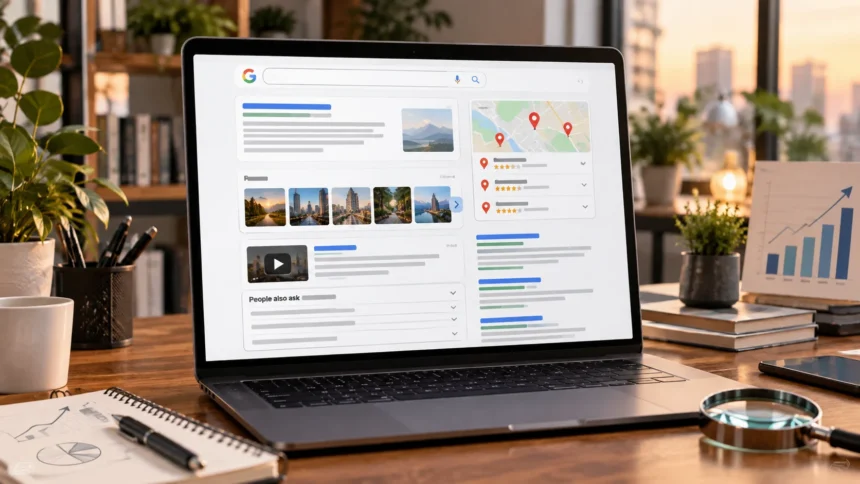
A SERP feature is any special result or enhanced element that appears on a search engine results page beyond a basic organic listing. These features can include featured snippets, People Also Ask boxes, local map results, videos, images, reviews, shopping listings, knowledge panels, and other rich search experiences. For SEO professionals, understanding SERP features matters because ranking number one organically no longer guarantees that your result receives the most attention. A prominent feature can appear above traditional results and change where users click, read, or take action. Some features can also create additional opportunities for your brand to occupy more search real estate. This guide explains the most common SERP feature examples and how to optimize your content for stronger visibility.
What Is a SERP Feature in SEO?
A SERP feature is a search result element designed to give users more useful information directly on the results page. Traditional organic listings usually contain a title, URL, and short description, while SERP features can present information in more visual, interactive, or structured formats. Search engines use different feature types depending on what they believe will best satisfy the query. Someone searching for a restaurant may see a map pack, while a person asking a factual question may see a featured snippet. Product searches can trigger shopping results, and tutorial searches may display videos. SERP features therefore reflect both search intent and the type of information available for a particular query.
SERP features have changed how SEO professionals think about ranking positions. In a traditional results page, ranking first meant appearing directly at the top of the organic listings. Today, the first organic result may appear below advertisements, an AI-generated overview, a featured snippet, People Also Ask questions, or another search module. This means numerical ranking alone does not always describe how visible a website actually is. A page technically ranking third could receive less attention than a video, map result, or snippet displayed above it. Modern SEO should therefore evaluate the complete search results page instead of focusing only on ten blue links.
Search engines display SERP features because different queries require different types of answers. A search such as “weather tomorrow” needs immediate information, while “best laptops for students” may benefit from products, reviews, and comparison content. Local searches require geographic context, and image-heavy queries may be easier to answer visually. Search engines analyze intent and available information to determine which formats should appear. This creates opportunities for websites that structure and present information in ways suited to those formats. Understanding why a feature appears is often more valuable than simply knowing that it exists.
SERP features can also change depending on device, location, language, query wording, and search context. A mobile user may see a different layout from someone searching the same keyword on desktop. Local results may vary significantly according to physical location, while shopping modules can change based on availability and commercial relevance. Some features appear consistently for certain queries, while others come and go as search systems test different layouts. This variability makes manual SERP review important during keyword research. SEO tools provide useful data, but actual search results can reveal details that broad ranking reports may miss.
From an SEO perspective, SERP features create both challenges and opportunities. They can reduce clicks to traditional organic listings by answering questions directly, but they can also give a website additional visibility when its content is selected. A brand may appear in the standard results while also earning a featured snippet, video result, image result, or local listing. This can increase recognition and make the website more prominent than competitors occupying only one result type. The goal should not be winning every possible feature. Instead, identify the features that regularly appear for your most valuable keywords and create content suited to those opportunities.
Why SERP Features Matter for Organic Visibility
SERP features matter because they influence where users focus their attention before clicking anything. Search pages have become increasingly visual, with maps, videos, images, products, expandable questions, and answer boxes competing with standard links. A traditional listing can therefore lose visibility even when its ranking remains unchanged. For example, a page may continue ranking position four while a new video carousel or People Also Ask box appears above it. Traffic could decline despite no obvious ranking loss. Understanding SERP changes helps SEO teams explain why organic performance sometimes moves independently from keyword positions.
Winning a SERP feature can provide substantial brand exposure because featured elements are often visually prominent. A featured snippet can display your content near the top of the page, while a local pack can put your business in front of users ready to call or visit. Videos and images can capture attention in searches where visual explanation matters. Product features can present pricing, availability, ratings, or images directly to shoppers. Even when users do not click immediately, repeated exposure can make your brand more familiar. Search visibility therefore includes being seen as well as generating direct visits.
SERP features can also reveal search intent more clearly than keywords alone. If a query consistently triggers video results, users may prefer demonstrations rather than purely written explanations. If Google shows comparison tables, reviews, or shopping modules, commercial investigation may be important. A large People Also Ask section indicates that users commonly explore related questions. Local packs show geographic intent, while image-heavy results suggest visual information plays a strong role. SEO teams can use these signals to decide what kind of page or content format is most likely to satisfy the searcher.
Some SERP features may reduce organic click-through rates because users can receive enough information without visiting a website. A concise definition, calculator, weather result, or direct answer may satisfy the query immediately. This does not mean those keywords should automatically be abandoned. Search visibility can still support brand awareness, and users with deeper needs may click through for more detail. However, traffic forecasts should consider the SERP layout rather than relying only on search volume. A keyword with ten thousand searches and heavy zero-click behavior may deliver fewer visits than a smaller query with a more traditional results page.
SERP feature analysis also improves competitive research. Instead of comparing only which competitor ranks first, examine which brands own snippets, videos, local results, product listings, or other enhanced placements. A competitor may dominate a topic because it appears across several search surfaces simultaneously. That creates a broader competitive gap than one organic position. By identifying which feature types competitors repeatedly capture, you can understand their content strengths and where additional formats may help your own strategy. SERP analysis turns ranking data into a more complete picture of actual search visibility.
Common SERP Feature Examples You Should Know
Featured snippets are among the most recognizable SERP features because they extract a concise answer from a webpage and display it prominently near the top of search results. They commonly appear as paragraphs, lists, tables, or short explanatory blocks depending on the query. Searches asking “what is,” “how to,” “why,” or comparison questions can often trigger snippet-style answers. A featured snippet can provide excellent visibility because the selected website receives prominent attribution. However, snippets can also satisfy simple questions without requiring a click. Successful optimization therefore involves giving a clear answer while also providing enough additional value for users who need deeper information.
People Also Ask boxes present expandable questions related to the original search query. When users open a question, they see a short answer and a source that can be visited for more information. This feature is particularly useful for keyword research because it reveals related concerns people often have around a topic. SEO writers can use those questions to improve content coverage when they genuinely fit the article’s intent. They can also inspire separate pages when the related question represents a distinct search need. The objective should not be copying every question mechanically. Use People Also Ask data to understand the wider problem the audience is trying to solve.
Knowledge panels and knowledge-style results provide structured information about recognized entities such as businesses, people, organizations, places, books, films, or other well-defined subjects. These features may include descriptions, images, related entities, key facts, social profiles, or additional information from trusted sources. Unlike featured snippets, knowledge panels are generally tied more closely to entity understanding than to selecting one paragraph from a webpage. Businesses can support clearer entity information by keeping organization details consistent across their website and credible external profiles. Strong structured information can reduce ambiguity about who the business is and what it does.
Sitelinks can appear beneath a standard organic listing and provide direct links to important sections of a website. They may help users reach pages such as pricing, contact information, login, products, services, or major categories without first visiting the homepage. Search engines determine sitelinks automatically based largely on website structure and perceived usefulness. Clear navigation, descriptive internal links, logical architecture, and strong page titles can improve the overall site structure from which sitelinks may be selected. There is no simple tag that guarantees them. Their appearance generally reflects how clearly search systems understand important paths through a website.
Rich results add enhanced information to standard listings when supported content and structured data make the page eligible. Depending on the result type, this can include ratings, prices, availability, breadcrumbs, event information, recipe details, or other structured elements. Rich results can make a listing more visually informative and potentially improve click appeal. However, structured data does not guarantee that enhanced elements will always appear. Search engines determine when and where eligible features are shown. The correct approach is implementing accurate structured data that describes visible page content rather than adding markup only to chase a more attractive search appearance.
Local, Image, Video, and Shopping SERP Features
Local packs are particularly important for businesses serving specific geographic areas. Searches such as “dentist near me,” “roof repair in Austin,” or “best coffee shop nearby” can trigger a map accompanied by several business listings. These results can include ratings, addresses, hours, directions, phone options, and other local information. Strong local visibility depends on accurate business information, a well-maintained Google Business Profile, relevant website content, reviews, and broader local authority. Traditional website rankings still matter, but local packs create an additional layer of competition. For many service businesses, appearing prominently in map results can generate more calls and visits than a standard organic listing.
Image packs appear when visual content is highly relevant to the query. Searches related to designs, products, plants, animals, places, fashion, home ideas, or visual examples can often produce image-heavy results. SEO teams should make important images useful and understandable by using descriptive file names where appropriate, meaningful alt text, suitable surrounding content, and technically accessible image files. Image quality also matters because users are more likely to engage with clear and relevant visuals. Do not optimize decorative images aggressively. Focus on images that genuinely help explain the subject, demonstrate a product, or answer the visual intent behind the search.
Video results and video carousels are especially common for tutorials, demonstrations, reviews, entertainment, and topics where showing a process is more effective than describing it. If several video results appear for an important keyword, that is a strong indication that users value visual explanation. Businesses can respond by creating videos that complement their written content rather than forcing every keyword into an article-only strategy. Videos should have clear titles, useful descriptions, strong spoken or visual information, and appropriate supporting pages when relevant. A written guide and video can work together, giving users different ways to consume the same core information.
Shopping results are highly relevant for ecommerce and product-based searches. These features can display product images, prices, merchant information, ratings, shipping details, and other commercial information directly within search. They can appear in dedicated shopping areas or alongside traditional results depending on the query. Ecommerce SEO therefore extends beyond optimizing product pages. Accurate product data, clear pricing, availability, structured information, and merchant feeds can all contribute to broader search visibility. Businesses should also understand that shopping features can push normal organic listings lower on the page. Product search strategy needs to account for both organic and shopping surfaces.
Review-related features can influence clicks because users often rely on ratings when comparing products, services, software, restaurants, and other options. Review information may appear through supported rich result types or within local and shopping modules. Businesses should focus on earning genuine customer feedback and representing ratings accurately. Manipulating reviews or marking up information users cannot actually see can create trust and eligibility problems. Reviews are valuable because they affect both search appearance and real purchasing decisions. A high ranking can attract attention, but strong social proof can determine which result ultimately receives the click.
How to Find SERP Feature Opportunities for Your Keywords
Begin by creating a list of keywords that already matter to your business rather than searching for SERP features in isolation. Include commercial terms, informational topics, high-performing pages, and keywords where your website ranks close to the first page. Then examine which features appear consistently for those queries. You might discover that comparison keywords trigger reviews and videos, while educational terms show snippets and People Also Ask boxes. Local searches may be dominated by maps. This creates a feature opportunity map tied directly to business priorities instead of a generic list of search enhancements.
Keyword research tools can help identify which tracked queries trigger specific SERP features. Many SEO platforms label keywords with icons or filters showing snippets, videos, image packs, local packs, shopping results, and other elements. These filters can make it easier to find opportunities across thousands of keywords. However, tool data should be verified manually for your most important terms because search layouts change and results can vary by location or device. Software is excellent for screening. Human review provides the context needed to understand whether the feature is stable and what type of content currently earns it.
Competitor analysis can reveal SERP features your own website is missing. Look for keywords where competitors appear in featured snippets, video results, image packs, or local listings while your page ranks only organically. Study the format they use rather than copying their wording. A competitor may win a snippet because it provides a concise definition, while another earns a video result because its tutorial demonstrates the task more clearly. Identify the structural advantage and determine whether you can create something more useful. SERP feature gaps can become practical optimization opportunities when your page already has underlying relevance.
Google Search Console can also help prioritize SERP-related work by showing which pages already receive impressions for relevant queries. If a page is ranking reasonably well but receiving a weak click-through rate, inspect the actual search results. A prominent feature may be drawing attention away from standard listings. You may be able to compete for the feature or improve your title and description to remain attractive beneath it. Search Console does not provide a complete SERP-feature map, but its performance data can reveal where ranking position and traffic do not align. That discrepancy is often worth investigating manually.
Prioritize feature opportunities based on business value rather than visibility alone. Earning a featured snippet for a broad definition may look impressive but create little commercial impact, while a local pack position could generate qualified leads immediately. A video result for a high-intent product comparison may support conversions, while an image pack for a low-value informational topic may primarily create awareness. Assign value based on search intent, potential traffic, conversion opportunity, and how realistic the feature is to target. SEO teams should treat SERP features as part of a larger growth strategy rather than collecting them as trophies.
How to Optimize for Featured Snippets and People Also Ask
Featured snippet optimization starts with answering the query clearly and directly. If the keyword asks for a definition, provide a concise definition near the relevant heading before expanding into more detail. For process-based searches, use logically ordered steps that readers can follow easily. Comparison queries may benefit from tables, while list-style searches should use properly structured lists when that format genuinely improves comprehension. Search engines choose snippet content automatically, so there is no guarantee that your preferred section will be used. Your job is to make the information easy to identify, accurate, and useful.
Content structure matters because search systems need to understand which section answers which question. Descriptive H2 and H3 headings can help separate concepts and make long articles easier to scan. A heading such as “How Does Technical SEO Work?” provides more context than a vague heading like “How It Works.” The paragraph immediately beneath it can then answer the question directly. Follow the concise answer with examples, exceptions, or additional explanation. This structure benefits users even when no snippet appears. Optimization works best when the page becomes easier to consume rather than being rewritten solely for extraction.
People Also Ask optimization follows a similar principle. Identify questions directly related to your primary topic and answer them clearly within the most relevant section. FAQs can be useful when several common questions do not fit naturally into the main article structure, but they should not become a dumping ground for unrelated keyword variations. Each answer should provide enough information to solve the immediate question while linking conceptually to deeper sections when necessary. Avoid answering twenty near-identical questions simply because they appeared in a keyword tool. Strong topical coverage is more valuable than artificial question volume.
Accuracy is particularly important for snippet-style content because concise answers can be displayed without the surrounding context of your full article. Avoid oversimplifying nuanced subjects to the point of becoming misleading. Health, finance, law, safety, and other high-stakes topics require especially careful wording and appropriate professional context. Even in ordinary SEO topics, definitions should reflect the concept accurately rather than being written only to fit a short paragraph. Clear does not mean simplistic. The best snippet-ready content communicates the central answer efficiently while preserving important qualifications.
Pages already ranking on the first page often have a stronger chance of earning certain snippet opportunities than completely invisible pages because the search engine already considers them relevant. This makes near-ranking content a practical place to start. Identify keywords where your page appears prominently but another domain owns the snippet. Compare the structure and clarity of the competing answer with yours. Improve your page where a genuine information gap exists, then continue strengthening overall content quality and authority. SERP-feature optimization should enhance a competitive page rather than substitute for basic ranking relevance.
How Technical SEO and Structured Data Support SERP Features
Technical SEO provides the foundation that allows search engines to access the content you want considered for enhanced search results. Pages should be crawlable, indexable, mobile-friendly, and connected through clear internal links. Important information should not be hidden behind technical barriers that prevent search engines from rendering it reliably. Broken canonical tags, accidental noindex directives, slow rendering, or inaccessible resources can limit search performance before SERP-feature optimization even begins. A technically healthy page gives search engines a cleaner view of your content. Feature targeting works best after fundamental crawling and indexing issues have been addressed.
Structured data helps search engines interpret specific information on a page in a machine-readable format. Different schema types can describe products, organizations, breadcrumbs, articles, events, local businesses, and other supported entities or content types. Correct markup can make a page eligible for certain enhanced search experiences where those features are supported. However, eligibility is not a guarantee of display. Search engines decide when rich results are useful for users. Implement structured data because it accurately represents the content, not because you expect every page to receive a visually enhanced listing immediately.
Structured data must match what users can actually see on the page. Marking up fabricated reviews, hidden information, inaccurate prices, or content that does not exist creates quality problems and undermines trust. The data should remain consistent with visible page information and be updated when products, events, ratings, or business details change. Validation tools can help identify syntax errors, but successful validation does not automatically mean the markup is strategically appropriate. Technical correctness and factual accuracy are separate requirements. SEO teams should review both whenever structured data is deployed at scale.
Internal linking can indirectly support SERP-feature opportunities by helping search engines understand relationships and importance across the website. A comprehensive pillar page connected to relevant supporting content may provide clearer topical context than an isolated article. Descriptive anchors help explain destinations, while breadcrumbs and logical navigation support broader architecture. Internal links also allow authority to flow toward pages you want to strengthen. A well-organized website makes it easier for both users and search engines to discover deeper information. SERP optimization should therefore include site structure rather than focusing only on the individual paragraph you hope will be extracted.
Page experience also matters because earning visibility is only useful when users have a positive experience after clicking. Mobile layouts should display answers clearly without intrusive popups or slow-loading elements. Images and videos should be optimized so they do not make pages unnecessarily heavy. Navigation should help users move from the feature-winning answer into deeper content or commercial pages naturally. A featured snippet can create a valuable entry point, but a poor landing experience may waste that attention. SEO should optimize both search appearance and what happens after the searcher reaches the website.
How to Track SERP Features and Measure Their SEO Value
SERP-feature tracking should begin with the keyword set already connected to your business goals. Rank tracking tools can often show which features appear for each keyword and whether your domain owns or appears within them. Track changes over time rather than taking one snapshot because SERP layouts can fluctuate. A feature may appear for several weeks and then disappear as search behavior or result testing changes. Historical tracking helps you understand whether your visibility gains are stable. It also makes it easier to connect traffic changes with shifts in search-page layout.
Measure clicks and impressions alongside feature visibility because winning a feature does not always generate additional traffic. A featured snippet may improve impressions and brand exposure while producing only a modest click increase if users receive the answer immediately. A local pack position, on the other hand, may generate calls or direction requests that do not appear as ordinary organic website clicks. Ecommerce features can influence product discovery differently again. The correct metric depends on the feature. Treating every SERP appearance as a standard website-click opportunity can produce misleading conclusions.
Click-through rate should be analyzed carefully when SERP features are present. A page can maintain the same average position but experience a lower CTR after a prominent feature appears above it. Conversely, earning an enhanced result may make the listing more appealing and increase clicks. Compare similar periods and account for seasonality where possible. Query-level analysis can help identify which searches changed most. When CTR falls while rankings remain stable, inspect the results page before immediately rewriting titles. The layout itself may explain part of the change.
Conversion tracking is essential because some SERP features are much more commercially valuable than others. A local business may care most about calls and bookings from map visibility, while a SaaS company could value demo requests generated by comparison queries. An ecommerce business may monitor product clicks and transactions from shopping-oriented searches. Informational snippets may contribute primarily to awareness and assisted conversions. Connect feature visibility with downstream actions whenever your analytics setup allows. The best SERP opportunities are those that support meaningful business outcomes rather than simply increasing the number of search appearances.
Reporting should explain feature performance in context rather than overwhelming stakeholders with icons and ranking screenshots. Highlight where the website gained or lost important search features, what that change likely means for visibility, and what actions should follow. For example, a report might show that a competitor captured a snippet on a high-value query and recommend restructuring a specific section. Another report might show growing video results within an important topic cluster and recommend producing demonstration content. SERP-feature reporting becomes valuable when it informs decisions. Measurement should always lead back to strategy and next steps.
Build a SERP Feature Strategy That Supports Long-Term Rankings
Start by mapping high-value keywords according to the SERP features that appear most consistently. Group them into categories such as featured snippets, People Also Ask, local packs, video results, images, shopping features, reviews, and rich results. This gives your team a clearer understanding of what types of search visibility matter in each topic. Avoid targeting every feature at once. Prioritize keywords already connected to revenue, qualified traffic, or strategic authority. Feature mapping should make SEO priorities clearer, not create an additional layer of busywork.
Next, match each feature with the content format most likely to satisfy the user’s intent. Featured snippets may benefit from concise definitions or structured steps, while video-heavy queries may deserve demonstrations. Local queries require strong business profiles and locally relevant pages, while image-based searches need useful visual assets. Shopping searches require accurate product information and well-optimized ecommerce systems. Do not force one content format across every keyword. Search results already provide clues about how people prefer to consume information. Use those clues to diversify your content strategy intelligently.
Existing pages should usually be optimized before creating entirely new content for every feature opportunity. If a page already ranks well, review whether better structure, clearer answers, stronger images, improved videos, or appropriate structured data could expand its visibility. This allows you to build on existing authority instead of splitting effort across unnecessary URLs. New pages should be created only when the search intent requires a distinct resource. This approach also reduces keyword cannibalization. SERP-feature growth is often an extension of good content optimization rather than a separate publishing strategy.
Competitive monitoring should continue because SERP features change as other brands improve their content. A competitor may suddenly begin capturing snippets, releasing videos, or dominating local results across your most valuable searches. Study the underlying improvement rather than reacting only to the ranking position. They may have created a stronger format, added original information, or improved technical eligibility. Use competitors as evidence of what can work, but continue looking for ways to provide something more helpful. Long-term search visibility comes from creating stronger experiences rather than permanently copying whoever currently holds the feature.
Finally, remember that SERP features are only one component of SEO success. Strong traditional rankings, high-quality content, technical accessibility, backlinks, brand authority, and conversion experience remain essential. Search layouts will continue evolving, and individual features may change in appearance or importance over time. A resilient SEO strategy focuses on understanding search intent and presenting information in formats users value. If your content remains useful, accessible, trustworthy, and well structured, it can adapt to many different search experiences. The goal is not simply to win a box on the results page, but to become one of the most useful sources searchers can discover.
Frequently Asked Questions
What is a SERP feature?
A SERP feature is an enhanced search result element that goes beyond a standard organic listing. Examples include featured snippets, People Also Ask boxes, local packs, images, videos, shopping results, knowledge panels, reviews, and rich results.
What are the most common SERP features?
Common SERP features include featured snippets, People Also Ask, local packs, image packs, video results, sitelinks, knowledge panels, shopping listings, reviews, and other rich result formats. The features shown depend largely on the query and search intent.
How do I rank for a featured snippet?
Answer the target question clearly, structure information logically, use descriptive headings, and provide concise definitions, lists, steps, or tables when appropriate. Strong overall page relevance and search visibility are also important because snippet optimization alone cannot compensate for a weak page.
Do SERP features increase organic traffic?
They can increase visibility and traffic, but the impact depends on the feature and query. Some features encourage clicks, while others answer the user’s question directly and may result in fewer website visits despite greater brand exposure.
How can I find keywords with SERP feature opportunities?
Use keyword research and rank tracking tools to identify terms that trigger snippets, local packs, videos, images, People Also Ask, and other features. Then manually review your most valuable search results to understand which formats competitors are winning and where your content can improve.