

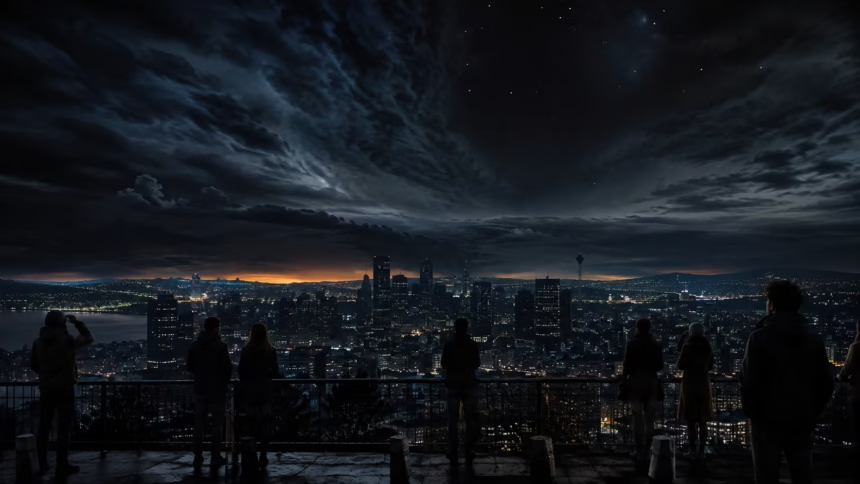
What Would Happen If the Sun Disappeared?
The Sun may look like an ordinary bright object in the sky, but nearly every natural system on Earth depends on it. It provides the light and heat that support plants, regulate weather, drive ocean currents and make the planet comfortable enough for life. Without the Sun, Earth would rapidly become a dark, frozen world.
The effects would not begin at the exact moment the Sun disappeared. Because sunlight takes time to travel through space, people on Earth would continue seeing the Sun for approximately eight minutes and twenty seconds. During that brief period, everything would appear completely normal, even though the solar system had already experienced an impossible and dramatic change.
Once the final sunlight reached Earth, daylight would vanish across the planet. The Sun’s gravitational influence would also disappear at the same time because changes in gravity travel at the speed of light. Earth would no longer orbit the Sun and would begin moving through space in a straight path rather than following its familiar elliptical orbit.
The disappearance of the Sun is not considered physically possible under our current understanding of astronomy. However, exploring this imaginary event helps explain how sunlight, gravity, photosynthesis, climate and planetary motion work together. It also reveals just how closely the survival of life on Earth is connected to our nearest star.
Would We Notice the Sun Disappearing Immediately?
People would not notice anything unusual during the first eight minutes and twenty seconds after the Sun disappeared. The sunlight already travelling toward Earth would continue arriving normally. The sky would remain bright, temperatures would feel unchanged and solar-powered systems would continue operating until the final waves of sunlight passed the planet.
The delay occurs because the Sun is approximately 150 million kilometres away from Earth. Light travels at almost 300,000 kilometres per second, yet it still requires more than eight minutes to cross that enormous distance. When we look at the Sun, we are therefore seeing it as it existed several minutes in the past.
Gravity would not provide an earlier warning. According to modern physics, changes in a gravitational field do not travel instantly across space. Earth would continue orbiting the location where the Sun had been until the gravitational change arrived at approximately the same time as the final sunlight.
When the delay ended, the change would be sudden and unmistakable. The daytime sky would turn black, solar heat would stop reaching Earth and the planet would leave its orbit. There would be no gradual sunset or fading glow because the main source of visible light in the solar system would simply be gone.
The Sky Would Become Completely Dark
After the last sunlight disappeared, every location experiencing daytime would suddenly enter darkness. The sky would no longer appear blue because blue skies are created when sunlight scatters through Earth’s atmosphere. Without direct sunlight, the atmosphere would become almost invisible against the darkness of space.
Stars would immediately become visible from nearly every part of the planet, assuming clouds and artificial lights did not block the view. The night sky might initially appear clearer because there would be no sunlight brightening the atmosphere. However, widespread power failures could eventually remove most human-made light as well.
The Moon and planets would also become difficult or impossible to see. The Moon does not create its own visible light; it shines by reflecting sunlight toward Earth. Once the remaining sunlight had passed through the solar system, the Moon would become a dark object orbiting Earth rather than a glowing feature in the sky.
A few objects could still produce visible light. Stars would continue shining because they are distant suns generating their own energy. Auroras, lightning, fires, volcanic eruptions and artificial lighting could also remain visible temporarily, but they would appear against a permanently dark sky without sunrise or daylight.
Earth Would Leave Its Orbit Around the Sun
Earth remains in orbit because its forward motion and the Sun’s gravity work together. The planet is constantly moving through space while the Sun’s gravitational pull bends its path into an orbit. If the Sun disappeared, there would no longer be a central gravitational force keeping Earth on that curved route.
The planet would not immediately stop moving or fall downward through space. Instead, Earth would continue travelling in the direction it was moving at the moment the Sun’s gravity disappeared. Its path would become approximately straight, following a tangent to its former orbit at nearly 30 kilometres per second.
Other planets would experience the same basic change. Mercury, Venus, Mars, Jupiter and the remaining planets would leave their solar orbits and travel independently through the Milky Way. Their new paths would depend on their positions and velocities at the instant the Sun vanished.
Some planets or smaller objects could eventually pass near one another and experience new gravitational interactions. However, most would probably move farther apart as the former solar system scattered. Earth would effectively become a rogue planet, travelling through interstellar space without orbiting a star.
What Would Happen to the Moon?
The Moon would no longer travel around the Sun with Earth in the same familiar solar orbit. However, it would not automatically shoot away from Earth when the Sun disappeared. Earth’s gravity would continue pulling on the Moon, allowing the two objects to remain a connected planetary system initially.
The Earth and Moon actually orbit a shared centre of mass while moving around the Sun together. Without the Sun, this Earth-Moon system would continue travelling through space. The Moon would likely remain in orbit unless another object passed close enough to disturb its motion.
Moonlight would disappear because the Moon depends on sunlight for its visible glow. From the ground, it would become nearly impossible to see without radar, infrared equipment or artificial illumination. Solar eclipses and lunar phases would also cease because those events require light from the Sun.
The Moon would still influence Earth through gravity. Ocean tides would continue for as long as liquid oceans remained exposed and mobile. As Earth became colder and its oceans froze, visible tidal movement at the surface would decrease, although gravitational forces would continue acting beneath the ice.
Earth’s Temperature Would Begin Falling
Earth would begin losing heat as soon as solar radiation stopped arriving. However, the planet would not freeze instantly because the atmosphere, soil and oceans store enormous amounts of thermal energy. This stored heat would slow the initial temperature drop, giving the surface a limited period before extreme cold became widespread.
Temperatures would fall unevenly depending on location, weather conditions, geography and ocean circulation. Tropical regions and large bodies of water would remain warmer slightly longer, while dry continental areas would cool more quickly. Within days, freezing conditions would spread across much of the planet.
Over the following weeks and months, average temperatures would continue dropping far below anything experienced during normal winters. Rivers, lakes and the upper layers of oceans would freeze. Buildings, roads, pipelines and electrical systems would begin failing as materials and machinery faced conditions they were never designed to withstand.
In the distant future, Earth’s surface could approach temperatures found in the outer solar system. The planet would still receive a small amount of heat from radioactive decay and its hot interior. This geothermal energy would not keep the surface comfortable, but it could help preserve liquid water deep underground.
Photosynthesis Would Stop Across the Planet
Photosynthesis would stop almost immediately after sunlight disappeared. Plants, algae and certain microorganisms use light energy to turn water and carbon dioxide into chemical energy. Without sunlight, they could no longer produce the sugars required for growth, repair and reproduction.
Plants would not all die at the same moment. Some could survive temporarily by using stored energy in their roots, seeds, stems or tissues. Large trees might remain alive longer than delicate crops, but continued darkness and falling temperatures would eventually overwhelm nearly all surface vegetation.
Agriculture would collapse quickly because crops depend on regular sunlight and manageable temperatures. Greenhouses would also fail unless they had powerful artificial lighting and reliable heating systems. Food shortages would become one of the earliest and most serious threats facing human communities.
The loss of photosynthesis would affect more than plants. It would disrupt the base of most food chains because herbivores depend on vegetation and predators depend on other animals. As plant life declined, ecosystems on land and in sunlit ocean waters would experience widespread collapse.
Animals and Ecosystems Would Struggle to Survive
Animals would initially respond to the sudden darkness as if night had arrived unexpectedly. Birds might attempt to return to their nests, nocturnal animals could become active and many species would show confused behaviour. Their biological clocks would no longer receive normal signals from sunrise and sunset.
Within days, cold temperatures and food shortages would become more dangerous than darkness itself. Many insects, reptiles, amphibians and small mammals would die rapidly because they could not regulate their body temperature or find enough food. Larger animals might survive longer by using stored body fat or available food supplies.
Marine ecosystems near the ocean surface would also suffer because phytoplankton require sunlight for photosynthesis. These microscopic organisms support much of the marine food web and contribute significantly to global oxygen production. Their decline would affect fish, whales and countless other ocean species.
Not every ecosystem would disappear immediately. Deep-sea communities near hydrothermal vents obtain energy from chemicals released by Earth’s interior rather than sunlight. Certain underground microbes and organisms living inside rocks could also survive, making them some of the strongest candidates for long-term life on a sunless Earth.
Would Earth Run Out of Oxygen?
Earth would not run out of oxygen immediately after photosynthesis stopped. The atmosphere already contains an enormous supply of oxygen, and humans use only a small portion of it each year. Breathing would therefore remain possible during the early stages of the crisis.
Over time, oxygen would continue being consumed by people, animals, fires, microorganisms and chemical reactions. With plants and algae no longer replacing it through photosynthesis, atmospheric oxygen levels would gradually decline. However, extreme cold and food shortages would threaten most life long before oxygen completely disappeared.
Carbon dioxide levels would also change as living organisms continued breathing and organic material decomposed. As temperatures fell, much of the carbon dioxide would eventually freeze or become trapped in ice. Water vapour would condense and fall as snow, leaving the atmosphere increasingly cold and dry.
During the planet’s long-term cooling, major atmospheric gases could eventually condense or freeze onto the surface. Oxygen and nitrogen require extremely low temperatures to become liquids or solids, so this change would take far longer than the freezing of water. Earth could ultimately lose the breathable atmosphere familiar to us today.
Oceans Would Freeze From the Surface Down
The upper surfaces of oceans would start freezing as global temperatures dropped. Ice is less dense than liquid water, so it would float and create a protective layer. This layer would slow additional heat loss and help prevent the entire ocean from freezing at the same rate.
The oceans are extremely deep and store more heat than the land or atmosphere. Their lower layers would therefore remain liquid longer than lakes and shallow seas. Ocean currents would change dramatically, but residual heat could continue circulating beneath the expanding ice cover.
Geothermal energy rising from Earth’s interior could keep some deep water liquid for a very long time. Under kilometres of ice, isolated environments might resemble the hidden oceans scientists believe exist beneath the icy surfaces of moons such as Europa and Enceladus.
Life near the ocean surface would largely disappear as sunlight and photosynthesis vanished. However, microorganisms and deep-sea species living near hydrothermal vents might continue surviving. Their ecosystems depend on chemosynthesis, a process that uses chemical energy instead of sunlight to support biological activity.
Weather and the Water Cycle Would Collapse
Most weather on Earth is powered by solar energy. Sunlight heats the surface unevenly, creating differences in air pressure that produce winds, storms and atmospheric circulation. Without the Sun, this energy source would disappear and familiar weather patterns would begin weakening.
Rainfall would decrease as evaporation slowed. Oceans, lakes and soil would release less water vapour into the atmosphere because temperatures would continue falling. Existing clouds could still produce rain or snow for a period, but the active water cycle would gradually collapse.
Strong winds and storms could continue temporarily because the atmosphere would not lose all its energy immediately. Differences between warmer oceans and colder land areas might even create unusual weather during the early cooling period. These effects would fade as the surface approached a more uniformly frozen state.
Eventually, most atmospheric water would settle onto the ground as snow and ice. With little evaporation or sunlight, there would be no normal cycle of clouds, rain, rivers and returning ocean water. Earth would become a dark, dry and largely motionless frozen world.
Modern Technology Would Begin Failing
Solar panels would stop producing electricity as soon as the final sunlight disappeared. Homes, businesses, satellites and remote stations that depended heavily on solar energy would lose an important power source. Battery storage could keep some equipment operating temporarily, but it would eventually run out.
Electrical grids powered by fossil fuels, nuclear energy, wind, geothermal energy or hydroelectric facilities could continue operating for a period. However, fuel shortages, frozen machinery, damaged infrastructure and transportation failures would make it difficult to maintain large interconnected power networks.
Many satellites would also face serious problems. Solar-powered spacecraft would lose their main energy supply, while communication and navigation systems could fail as batteries drained. Some satellites might remain in Earth orbit, but ground stations and support networks would struggle to keep them useful.
Technology itself would not disappear, but maintaining it would become increasingly difficult. The most valuable systems would be those designed for sealed environments, underground facilities and extreme cold. Nuclear reactors, geothermal plants, artificial lighting and controlled agriculture would become essential for any organized survival effort.
Could Humans Survive Without the Sun?
Most people on the surface would face life-threatening conditions within a relatively short period. Darkness, falling temperatures, food shortages and infrastructure collapse would create overlapping emergencies. Conventional homes and cities could not protect large populations once heating systems and supply chains failed.
Human survival would be more realistic in underground shelters located near reliable energy sources. Nuclear reactors and geothermal power could provide heat and electricity without depending on sunlight. Deep mines, tunnels and purpose-built facilities would offer insulation from the extreme temperatures developing above ground.
Food production would require completely controlled environments. Survivors could grow plants beneath artificial lights, cultivate mushrooms, produce algae or use microorganisms to create protein. These systems would need dependable electricity, recycled nutrients, clean water and careful management to remain productive.
Small human populations might survive for generations if they had advanced preparation, stable power and protected food systems. However, supporting billions of people would be almost impossible. Human civilization would become concentrated in isolated habitats rather than open cities spread across Earth’s surface.
How Long Could Life Continue on Earth?
Surface plants and many small animals would begin dying within days or weeks, depending on temperature and stored food. Larger animals and people with access to shelter might survive longer. The speed of ecosystem collapse would vary because different environments store different amounts of heat and energy.
Life in deep oceans, underground caves and protected rock layers could survive much longer. These organisms do not depend directly on sunlight and are naturally protected from surface temperature changes. Microbial life could potentially continue for millions or even billions of years.
Earth’s internal heat would gradually weaken, but the process would be extremely slow. Radioactive elements inside the planet would continue releasing energy, while the core and mantle would retain heat from Earth’s formation. This energy could preserve pockets of habitable water far below the frozen surface.
The planet would no longer resemble the living world we know today. Yet Earth might not become completely lifeless. Simple organisms in geothermal environments could remain active long after forests, animals and human societies had disappeared from the surface.
Could Another Star Replace the Sun?
Earth would not automatically begin orbiting another star after leaving the solar system. Stars are separated by enormous distances, and the probability of Earth passing close enough to be captured is extremely small. The planet could travel through the galaxy alone for an immense period.
A close encounter with another star could theoretically alter Earth’s direction. However, gravitational capture is difficult because Earth would need to lose energy to settle into a stable orbit. It would be more likely to pass the star and continue moving through interstellar space.
Even if Earth entered another star system, the conditions might not support life. The planet could end up too close to the new star, too far away or in an unstable orbit. Its frozen atmosphere and transformed ecosystems would also make recovery extremely difficult.
A new star could gradually warm Earth if the planet entered a suitable orbit. Frozen gases and water might begin melting or evaporating again. However, rebuilding a stable atmosphere, climate and complex biosphere would require far more than simply receiving sunlight from another star.
Why the Sun Is Essential for Life on Earth
The Sun provides nearly all the energy used by Earth’s surface ecosystems. Plants capture solar energy, animals eat plants or other animals and humans depend on both natural and agricultural food chains. Even fossil fuels contain ancient solar energy stored by organisms millions of years ago.
Solar heating also keeps Earth’s water cycle active. It causes evaporation, creates clouds, supports rainfall and powers winds that move moisture across continents. Without this continuous energy input, rivers, weather systems and most accessible freshwater processes would eventually stop.
The Sun’s gravity keeps Earth in a stable orbit at a distance where liquid water can exist. This position within the habitable zone has helped maintain conditions suitable for life over billions of years. A major change in Earth’s orbit could make the planet dangerously hot or cold.
Imagining what would happen if the Sun disappeared shows that it is far more than a source of daylight. It is the gravitational centre of our planetary system, the engine of Earth’s climate and the foundation of most life. Without it, the familiar planet around us could not continue.
Final Thoughts: What Would Happen If the Sun Disappeared?
If the Sun disappeared, Earth would continue receiving sunlight and feeling its gravitational pull for approximately eight minutes and twenty seconds. After that delay, the sky would become dark and the planet would leave its orbit, moving through space along a new path.
Temperatures would begin dropping as soon as solar energy stopped reaching the surface. Plants would lose the ability to perform photosynthesis, food chains would collapse and the oceans would gradually freeze. Most surface life would be unable to survive the combined effects of cold, darkness and hunger.
Some humans might survive in underground habitats powered by nuclear or geothermal energy. Deep-sea organisms and underground microbes could also remain alive because their energy sources do not depend directly on sunlight. These survivors would exist in isolated environments beneath a frozen surface.
Although the scenario is scientifically unrealistic, it offers a powerful way to understand Earth’s dependence on the Sun. Nearly every sunrise, meal, rainfall and living ecosystem is connected to solar energy. The disappearance of our star would transform Earth from a vibrant planet into a frozen world drifting through darkness.
Frequently Asked Questions
How long would humans survive if the Sun disappeared?
Most people would face severe danger within days or weeks because of freezing temperatures, food shortages and infrastructure failure. Small groups might survive much longer inside heated underground facilities powered by nuclear or geothermal energy.
Would Earth freeze instantly without the Sun?
No, Earth would not freeze instantly. The atmosphere, land and oceans store large amounts of heat, so cooling would occur gradually, although dangerous freezing conditions would spread quickly across the surface.
Would we still have gravity if the Sun disappeared?
Earth would keep its own gravity, so people and objects would remain on the ground. However, the Sun’s gravitational pull would disappear after about eight minutes and twenty seconds, causing Earth to leave its solar orbit.
Could plants survive without sunlight?
Most plants could survive only temporarily by using stored energy. Without sunlight, photosynthesis would stop, and falling temperatures would eventually kill nearly all natural vegetation on Earth’s surface.
Would any life remain on Earth?
Some life could remain in deep oceans