

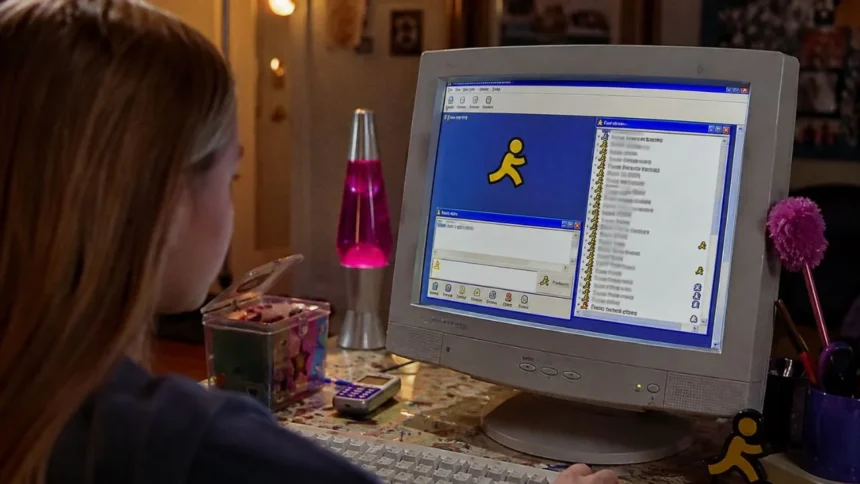
AOL Instant Messenger: The Rise, Fall and Lasting Legacy
AOL Instant Messenger introduced millions of people to the idea that friends could remain continuously available online. Better known as AIM, the free desktop application allowed users to exchange real-time messages, organise contacts and see when someone entered or left the internet. It launched in 1997 and remained active for two decades.
AIM arrived before smartphones, social media feeds and modern messaging applications became part of everyday life. For many users, logging on after school or work became a daily ritual. The sound of a digital door opening announced that a friend had appeared, while the Buddy List showed exactly who was available to talk.
The service was not simply a faster version of email. Screen names, profiles, buddy icons and away messages gave people new ways to build online identities. Users could communicate privately while also signalling moods, relationships and personal interests to everyone on their contact lists.
Despite its influence, AOL Instant Messenger struggled to adapt as communication shifted from desktop computers to mobile phones. Text messaging, social networks and mobile-first apps gradually replaced it. AIM officially shut down on December 15, 2017, but many of its ideas remain visible in the communication platforms used today.
What Was AOL Instant Messenger?
AOL Instant Messenger was a real-time communication service developed by America Online. It allowed people to exchange private text messages over the internet without waiting for email responses. Users signed in with unique screen names and could begin conversations with other people who were connected to the AIM network.
The service grew from messaging and presence features that already existed inside AOL’s paid online platform. AIM turned those capabilities into a separate application that internet users could download and use without subscribing to AOL’s wider service. This free approach helped AIM reach people outside AOL’s traditional customer base.
AIM centred on the Buddy List, which displayed saved contacts and showed whether they were online, away or offline. Instead of searching for a friend every time they connected, users could glance at one window and immediately understand which conversations were possible.
Later versions added group conversations, file transfers, buddy icons, profile information, voice features, games and connections with mobile messaging. AIM 6.0, released in 2006, introduced offline messages, grouped chat windows, mobile forwarding and support for as many as 1,000 contacts.
AIM’s Secret Beginning
AIM began as an unofficial project inside AOL rather than a carefully approved corporate product. Engineers Barry Appelman, Eric Bosco and Jerry Harris saw that people wanted an easier way to identify friends online and communicate with users outside AOL’s closed subscription platform.
Appelman had already created an early version of the Buddy List after users overloaded AOL systems by repeatedly checking whether particular screen names were online. The tool allowed people to create a permanent contact list that automatically updated whenever one of those users connected.
The engineering team worked on the standalone messenger without full approval from AOL’s leadership. Because the company made money through paid subscriptions, executives worried that offering a valuable communication service for free could weaken the existing business model.
The first release was not supported by a major promotional campaign. However, users quickly discovered it, and approximately 900 people connected simultaneously on its first night. That early demand helped demonstrate that online presence and instant conversation could become products in their own right.
The Buddy List Changed Communication
Before tools such as the AIM Buddy List, internet users could not always see which friends were available at a particular moment. Email did not provide a clear online presence, while websites and forums required users to visit specific locations before discovering whether someone had posted.
The Buddy List changed communication by turning online availability into visible information. When a friend signed in, their screen name appeared as active and the application played a recognisable sound. When the person logged out, another sound signalled that the opportunity for an immediate conversation had ended.
This feature created a new form of social anticipation. Users could open AIM without messaging anyone and still feel connected to a wider group. They could wait for a friend, classmate or romantic interest to appear and decide whether to start a conversation after seeing that person come online.
Modern apps now treat online indicators, contact lists and activity status as ordinary features. AIM helped establish the expectation that a communication service should show not only who a user knows but also whether each person is presently available to respond.
Screen Names and Online Identity
Every AIM user needed a screen name, and choosing one became an important part of joining the service. The name could contain interests, jokes, initials, numbers or references to music and popular culture. It acted as both a login identity and a public introduction.
Unlike many modern platforms, AIM did not require users to display their full legal names. People could experiment with different identities and communicate through names created specifically for the internet. This helped make the service feel separate from school, family life and other offline environments.
Profiles added another layer of personal expression. Users could include quotes, song lyrics, links, colours and formatting that revealed their mood or personality. Buddy icons provided a small visual image beside conversations and became an early version of the profile pictures now used across social networks.
These elements taught a generation to think carefully about digital presentation. A screen name, profile and icon could shape how others interpreted a person before the conversation even began. Similar identity choices now appear in usernames, avatars, bios and profile pages across modern platforms.
Why Away Messages Became Popular
Away messages were originally a practical feature. Employees could leave a short note explaining that they were attending a meeting, eating lunch or temporarily unavailable. This prevented contacts from assuming that an unanswered message was being deliberately ignored.
Teenagers transformed the feature into something far more expressive. They used away messages for jokes, song lyrics, emotional statements, party information and indirect comments aimed at friends or romantic interests. Fonts, colours and simple formatting made the messages feel personal.
An away message could communicate with several people without directly contacting any of them. A user might post a sad lyric and wait for one particular person to notice it. Others used vague statements that created curiosity while still allowing the writer to deny that the message referred to anyone specific.
This behaviour anticipated status updates and social posts. AIM users learned to publish brief thoughts to a selected audience, monitor reactions and express feelings through short pieces of text. Twitter co-founder Biz Stone later acknowledged that AIM’s away-message concept influenced Twitter to some degree.
Messaging Features and Social Habits
The central AIM experience involved a simple conversation window containing sent and received messages. Users could change fonts, colours and text sizes, which made conversations visually different from formal email. Abbreviations such as “BRB,” “LOL” and “TTYL” helped people communicate quickly.
Buddy icons, smileys and custom profiles added emotional signals that plain text could not always provide. AIM’s developers said that these expressive features made a stronger personal impact than several more complicated additions, including shared games and file-transfer tools.
Group chats allowed several friends to talk inside one conversation. File sharing enabled users to exchange photographs, documents and music, although slower internet connections could make large transfers frustrating. Later versions also introduced offline messages, mobile forwarding and improved organisation.
AIM developed its own social etiquette. Users thought about who should send the first message, how quickly to reply and whether an away status was genuine. Signing in and immediately signing out could attract attention, while remaining invisible or idle allowed people to control how available they appeared.
How AIM Worked
AIM relied mainly on AOL’s proprietary OSCAR messaging system. OSCAR stood for Open System for Communication in Realtime, although the technology was controlled by AOL rather than operating as an open communication standard available equally to competing services.
When a user logged in, AIM connected to AOL’s servers and authenticated the screen name. The service then notified the user’s saved contacts that the account was online. Messages travelled through the network so conversations could appear almost immediately on both computers.
The server also managed presence information, Buddy Lists and other account features. This centralised model allowed AOL to control the user experience, but it also meant that other messaging applications could not freely communicate with AIM unless AOL permitted or supported the connection.
AOL also offered a simpler protocol called TOC for some clients and developer uses. However, OSCAR remained central to much of the AIM experience. The cost of maintaining the older messaging infrastructure reportedly became one factor in AOL’s eventual decision to discontinue the service.
AIM’s Rapid Rise
AIM grew at the same time that home internet access was becoming more common. AOL had already introduced many households to online communication, and the standalone messenger gave people a reason to keep their computers connected even when they were not browsing websites or checking email.
The service expanded quickly through network effects. One person had little reason to use AIM alone, but each new friend made it more valuable. School groups, college communities and workplaces often adopted the platform together because users wanted access to the same contact network.
Smithsonian reported that AIM had attracted approximately 61 million users by 2000. By the middle of the decade, it held an estimated 52 percent of the North American instant-messaging market, demonstrating how strongly the service had become associated with online conversation.
AIM’s simple interface helped support this growth. Users did not need to understand the technical structure behind the service. They only needed a screen name, an internet connection and the screen names of their friends before they could begin communicating.
The Instant-Messaging Wars
AIM’s success attracted competition from Microsoft, Yahoo, ICQ and other communication services. Each platform wanted to become the main place where users maintained contacts, exchanged messages and developed online identities.
The networks generally could not communicate directly with one another. A user on AIM could not automatically message someone using Yahoo Messenger or MSN Messenger. This fragmentation encouraged people to install multiple applications or use unofficial multi-network clients.
Microsoft attempted to make MSN Messenger communicate with AIM in 1999. AOL repeatedly blocked the connection, arguing that Microsoft was accessing its system without permission and could create privacy or security problems. Microsoft eventually removed AIM compatibility after months of technical conflict.
The dispute demonstrated the power of AIM’s network. A service with the largest contact base could make it difficult for a competitor to grow because users did not want to leave their existing friends behind. It also raised early questions about whether messaging systems should work together like email providers.
AIM at School and Home
For teenagers and college students, AIM became a place to continue social life after leaving school. Friends could discuss homework, relationships, music and weekend plans without using a family telephone line for a long voice conversation.
The keyboard gave shy users more time to form their thoughts. A person could write, revise and delete a message before sending it, making difficult conversations feel more manageable than speaking face to face or over the phone.
Because many households shared one computer, AIM use still had limits. Parents or siblings could interrupt, and users sometimes left away messages explaining why they had stepped away. Even so, the individual screen name created a sense of personal space on a shared machine.
The service also made distance less important. Friends who moved, attended different schools or lived in nearby towns could remain part of the same daily conversation. AIM helped make the internet feel like a social place where people spent time, not merely a tool used to retrieve information.
AIM in the Workplace
AIM was not limited to personal conversations. Office workers used it to ask quick questions, coordinate tasks and communicate without making a telephone call or sending a formal email. The application spread through companies even when information technology departments had not officially approved it.
The software was designed to reconnect through alternative routes when its main connection was blocked. AIM engineers later recalled that this behaviour made it difficult for workplace administrators to prevent employees from using the service.
Instant messaging became particularly important in industries where workers needed rapid updates. Six major financial firms formed an Instant Messaging Standards Board partly because employees depended on messaging but were divided across incompatible services.
This workplace adoption anticipated tools such as Slack, Microsoft Teams and Google Chat. AIM demonstrated that short, real-time messages could reduce dependence on email for simple questions, although businesses also needed stronger security, record-keeping and management controls than a consumer chat app provided.
Security and Privacy Problems
AIM emerged during a period when many internet users had limited experience recognising digital risks. Messages appeared to come from known screen names, which made people more likely to trust links, files and requests received through the platform.
Attackers could exploit that trust by taking over accounts or sending malicious links that appeared to come from friends. AIM and related AOL services faced phishing, worms, unwanted messages and social-engineering schemes that attempted to steal passwords or install harmful software.
Technical vulnerabilities were also discovered. In 2002, security researchers identified a buffer-overflow problem affecting certain AIM versions that could potentially allow an attacker to run code on a Windows computer. AOL subsequently applied a server-side fix.
AIM was not designed around the end-to-end encryption expectations associated with modern secure messengers. The Electronic Frontier Foundation’s historical secure-messaging scorecard showed that AIM met only its basic encrypted-transit criterion and lacked several stronger protections assessed by the organisation.
Why AIM Began to Decline
AIM’s greatest strength became a weakness when communication habits changed. The service was built around logging into a desktop computer, checking a Buddy List and starting live conversations. Users were available mainly when they were sitting near that computer.
Mobile phones made communication more continuous. SMS allowed people to send messages directly to phone numbers, while smartphones eventually combined messaging, photographs, social feeds and internet access inside one device that users carried everywhere.
Social networks also changed how online identity worked. Facebook connected users through real names, photographs, schools and existing relationships. Instead of maintaining a separate Buddy List, people could build broader networks and communicate through profiles, public posts and private messages.
Google Chat, Facebook Messenger, WhatsApp, iMessage and other services made AIM feel increasingly disconnected from the places where users spent their time. AOL stated at the shutdown that communication had changed profoundly, while contemporary reporting noted that AIM never fully managed the transition to mobile.
Attempts to Modernise AIM
AOL continued adding features as the market changed. AIM 6.0 introduced offline messaging, a larger contact limit, grouped windows and mobile forwarding. The service also experimented with social pages, content subscriptions and connections to other online services.
Official versions eventually became available for several desktop and mobile operating systems. AIM added SMS-related features and attempted to connect parts of its network with other communication tools, but these changes did not restore its earlier position.
Many additions arrived after users had already begun moving elsewhere. Newer competitors were designed around smartphones, phone contacts and mobile notifications from the beginning, while AIM still carried the structure and expectations of a desktop-era product.
AOL also struggled to turn AIM’s enormous cultural value into a strong business model. Former members of the development team said AIM was not a major moneymaker, and later analysis concluded that AOL never fully built a successful strategy around one of its most influential products.
The Shutdown of AIM
AOL’s parent organisation announced AIM’s closure on October 6, 2017. The company explained that communication habits had changed and that it planned to focus its resources on newer products rather than continuing to operate the ageing service.
AIM officially stopped operating on December 15, 2017, exactly 20 years after its launch year. Official Windows, macOS, Android and iOS applications could no longer connect to AOL’s messaging servers after the shutdown.
Users were given limited time to save images they had shared, but AOL did not provide a full method for transferring Buddy Lists to another platform. This meant that some users lost contact lists containing screen names they had collected over many years.
Independent hobby projects have since attempted to recreate parts of the old experience through unofficial servers or applications. These services are not the original AOL Instant Messenger and should not be assumed to provide AOL support, compatibility or modern security protections.
AIM’s Lasting Cultural Legacy
AIM helped normalise the idea that people could maintain real friendships through typed conversations. Before social media became dominant, it demonstrated that the internet could function as an everyday meeting place where users gathered simply because their friends were present.
Its interface created sounds and visual signals that remain strongly connected with early internet memories. The opening and closing doors, yellow running-person logo, message alerts and Buddy List became recognisable symbols of online life during the late 1990s and early 2000s.
Away messages influenced the development of public status updates, while screen names, profiles and buddy icons helped establish the idea of maintaining a designed digital identity. Modern platforms use different interfaces, but the social behaviour behind these features remains familiar.
AIM also influenced people who later built major internet companies. Mark Zuckerberg described how AIM shaped his thinking about online presence and communication, while Twitter co-founder Biz Stone acknowledged the influence of away messages on status-based posting.
What Modern Apps Learned From AIM
Modern messaging applications inherited AIM’s most basic structure: a list of contacts, visible presence information and private conversation windows. Online indicators, typing signals, profile pictures and status messages all develop ideas that AIM helped make familiar.
AIM also demonstrated the importance of emotional expression in digital communication. Users wanted more than efficient text delivery. They wanted colours, icons, custom profiles, jokes and indirect ways to show how they felt.
The service showed that small product details could become culturally important. A login sound, status symbol or profile field might appear technically minor, yet it could shape how millions of users behaved and how strongly they felt attached to the platform.
Its decline offered an equally important lesson. A large existing network does not guarantee permanent success when devices, competitors and user expectations change. Communication products must follow users across platforms while protecting privacy and making it easy to maintain existing relationships.
Frequently Asked Questions
When did AOL Instant Messenger launch?
AOL Instant Messenger launched as a standalone service in May 1997. It grew from messaging and Buddy List features developed inside AOL’s existing online platform.
When did AIM shut down?
AIM officially shut down on December 15, 2017, after operating for approximately 20 years. AOL did not launch an official replacement carrying the AIM brand.
What was an AIM away message?
An away message was a custom status displayed when a user was unavailable. People later used the feature for song lyrics, jokes, emotional comments and indirect messages aimed at friends.
Why did AOL Instant Messenger fail?
AIM declined as users moved from desktop computers to SMS, smartphones, social networks and mobile-first messaging apps. AOL added new features but did not adapt quickly enough to changing communication habits.
Can you still use the original AIM?
No. AOL’s official AIM servers and applications were discontinued in 2017. Unofficial recreation projects may imitate the experience, but they are not operated or supported by AOL.
Conclusion: AOL Instant Messenger’s Lasting Legacy
AOL Instant Messenger rose because it solved a simple but important problem. It allowed people to see when friends were online and begin a private conversation immediately. The Buddy List turned internet presence into a visible part of everyday social life.
AIM became much more than a messaging utility. Screen names, profiles, buddy icons and away messages gave users space to experiment with identity and emotion. Teenagers, students and office workers adapted the platform to fit their own relationships and routines.
The service eventually fell behind as communication moved to mobile phones and social platforms. Text messaging, Facebook, WhatsApp, iMessage and other tools offered easier ways to remain connected across devices, while AIM remained closely associated with the desktop era.
Although AOL Instant Messenger no longer operates, its influence is still visible. Contact lists, online indicators, avatars, status messages and real-time chats remain central to modern communication. AIM disappeared, but the social internet it helped create never signed off.