

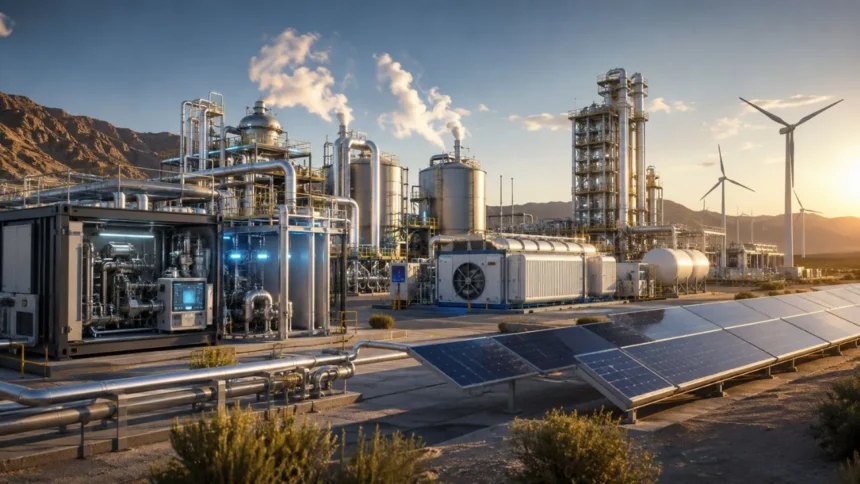
Terraform Industries Explained: How Air and Solar Power Become Clean Fuel
Terraform Industries is a California-based clean technology company developing equipment that turns renewable electricity, atmospheric carbon dioxide and water into synthetic fuels. Its main product, known as the Terraformer, is designed to manufacture synthetic natural gas without extracting fossil carbon from underground. The company’s larger goal is to make renewable hydrocarbons affordable enough to compete directly with conventional oil and gas.
The company was founded by Casey Handmer in November 2021. Rather than asking homes, factories and power plants to abandon every machine that currently uses natural gas, its strategy is to create a cleaner version of the same familiar fuel. Synthetic methane can potentially move through existing pipelines and work with equipment already designed for conventional natural gas. roach makes Terraform Industries different from businesses focused entirely on electric vehicles, batteries or hydrogen distribution. The company accepts that modern economies still depend on energy-dense hydrocarbons for industrial heat, chemicals, transportation and seasonal energy storage. It is therefore trying to change where those hydrocarbons come from rather than requiring the immediate replacement of the entire energy system.
As of May 2026, Terraform reported that it had produced and sold thousands of cubic feet of pipeline-grade natural gas, produced industrial-grade methanol and installed 1.8 megawatts of solar capacity at its Muroc desert test site. It also reported closing approximately $38 million in seed investment at a valuation of about $150 million. he Terraformer Works
The Terraformer is a modular power-to-gas system that combines three main processes: water electrolysis, direct air capture and methanation. Renewable electricity powers the entire system. Water supplies the hydrogen, while carbon dioxide is collected from ambient air. These ingredients are then processed inside a chemical reactor to produce methane that is intended to meet natural gas pipeline standards.
First, an electrolyzer uses electricity to separate water into hydrogen and oxygen. The hydrogen becomes a core ingredient in the synthetic fuel, while oxygen is produced as a secondary output. Terraform has been developing its own electrolyzer because commercial systems can be too expensive for low-cost fuel manufacturing, especially when they must operate with intermittent solar electricity.
Next, a direct air capture system removes small quantities of carbon dioxide from the surrounding atmosphere. Direct air capture is more difficult than collecting CO₂ from an industrial exhaust pipe because atmospheric carbon dioxide is highly diluted. Terraform’s system must capture, concentrate and prepare that carbon efficiently enough to support continuous fuel production without making the final renewable methane prohibitively expensive.
Finally, hydrogen and carbon dioxide enter a multistage Sabatier reactor. The Sabatier reaction combines CO₂ with hydrogen to create methane and water. Terraform’s 2024 integrated demonstrator produced pipeline-grade synthetic natural gas, and its Gen 4 reactor later achieved 99.4% methane purity, according to the company. olar Power Matters
Solar energy is the economic foundation of the Terraform Industries business model. Fuel synthesis consumes large amounts of electricity, which means the price of power has a major effect on the final cost of synthetic natural gas. The International Energy Agency estimates that electricity can represent approximately 30% to 80% of synthetic fuel production costs, depending on the process and local renewable power prices. m plans to place its machines beside utility-scale solar farms, especially in dry regions where land is inexpensive and sunlight is abundant.
Connecting directly to solar panels could help the system avoid some inverters, grid fees, transmission constraints and interconnection delays. Instead of transporting electricity through congested power networks, the site would convert solar energy into a storable and transportable chemical fuel.
The Terraformer Mark One was designed around a standard one-megawatt solar array. The original product concept targeted about 1,000 cubic feet of synthetic natural gas for each operating hour, or roughly 6,000 cubic feet during a typical six-hour solar production day. These figures remain company design targets rather than evidence of continuous full-scale commercial operation. ar-first model is also why Terraform closely follows the declining cost of photovoltaic technology. If solar panels, installation and manufacturing become cheaper, renewable methane may become more competitive without requiring a scientific breakthrough in every part of the process. However, the economics will still depend on equipment reliability, financing, maintenance, land availability and actual fuel production across changing weather conditions.
Direct Air Capture and Green Hydrogen
Green hydrogen is produced when an electrolyzer splits water using low-emission electricity. It can be used directly in certain industries, but storing and transporting pure hydrogen often requires specialised infrastructure. Terraform instead uses green hydrogen as an intermediate ingredient, combining it with captured carbon dioxide to manufacture methane that is easier to handle through existing natural gas systems.
The company has focused heavily on reducing electrolyzer capital costs. In December 2025, Terraform said it had qualified an electrolyzer stack costing less than $100 per kilowatt and had injection-moulded almost 6,000 component slices. It has also installed large plastic injection-moulding and welding equipment to prepare for repeatable electrolyzer production. These manufacturing claims will need to be validated through long-term field performance. ir capture is another crucial part of the system.
It gives the Terraformer a distributed carbon source, allowing a project to operate away from factories, refineries or other concentrated emitters. The IEA defines direct air capture as removing CO₂ from the atmosphere in a form that can be permanently stored or used in fuels, chemicals and other products. lenge is cost. Capturing diluted CO₂ from air requires energy, specialised materials and reliable equipment. The IEA has estimated future direct air capture costs within a broad range of approximately $135 to $345 per tonne, while emphasising that the technology remains relatively early in its development. Terraform must therefore prove that its simpler capture design can operate economically at much larger volumes. ynthetic Natural Gas Matters
Synthetic natural gas, also called e-methane or renewable methane, has almost the same chemical structure as the methane found in fossil natural gas. This compatibility is its biggest potential advantage. It could be blended into current gas networks, compressed or liquefied using established equipment and consumed by many existing boilers, turbines, furnaces and industrial systems.
That feature may be especially useful in sectors that are difficult to electrify. High-temperature industrial processes, long-duration energy storage, chemical production and some forms of heavy transportation may continue to need energy-dense molecules. The IPCC has recognised that low-emission hydrogen and synthetic fuel derivatives can support emissions reductions in hard-to-abate activities such as shipping. e methane may also help store surplus solar power. Batteries are effective for balancing electricity over hours, but storing enough electricity for weeks or seasons can become expensive. Converting electricity into gas sacrifices some energy efficiency, yet the resulting fuel can be stored in tanks, underground facilities or pipeline networks and used when renewable electricity is less available.
Energy security is another possible benefit. A country with strong sunlight, suitable land and water access could theoretically manufacture part of its own fuel supply instead of depending entirely on fossil fuel imports. Terraform describes its machine as a way to turn economically underused land into a synthetic gas production site, although real projects would still require permits, water management, infrastructure and customers. and Manufacturing Strategy
Terraform Industries believes clean fuels will achieve rapid adoption only when they compete economically with conventional fuels. Its strategy therefore focuses less on creating a premium environmental product and more on lowering the capital cost of every subsystem. The company is redesigning electrolyzers, carbon capture equipment and chemical reactors for automated production rather than relying exclusively on expensive, custom-built industrial machinery.
This manufacturing approach is based on learning curves. As production volume increases, workers improve processes, suppliers reduce component costs and designs become easier to assemble. Terraform argues that even a modest cost reduction with every doubling of cumulative production could eventually move its renewable methane into larger fuel markets. In June 2026, the company estimated that it could produce methane for under $30 per thousand cubic feet. ure should be viewed as a company estimate rather than a fully independent commercial benchmark. Natural gas prices vary considerably by region, season, infrastructure and customer type. A synthetic fuel project must also cover solar equipment, land, financing, labour, maintenance, compression, storage and distribution. Government incentives may improve early economics, but lasting competitiveness would ideally remain possible even when policy support changes.
The Terraformer’s modular design is intended to make expansion easier. Instead of constructing only a small number of highly customised plants, the company wants to manufacture many standardised units that can be installed beside renewable energy projects. This model resembles mass production more than traditional chemical plant construction, but achieving automotive-style manufacturing rates would require a much larger supply chain and dependable customer demand.
Progress Toward Deployment
Terraform reached an important technical milestone on March 27, 2024, when it commissioned an integrated demonstrator that combined electrolysis, direct air capture and methanation. The system successfully produced synthetic natural gas from electricity and air. It also demonstrated that the company’s independently developed components could operate together as a complete power-to-gas process. 024, the company reported delivering carbon-neutral, pipeline-grade synthetic gas to two utility partners. Its Gen 4 reactor achieved 99.4% methane purity, exceeding the 97% methane level described in its earlier pipeline-grade demonstration.
These accomplishments provided early technical validation, although they did not yet demonstrate the output, durability or economics of a mature commercial plant. ent continued through 2025. Terraform reported testing its integrated high-pressure reactor injection system, obtaining large-scale injection-moulding equipment and completing major components of the direct air capture system. By December, the company said a full-scale injection system, reactor and DAC components had been installed, with field deployment planned for 2026. 026, the business reported producing and selling thousands of cubic feet of gas, operating a welded electrolyzer stack and producing industrial-grade methanol. It had also deployed 1.8 megawatts of solar power at its desert test location. These developments suggest movement beyond laboratory experiments, but sustained production data and independently verified project economics will be critical for evaluating commercial readiness. nol and Future Products
Terraform Industries is expanding beyond renewable methane. Methanol is one of its most important additional targets because it is a liquid at normal temperatures and can be transported more easily than gaseous hydrogen. It is already widely used as an industrial chemical, solvent, fuel ingredient and building block for numerous plastics and chemical products.
Synthetic methanol can be produced by combining captured carbon dioxide with renewable hydrogen. The process shares important equipment with synthetic methane production, including electrolyzers and direct air capture systems. Terraform’s master plan describes a methanol system that integrates these components with a dedicated reactor, allowing solar energy to become a transportable liquid chemical feedstock. any reported producing industrial-grade methanol by May 2026.
This achievement expands its potential customer base beyond natural gas utilities and into chemical manufacturing, shipping fuels and other industrial markets. However, the amount produced, operating duration, independently measured carbon intensity and complete production cost will matter more than laboratory purity when customers evaluate commercial contracts. m’s longer-term roadmap also discusses ammonia, coke, cement, steel, aluminium, silicon, desalination and other energy-intensive products. The common idea is to locate industrial processes beside very inexpensive solar generation. This vision is much broader and less mature than its methane programme, so these products should currently be understood as strategic ambitions rather than established commercial business lines. te Benefits and Limits
The main climate argument for synthetic methane is based on recycling atmospheric carbon. Plants capture carbon dioxide from the air, transform it into methane and release approximately the same carbon when the fuel is eventually burned. In principle, this creates a shorter carbon cycle than extracting and burning fossil carbon that has remained underground for millions of years.
However, renewable methane is not automatically carbon-neutral. Its lifecycle emissions depend on the source of electricity, equipment manufacturing, construction, water treatment, gas compression and transportation. The IEA reports that synthetic methane generally needs electricity with a sufficiently low emissions intensity to outperform fossil fuel, with the exact threshold depending on production conditions and lifecycle assumptions. leakage is another serious concern. Methane traps substantially more heat than carbon dioxide over a 100-year period, and emissions can occur during fuel production, storage, transmission, distribution and use.
A clean synthetic gas supply chain would therefore need rigorous monitoring, high-quality equipment, rapid leak repairs and transparent reporting from the production site to the final customer. also returns captured CO₂ to the atmosphere when burned, so it is different from permanent carbon removal. Direct air capture becomes a carbon-removal method when the collected CO₂ is stored for a very long period. When it is converted into fuel, the environmental benefit comes from avoiding new fossil carbon extraction rather than permanently reducing atmospheric carbon dioxide. and Challenges
Cost remains the largest commercial challenge. Synthetic natural gas requires several energy-intensive steps, and each one adds equipment, maintenance and conversion losses. Even when solar electricity is inexpensive, the project must recover the cost of electrolysis, carbon capture, reactors, compression and storage. Terraform’s ability to reach mainstream fuel markets will depend on reducing these costs without sacrificing safety or durability.
Efficiency is another concern. Directly using renewable electricity in an electric motor, heat pump or battery generally delivers more useful energy than converting that electricity into hydrogen and then methane. Renewable methane is therefore likely to create the most value where direct electrification is technically difficult, where long-term storage is needed or where a chemical feedstock cannot easily be replaced.
Scaling hardware from a successful demonstrator to thousands of reliable machines is also difficult. Components must survive heat, pressure, dust, chemical exposure and daily power fluctuations. A system that performs well during a controlled test may behave differently after years in a desert environment. Customers and project financiers will want independently verified data on uptime, maintenance requirements, output and operating life.
Permitting and infrastructure may create additional delays. Large projects need land, solar arrays, water access, environmental reviews, gas-quality testing, safety systems and connections to pipelines or industrial customers. Terraform’s off-grid design may avoid electricity interconnection queues, but it does not eliminate every regulatory or construction requirement associated with producing and distributing combustible gas.
What Decision-Makers Should Watch
Businesses considering synthetic natural gas should first examine verified production data. Important indicators include annual output, methane purity, electricity consumption, system uptime and maintenance frequency. Buyers should also determine whether the quoted production cost includes solar infrastructure, financing, compression, storage and delivery rather than comparing only one part of the process with wholesale fossil gas prices.
Investors should follow Terraform’s transition from prototype manufacturing to repeatable field deployment. The most meaningful milestones will be multiple operating units, predictable installation schedules, improving production yields and long-term customer agreements. Capital raised and technical demonstrations are valuable, but recurring revenue and independently measured performance will provide stronger evidence that the technology can scale.
Policymakers should evaluate renewable methane according to its full lifecycle carbon intensity. Support programmes can encourage early deployment, but eligibility should require low-emission electricity, credible carbon accounting and strict methane leak control. Policy should also prioritise synthetic fuel for applications where direct electrification is difficult instead of encouraging inefficient fuel conversion where simpler electric alternatives already work well.
Readers should watch for independently audited results from the Muroc test site, the first full-scale Terraformer deployments and any utility or industrial purchase agreements. Progress in electrolyzer manufacturing, direct air capture costs and methanol production will also indicate whether Terraform Industries is building one successful machine or establishing a repeatable clean fuel platform.
FAQs
What does Terraform Industries produce?
Terraform Industries develops machines that use renewable electricity, water and atmospheric carbon dioxide to produce synthetic natural gas. It is also developing synthetic methanol and exploring other energy-intensive industrial products.
Who founded Terraform Industries?
Casey Handmer founded Terraform Industries in November 2021. The company is based in California and focuses on mass-manufactured equipment for renewable hydrocarbon production. erraform synthetic natural gas completely carbon-free?
No. Burning synthetic methane still releases carbon dioxide. Its potential climate benefit comes from using carbon previously captured from the atmosphere instead of extracting additional fossil carbon, and its true impact depends on lifecycle emissions and methane leakage.
Can synthetic methane use existing pipelines?
Synthetic methane that meets the required purity and safety standards can potentially be blended into existing natural gas infrastructure. Pipeline operators and regulators must still verify composition, pressure, moisture and other gas-quality requirements.
Is Terraform Industries commercially operational?
The company has produced and sold limited quantities of pipeline-grade gas and has begun larger field-testing activities. However, widespread commercial deployment and long-term independent performance data are still developing as of August 2026. usion: Terraform Industries and the Clean Fuel Revolution
Terraform Industries is pursuing an unconventional route to energy transition. Instead of eliminating hydrocarbons from every part of the economy, it wants to manufacture them using sunlight, air and water. This approach could preserve the usefulness of existing pipelines, storage systems and industrial equipment while gradually reducing dependence on newly extracted fossil carbon.
The company has already moved beyond a theoretical concept. It has demonstrated integrated synthetic methane production, achieved high methane purity, supplied limited quantities of gas to utilities and produced industrial-grade methanol. Its 2026 solar deployment and increased funding provide additional resources for field testing and manufacturing expansion. technical success alone will not guarantee a clean fuel revolution. Terraform must demonstrate competitive lifecycle costs, reliable multi-year operation, responsible water use and extremely low methane leakage. Independent verification will be essential because environmental value depends on the entire production and distribution system, not simply the source of the carbon dioxide.
The next stage will reveal whether the Terraformer can become a repeatable commercial product. If manufacturing costs decline and field systems deliver dependable output, renewable methane could support industries that cannot easily run directly on electricity. If those targets are missed, the technology may remain limited to premium fuel markets rather than transforming global energy production.