
Buying an affordable Android phone no longer means accepting a dim display, weak camera, or frustrating performance. The best budget Android phones in 2026 offer smooth AMOLED screens, dependable 5G connectivity, large batteries, optical image stabilization, fast charging, and software-support policies that were once associated mainly with premium flagship devices.
The challenge is that the term “budget phone” means different things in different markets. A handset priced below $300 may be considered affordable in the United States, while buyers in Europe, Pakistan, India, and the Middle East may compare phones using completely different price bands. Taxes, import duties, carrier promotions, storage configurations, and official warranty coverage can significantly change the final value.
For this guide, a budget Android phone is any device designed to deliver strong everyday value without entering the traditional flagship price category. Most recommendations sit around or below $500 or an equivalent regional price, although two upper-budget models are included for shoppers who can stretch further. Availability and specifications may vary by country and carrier.
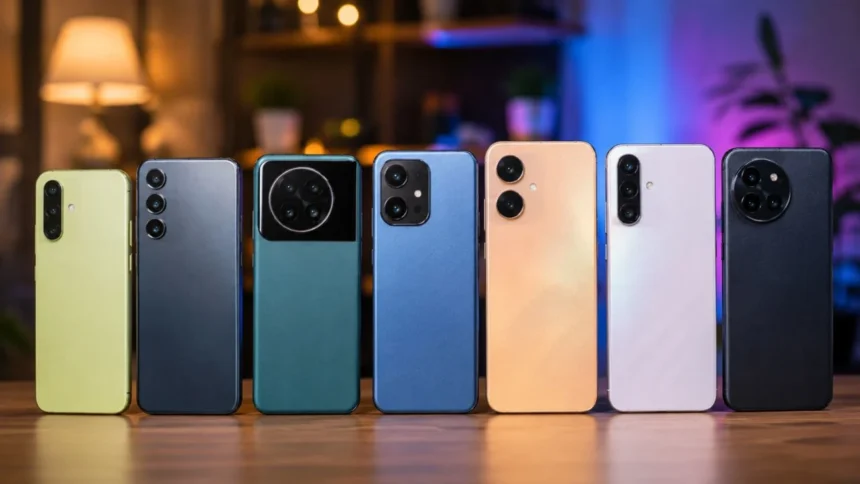
The top choices include the Google Pixel 10a, Samsung Galaxy A37 5G, OnePlus Nord 6, POCO X8 Pro, Nothing Phone (4a), OnePlus Nord CE6, Samsung Galaxy A57 5G, Motorola Edge 70 Fusion, Galaxy A17 5G, and Moto G Power 2026. Each model solves a different problem, so the best affordable Android phone depends on how you actually use it.
Which Budget Android Phone Is Best in 2026?
The Google Pixel 10a is the best budget Android phone for most people because it combines a manageable design, capable cameras, wireless charging, IP68 protection, helpful Google software, and seven years of updates. It starts at $499 in the United States, placing it at the upper end of the budget category but giving buyers unusually strong long-term support.
The Samsung Galaxy A37 5G is the best alternative for users who prefer a larger display and Samsung’s One UI experience. It starts at $449.99 in the United States and includes a 6.7-inch Super AMOLED display, a 5,000mAh battery, IP68 water resistance, a stabilized main camera, and six generations of Android operating-system upgrades.
Buyers focused on mobile gaming and raw speed should compare the OnePlus Nord 6 and POCO X8 Pro. Both concentrate on powerful processors, high-refresh-rate AMOLED displays, large batteries, and rapid charging. Their availability is more limited than that of Samsung and Google phones, so local network compatibility and official warranty support must be checked before purchasing.
For shoppers with tighter budgets, the Samsung Galaxy A17 5G and Moto G Power 2026 provide dependable essentials without unnecessary luxury features. These phones are not designed to beat premium models in gaming or nighttime photography, but they can comfortably support messaging, streaming, navigation, banking, social media, calls, and everyday photographs.
How We Selected These Affordable Android Phones
The ranking focuses on practical ownership rather than impressive specifications alone. A good budget smartphone should remain responsive during ordinary applications, deliver enough battery life for a working day, connect reliably to mobile networks, and capture usable photographs without complicated adjustments. Display quality, storage, durability, charging speed, and software support were also considered.
Official manufacturer specifications were used to verify processors, battery capacities, charging systems, displays, camera hardware, update commitments, and launch prices where available. Current expert roundups were then considered to understand how the leading devices compare within their price categories. Tom’s Guide, for example, identifies the Pixel 10a as its leading value phone below $500 in its current 2026 guide.
Value was judged according to the complete ownership experience rather than the lowest advertised price. A phone that costs slightly more may be the smarter purchase when it includes better water resistance, a brighter screen, longer security support, higher base storage, or dependable repair services. A cheap phone becomes poor value when it must be replaced after only two years.
Regional availability was treated as an important limitation. OnePlus, Nothing, POCO, Motorola, and Samsung do not sell identical configurations in every country, and imported phones may lack compatible frequency bands, eSIM functionality, official repairs, or complete software localization. Buyers should always confirm the exact model number rather than relying only on the marketing name.
Top 10 Budget Android Phones at a Glance
The list is intentionally varied instead of ranking ten nearly identical mid-range phones. Some devices prioritize camera consistency, while others deliver faster processors, larger displays, longer battery life, or more generous update policies. This makes the guide useful for students, families, mobile gamers, professionals, travelers, and people replacing an older Android handset.
The Pixel 10a and Samsung Galaxy A37 provide the most balanced overall experiences. The OnePlus Nord 6 and POCO X8 Pro are stronger choices for performance-focused buyers, while the Nothing Phone (4a) appeals to users who want distinctive design and a more unusual camera system without paying flagship prices.
Battery-focused shoppers should consider the OnePlus Nord CE6 and Motorola Edge 70 Fusion. Both contain much larger batteries than a conventional 5,000mAh budget smartphone. The Galaxy A17 5G and Moto G Power 2026 are less ambitious, but their simpler positioning may provide better value for people who only need reliable everyday features.
The Galaxy A57 5G is included as a stretch-budget option because its official launch price is higher than the other Samsung recommendations. It is best understood as a lower-cost alternative to a Galaxy S flagship rather than a genuinely cheap phone. Discounts and trade-in promotions may make it considerably more competitive after launch.
1. Google Pixel 10a — Best Budget Android Phone Overall
The Google Pixel 10a is the strongest all-round budget Android phone in 2026 because it avoids many of the compromises normally associated with lower-priced handsets. Its 6.3-inch pOLED Actua display supports a variable refresh rate between 60Hz and 120Hz, reaches a claimed peak brightness of 3,000 nits, and uses Gorilla Glass 7i for improved scratch protection.
Google equips the phone with the Tensor G4 processor, 8GB of memory, and either 128GB or 256GB of storage. It will not outperform dedicated gaming phones, but it offers sufficient power for messaging, photography, video calls, navigation, streaming, document editing, and everyday multitasking. The clean Pixel interface also avoids some of the duplicate applications found on other Android devices.
The rear camera system combines a stabilized 48MP main camera with a 13MP ultrawide camera. Computational photography tools such as Night Sight, Photo Unblur, Best Take, Magic Eraser, and Macro Focus make the phone particularly attractive to people who want dependable photographs without manually changing camera settings. It is one of the best affordable camera phones available.
The Pixel 10a also includes a 5,100mAh battery, wireless charging, IP68 protection, and seven years of operating-system, security, and Pixel Drop updates. Its main weaknesses are the older-generation Tensor processor, slower charging than several Chinese competitors, and the absence of a telephoto camera. Even so, its combination of cameras, durability, software, and longevity is difficult to beat.
2. Samsung Galaxy A37 5G — Best Samsung Phone Under $500
The Galaxy A37 5G is Samsung’s most balanced budget phone for buyers who want a large, high-quality display and familiar Galaxy software. Its 6.7-inch FHD+ Super AMOLED screen provides ample room for videos, reading, social media, maps, and split-screen applications. Vision Booster is designed to help the display remain readable under changing lighting conditions.
Samsung uses an Exynos 1480 processor with LPDDR5X memory and either 128GB or 256GB of storage. The processor is intended for mainstream daily use rather than intensive flagship gaming, but Samsung has added a vapor chamber to help manage heat. The phone should comfortably handle communication, entertainment, mobile payments, photography, and moderate gaming.
The rear camera arrangement consists of a 50MP main camera with optical image stabilization, an 8MP ultrawide camera, and a 5MP macro camera. The main camera is the most important part of this setup because OIS can improve low-light photographs and reduce unwanted movement in video. The ultrawide is useful for landscapes, buildings, interiors, and larger groups.
Samsung launched the Galaxy A37 5G at $449.99 in the United States. It also provides a 5,000mAh battery, IP68 dust and water resistance, 45W-class Super Fast Charging 2.0, six Android OS upgrades, and six years of security updates. Buyers seeking a big-screen 5G smartphone with reliable after-sales support should place it near the top of their shortlist.
3. OnePlus Nord 6 — Best Budget Android Phone for Performance
The OnePlus Nord 6 is designed for users who want near-flagship performance without paying for a premium OnePlus model. It uses a Snapdragon 8-series processor and supports high-frame-rate gaming on compatible titles. This makes it a strong choice for people who frequently play competitive games, edit videos, multitask heavily, or keep many applications open.
Its 165Hz AMOLED display is one of the fastest screens in this guide. A higher refresh rate can make scrolling and supported games appear smoother, although it may also use more battery than a standard 60Hz or 120Hz mode. Most users will appreciate the responsiveness, but casual buyers should not select a phone based on refresh rate alone.
Battery capacity is another significant strength. OnePlus lists a 7,500mAh battery with 80W charging and claims more than 22 hours of continuous YouTube playback under its testing conditions. The camera system includes a stabilized 50MP Sony main camera and a 32MP autofocus front camera capable of recording 4K video.
OnePlus promises four Android version upgrades and six years of security updates for the Nord 6. That policy is respectable but shorter than Google’s seven-year Pixel commitment. The greater concern is availability, as OnePlus distribution differs significantly between regions. Where officially sold with a competitive price and warranty, the Nord 6 is among the best performance-focused mid-range phones of 2026.
4. POCO X8 Pro — Best Budget Gaming Phone
The POCO X8 Pro is built around performance and is particularly appealing to mobile gamers. Its MediaTek Dimensity 8500-Ultra processor is paired with a 6.59-inch 1.5K AMOLED display operating at up to 120Hz. The combination provides sharper visuals and faster performance than buyers might expect from a conventional affordable Android phone.
A large 6,500mAh battery helps support long gaming, streaming, and navigation sessions. POCO also includes 100W HyperCharge, which is substantially faster than the charging systems offered by Google and Samsung’s lower-priced phones. The exact charging time can vary according to temperature, adapter compatibility, battery protection settings, and background activity.
The 50MP Sony IMX882 main camera includes optical image stabilization, making the phone more practical outside gaming. Its camera processing may not be as consistently natural as Google’s Pixel photography, but the stabilized sensor should perform well enough for everyday photographs, social media videos, documents, food, and travel scenes.
IP68 dust and water resistance is another valuable feature because many performance-oriented budget phones sacrifice durability to reach a lower price. The main compromise is software preference: POCO’s interface contains extensive features and may feel less clean than Pixel or Nothing OS. For buyers who prioritize gaming power, display quality, battery capacity, and fast charging, it offers exceptional hardware value.
5. Nothing Phone (4a) — Best Budget Phone for Design
The Nothing Phone (4a) is one of the most visually distinctive affordable Android phones in 2026. Nothing uses a recognizable transparent-inspired design language and a custom interface built around bold typography and monochrome elements. The software remains Android underneath, but it feels different from the more familiar Samsung, Google, Motorola, and Xiaomi experiences.
Nothing sells the Phone (4a) in several memory configurations, including 8GB with 128GB, 8GB with 256GB, and 12GB with 256GB. The official UK starting price is £379, positioning it as a direct alternative to established mid-range phones rather than an extremely cheap entry-level handset.
Its most unusual feature is the camera arrangement. Nothing advertises a three-camera system that includes a stabilized 50MP periscope camera and supports up to 70x processed zoom. The maximum figure should not be confused with 70x optical magnification, but the presence of periscope hardware is still unusual in this price class.
Nothing OS and the company’s Essential AI tools are intended to organize useful information without making the interface feel crowded. However, Nothing’s official availability and service network are smaller than those of Samsung and Google. The Phone (4a) is therefore best for someone who values design, clean software, and zoom flexibility and can obtain dependable warranty coverage locally.
6. OnePlus Nord CE6 — Best Battery Phone for the Money
The OnePlus Nord CE6 is aimed at buyers who prioritize battery life, media consumption, and smooth performance. Its 7,500mAh battery is considerably larger than the 5,000mAh capacity found in many affordable 5G phones. OnePlus claims more than two and a half days of use under its testing conditions, although real results will depend on signal strength, brightness, applications, and gaming.
The 6.7-class 1.5K AMOLED display supports a refresh rate of up to 144Hz. That combination provides sharper text and smoother animations than a basic Full HD 60Hz screen. OnePlus also advertises up to 1,800 nits of HDR brightness, which should help with outdoor visibility when viewing supported content.
Performance comes from the Snapdragon 7s Gen 4 and a separate touch-response chip. The additional gaming features target users who want quick input and high frame rates without buying a specialist gaming phone. The device can also record 4K video using both its rear and front cameras, making it useful for students and social content creators.
The Nord CE6 makes less sense in a market where OnePlus does not provide official distribution, network certification, or repair support. Importing may appear attractive, but warranty claims and replacement parts can become difficult. Where officially available, it is one of the best cheap Android phones for battery life, gaming responsiveness, fast charging, and large-screen entertainment.
7. Samsung Galaxy A57 5G — Best Upper-Budget Android Phone
The Galaxy A57 5G sits above the strict budget category, but it is worth considering when discounts bring it closer to $500. Samsung launched it at $549.99 in the United States, only $100 above the Galaxy A37. That additional cost is intended to deliver a thinner, lighter construction, upgraded processing, and more premium materials.
Its 6.7-inch FHD+ Super AMOLED Plus display provides a large viewing area for movies, browsing, gaming, and productivity. At approximately 6.9mm thick and 179 grams, it is notably slim and light for a large-screen phone. This may make it more comfortable than cheaper devices that use thicker plastic bodies and heavier battery designs.
The camera system combines a stabilized 50MP main camera, a 12MP ultrawide camera, and a 5MP macro camera. The stronger ultrawide sensor is one reason to choose the A57 over the A37. Samsung also provides a 5,000mAh battery, fast charging, IP68 protection, and a lengthy software-support commitment.
The Galaxy A57 is not the value winner at its full launch price because it competes with discounted flagship models and the Pixel 10a. It becomes more compelling during promotions, particularly for Samsung users who value Smart Switch, One UI, Galaxy wearables, service-center availability, and premium construction. Always compare its current price with the Galaxy A37 before purchasing.
8. Motorola Edge 70 Fusion — Best Big-Screen Battery Phone
The Motorola Edge 70 Fusion is designed for buyers who want a large screen and extremely long battery life. Its 6.78-inch Extreme AMOLED display provides substantial space for videos, navigation, social media, gaming, and documents. The curved or region-specific display design may not suit everyone, so buyers should handle the phone before ordering when possible.
Motorola offers different regional configurations, but an official specification listing includes a Snapdragon 7s Gen 3 processor, 8GB of memory, and 256GB of storage. These specifications are suitable for ordinary multitasking and moderate gaming, although the device should not be expected to match the OnePlus Nord 6 or POCO X8 Pro in sustained performance.
Its major advantage is the 7,000mAh battery, which Motorola pairs with 68W TurboPower charging. The company claims up to 50 hours of battery life for the listed version. Actual endurance will depend on refresh rate, network conditions, display brightness, navigation use, camera activity, and background syncing.
The Edge 70 Fusion is a strong option for delivery workers, travelers, field staff, students, and heavy media users who cannot charge frequently. Its main weakness is long-term software support, which has historically been less competitive than Google and Samsung policies on similarly priced phones. Confirm the exact update promise for the regional model before buying.
9. Samsung Galaxy A17 5G — Best Cheap Samsung Phone
The Galaxy A17 5G is an affordable option for people who want Samsung software without paying Galaxy A3x or A5x prices. Its 6.7-inch FHD+ Super AMOLED display supports a 90Hz refresh rate, providing richer contrast and smoother scrolling than the basic LCD panels still found on some inexpensive phones.
Samsung uses an Exynos 1330 processor with several memory configurations and 128GB of internal storage. A microSD slot supports substantial storage expansion in selected variants, making the phone practical for offline music, downloaded videos, photographs, and work files. Performance is appropriate for everyday applications, but heavy gaming and advanced video editing are not its intended purpose.
The rear camera system includes a 50MP main camera with optical image stabilization, a 5MP ultrawide camera, and a 2MP macro camera. OIS is a meaningful feature at this price because it can reduce blur in lower light. A 5,000mAh battery and 25W charging support normal daily use.
Samsung promises six generations of operating-system upgrades and six years of security updates from the phone’s global launch. It also provides IP54 splash protection and Gorilla Glass Victus on selected market versions. The A17 5G is not the fastest phone on this list, but it is a sensible choice for calls, WhatsApp, YouTube, banking, navigation, and long-term basic use.
10. Moto G Power 2026 — Best Affordable Android Phone in the US
The Moto G Power 2026 is a practical budget phone for United States buyers who value battery life and straightforward everyday features. Motorola lists it at $399.99 before promotions, although carrier discounts may reduce the effective price. It is more widely accessible in the US than several globally focused OnePlus and POCO recommendations.
Motorola markets the device around two-day battery life, making it suitable for commuting, navigation, music streaming, work calls, and social media. Manufacturer battery claims are produced under controlled conditions, so power users should still expect to charge more frequently when gaming, recording video, using hotspot mode, or maintaining weak mobile signals.
Its 50MP main camera is designed to provide clearer photographs in lower light, while Motorola’s software keeps the Android interface relatively easy to understand. The phone should be considered an everyday communication device rather than a professional camera phone. Pixel image processing and more expensive Samsung models remain stronger choices for demanding photography.
The Moto G Power 2026 is most attractive when sold with a meaningful promotion or carrier offer. At its full price, it competes directly with stronger unlocked models, including the Nothing Phone (4a) in some regions. Buyers should compare storage, update support, carrier restrictions, and included accessories before assuming that the familiar Motorola name automatically provides the best value.
What Specifications Matter in a Budget Android Phone?
The processor and memory determine how responsive a phone feels during multitasking. In 2026, buyers should generally look for at least 6GB of physical RAM for standard use and 8GB when gaming or keeping many applications open. Marketing features that convert storage into “virtual RAM” cannot fully replace genuine physical memory and should not be treated as equivalent.
A 120Hz AMOLED display is highly desirable but not essential for everyone. AMOLED technology provides deep blacks, excellent contrast, and efficient dark-mode operation, while a higher refresh rate makes scrolling smoother. Brightness matters just as much because a beautiful screen provides little benefit when maps, messages, or camera controls become difficult to read outdoors.
For cameras, prioritize the quality of the main sensor and the presence of optical image stabilization. A stabilized 48MP or 50MP camera will often be more useful than a phone advertising several low-resolution secondary lenses. An ultrawide camera adds practical flexibility, while a telephoto or periscope lens is valuable for portraits, concerts, travel, and distant subjects.
Battery capacity must be evaluated alongside processor efficiency, display size, refresh rate, and charging speed. A 7,500mAh phone may last longer, but it can also be heavier and more difficult to hold. Most people should seek a device that comfortably survives their normal day rather than automatically choosing the largest published battery number.
How Much Storage Should a Budget Phone Have?
A 128GB smartphone is sufficient for people who stream most entertainment, use cloud photo storage, and install a moderate number of applications. The operating system and preinstalled software occupy part of the advertised capacity, so the usable space will always be lower than the number printed on the box.
A 256GB configuration is the safer choice for mobile gamers, frequent travelers, students storing lectures, and parents recording large amounts of video. Modern games can require many gigabytes, while 4K recordings consume storage rapidly. Paying slightly more at purchase may prevent the inconvenience of constantly deleting applications and photographs.
Expandable microSD storage remains useful but is becoming less common on mid-range phones. A memory card works well for photographs, videos, music, and documents, but many applications and games still need internal storage. Buyers should not choose a 64GB phone only because it supports a large external memory card.
Cloud storage can reduce local requirements but introduces ongoing subscription costs and depends on reliable internet access. Uploading and downloading large files also consumes mobile data. The best approach is to choose enough internal storage for essential applications and recent media, then use cloud or external storage as a backup rather than a permanent solution to insufficient capacity.
Software Updates Matter More Than Most Buyers Realize
Long software support helps protect banking information, passwords, messages, photographs, and account credentials. Android security threats evolve continuously, and a phone that no longer receives patches may become risky even when its screen, battery, and processor still function. Update duration should therefore be considered part of the purchase price.
Google currently provides the strongest commitment in this comparison, promising seven years of operating-system, security, and Pixel Drop updates for the Pixel 10a. Samsung offers six generations of OS upgrades and six years of security support for devices such as the Galaxy A37 and A17.
OnePlus promises four Android version upgrades and six years of security updates for the Nord 6. Other manufacturers may provide shorter or region-dependent commitments, and the frequency of updates can vary even when the total support period sounds generous. Buyers should check the official policy for the exact model rather than relying on general brand reputation.
A longer support period is especially valuable when purchasing a phone for a child, parent, employee, or family member who does not upgrade frequently. The cheapest handset may save money today, but replacing it after two years can cost more than purchasing a slightly better-supported device and keeping it for five or six years.
Common Budget Phone Buying Mistakes
The first mistake is choosing a phone only because it advertises a high megapixel count. A 108MP or 200MP sensor does not automatically produce better photographs than a stabilized 48MP camera with superior processing. Lens quality, sensor size, autofocus, image stabilization, dynamic range, and software tuning all influence the final result.
The second mistake is buying an imported model without checking network compatibility. A phone may support 5G in one country but lack the required bands in another. Imported devices can also lose access to eSIM support, Wi-Fi calling, carrier aggregation, local language features, official repairs, or reliable warranty service.
The third mistake is underestimating storage needs. A heavily discounted 64GB phone may appear affordable but can become frustrating after system updates, messaging backups, applications, and photographs consume the available space. Most buyers should treat 128GB as a practical minimum unless the phone is intended only for basic calls and communication.
The final mistake is paying for features that will never be used. A mobile gamer benefits from a powerful processor and high-refresh-rate screen, while a casual user may gain more from longer updates and a better main camera. The best value Android phone is the one aligned with real habits rather than the model with the longest specification list.
Final Verdict: Which Budget Android Phone Should You Buy?
The Google Pixel 10a is the best budget Android phone for most users in 2026. Its dependable cameras, clean software, bright display, water resistance, wireless charging, and seven-year update policy create a complete ownership experience. It is particularly suitable for families, professionals, travelers, casual photographers, and buyers planning to keep their phone for several years.
The Samsung Galaxy A37 5G is the better choice for users who want a larger display, Samsung One UI, strong durability, fast charging, and broad retail support. Buyers who can spend more should compare it with the Galaxy A57, while those with tighter budgets can step down to the Galaxy A17 5G.
The OnePlus Nord 6 and POCO X8 Pro are the best performance-oriented choices, especially for gaming and demanding applications. The Nord CE6 and Motorola Edge 70 Fusion are more appropriate for battery-focused users. Their value depends heavily on official regional pricing, network compatibility, warranty coverage, and access to replacement parts.
The Nothing Phone (4a) is the most distinctive recommendation, combining recognizable design, clean software, and unusual zoom hardware. The Moto G Power 2026 completes the list as an accessible US option. Before purchasing any phone, compare the exact storage configuration, update policy, local warranty, and current price rather than choosing according to brand name alone.
Frequently Asked Questions
1. What is the best budget Android phone in 2026?
The Google Pixel 10a is the best overall option because it combines reliable cameras, wireless charging, IP68 protection, a bright 120Hz display, and seven years of software updates.
2. Which budget Android phone has the best battery life?
The OnePlus Nord CE6 and Nord 6 both include 7,500mAh batteries, while the Motorola Edge 70 Fusion offers 7,000mAh. Real battery life varies according to display settings, signal strength, and application use.
3. What is the best affordable Samsung phone in 2026?
The Galaxy A37 5G offers the best balance of price, AMOLED display quality, performance, cameras, water resistance, and software support. The Galaxy A17 5G is better for a stricter budget.
4. Which cheap Android phone is best for gaming?
The POCO X8 Pro is an excellent budget gaming phone because of its Dimensity 8500-Ultra processor, 120Hz AMOLED display, 6,500mAh battery, and 100W charging. The OnePlus Nord 6 is another powerful option.
5. How much should I spend on a budget Android phone?
Spending approximately $300 to $500 generally provides the best balance of performance, cameras, battery life, 5G connectivity, and software support. Lower-priced phones are suitable for simpler calls, messaging, and streaming.