

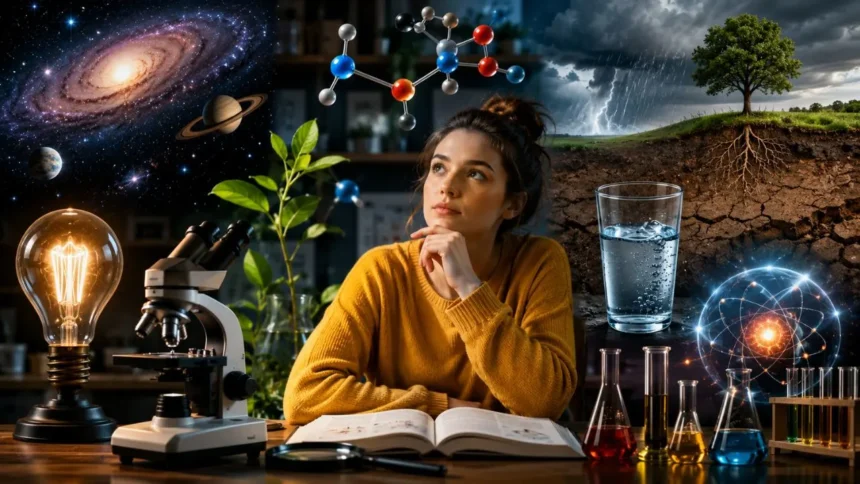
Science is part of almost everything we do each day. It explains why the sky looks blue, why ice floats, why soap removes grease, and why we see lightning before hearing thunder. These questions may seem simple, but the answers show how nature works. Learning everyday science can make the world around us easier to understand.
You don’t need advanced formulas or difficult words to understand common science questions. Most everyday events can be explained through basic ideas about light, heat, air, water, sound, and the human body. Once these ideas are clear, many confusing things begin to make sense. Science becomes more interesting when it connects with real life.
This guide answers common science questions using easy words and familiar examples. Each section explains what happens, why it happens, and where you may notice it in daily life. The explanations are written for beginners, students, and curious readers. You can use them to learn, revise, or simply satisfy your curiosity.
Science doesn’t always provide a one-line answer because many events involve several forces working together. However, the basic reason can usually be explained clearly. The goal is not to memorize every detail but to understand the main idea. That understanding can help you ask better questions about the world.
Why Is the Sky Blue?
Sunlight may look white, but it contains many colors. These colors include red, orange, yellow, green, blue, and violet. Each color travels as a different wavelength of light. Blue light has a shorter wavelength than red light.
When sunlight enters Earth’s atmosphere, it hits tiny gas particles. These particles scatter shorter wavelengths more strongly than longer wavelengths. Blue light is therefore spread across the sky in many directions. That scattered light reaches our eyes from almost every part of the sky.
The sky doesn’t usually look violet even though violet light has an even shorter wavelength. Human eyes are more sensitive to blue light than violet light. Some violet light is also absorbed high in the atmosphere. As a result, blue becomes the main color we notice.
At sunrise and sunset, sunlight travels through more of the atmosphere. Much of the blue light is scattered away before reaching our eyes. Red and orange light can travel through more easily. This is why sunsets often appear red, orange, or pink.
Why Does It Rain?
Rain begins when water from oceans, lakes, rivers, plants, and soil enters the air. Heat from the Sun changes some liquid water into water vapor. This process is called evaporation. The vapor rises because warm air is lighter than cool air.
As the moist air rises, it becomes cooler. The water vapor then changes into tiny liquid droplets. This process is called condensation. Large groups of these droplets form clouds.
Cloud droplets are very small and can stay in the air for some time. They move around and join with other droplets. As they combine, they become larger and heavier. Eventually, the air can no longer hold them up.
The heavy droplets fall toward the ground as rain. If the air is cold enough, water may fall as snow, sleet, or hail instead. Rain is part of the water cycle that moves water around Earth. Without this cycle, plants, animals, and people couldn’t survive.
Why Does Ice Float on Water?
Most solid materials are denser than their liquid forms. Water behaves differently because of the way its molecules arrange themselves when it freezes. In liquid water, the molecules move around and stay fairly close together. In ice, they form a more open structure.
This open structure takes up more space than the same amount of liquid water. The mass stays the same, but the volume becomes larger. This makes ice less dense than liquid water. Materials that are less dense than water can float on it.
You may notice this when ice cubes rise to the top of a drink. The same rule explains why icebergs float in the ocean. Most of an iceberg remains below the surface because ice is only slightly less dense than water. A smaller part stays visible above the water.
Floating ice is important for life in cold places. When lakes freeze, the ice forms on the surface first. The layer of ice slows heat loss from the water below. Fish and other living things can survive in the liquid water underneath.
Why Do We See Lightning Before Hearing Thunder?
Lightning and thunder happen at almost the same time. Lightning is a bright flash caused by a powerful electrical discharge in the atmosphere. Thunder is the sound created when lightning quickly heats the surrounding air. The heated air expands and produces a strong pressure wave.
We see lightning before hearing thunder because light travels much faster than sound. Light moves so quickly that it appears to reach us almost instantly over short distances. Sound travels through air much more slowly. It may take several seconds for thunder to arrive.
You can estimate how far away a storm is by counting the seconds between lightning and thunder. About three seconds usually represents roughly one kilometer of distance. About five seconds represents close to one mile. This is only an estimate because local conditions can affect sound.
If the time between lightning and thunder becomes shorter, the storm may be moving closer. Lightning can strike far from the center of a storm. The safest place is inside a solid building or closed vehicle. Outdoor shelters, trees, and open fields don’t provide safe protection.
Why Do We Yawn?
Yawning is an automatic action in which we open our mouth and take a deep breath. People often yawn when they are tired, bored, waking up, or getting ready to sleep. Scientists have studied yawning for many years. Its exact purpose is still not completely understood.
One idea is that yawning may help control brain temperature. A deep breath and movement of the jaw may increase blood flow around the head. Cooler air may also enter the mouth and nose. Together, these changes may help the brain stay at a useful temperature.
Yawning is also connected with changes in alertness. People may yawn when moving from sleep to wakefulness or from activity to rest. This suggests that yawning may help the body change between different states. It isn’t simply a sign that the body needs more oxygen.
Yawning can also be contagious. Seeing, hearing, or even reading about yawning can make another person yawn. This response may be linked with attention, social behavior, and brain activity. However, researchers are still studying why some people are more affected than others.
Why Does Soap Remove Grease?
Water alone doesn’t remove grease very well. Water molecules are attracted to one another, while oil and grease don’t mix easily with water. This is why greasy dishes remain slippery after rinsing. Soap solves the problem by connecting water with oil.
A soap molecule has two different ends. One end is attracted to water. The other end is attracted to oil and grease. This special shape allows soap to surround greasy dirt.
When you scrub with soap and water, the oil-loving ends move into the grease. The water-loving ends remain outside and face the water. The soap molecules form tiny groups around the grease. These groups can then move through the water.
Rinsing carries the trapped grease away from the surface. Warm water can make the process easier because it softens many types of fat. Scrubbing also helps break dirt into smaller pieces. This is why soap, water, and movement work better together than water alone.
Why Do Onions Make Us Cry?
Cutting an onion damages its cells. This allows chemicals that were stored separately inside the onion to mix together. A chemical reaction begins and creates an irritating gas. The gas rises into the air near your face.
When the gas reaches your eyes, it mixes with the moisture on their surface. This creates a mild irritating substance. Nerves in the eyes detect the irritation. Your brain then tells the tear glands to produce more tears.
The extra tears help wash the irritating chemical away. This is a protective response rather than an emotional reaction. Your eyes are trying to clean themselves. The burning feeling usually stops after you move away from the gas.
A sharp knife may reduce tearing because it damages fewer onion cells. Cooling the onion can also slow the chemical reaction. Good airflow helps move the gas away from your face. None of these methods works perfectly, but they may make cutting onions easier.
Why Do We Get Static Electricity?
Static electricity happens when electric charges build up on the surface of an object. All matter contains tiny particles, including negatively charged electrons. When two materials touch and separate, some electrons may move from one surface to another. One object then gains extra electrons while the other loses some.
Walking across a carpet can create static electricity. Your shoes rub against the carpet and may collect extra electrons. These charges remain on your body for a short time. They can build up when the air is dry.
When you touch a metal object, the extra electrons may move suddenly. This quick movement creates a tiny electric spark. You may feel a small shock or hear a snapping sound. The event is fast and usually harmless.
Static electricity is more common in dry weather because moisture helps charges move away. Humid air contains more water vapor, which allows electricity to escape more easily. Clothing made from certain materials can also increase static buildup. Fabric softener and added moisture may reduce the problem.
Why Do Mirrors Show a Reflection?
We see objects when light enters our eyes. Light may come directly from a source or bounce off another surface. A mirror has a very smooth reflective surface. It sends much of the incoming light back in an organized direction.
When light hits a mirror, it reflects at the same angle at which it arrived. This basic rule is called the law of reflection. Because the mirror is smooth, reflected rays remain well ordered. Your brain uses those rays to form an image.
The image appears to be behind the mirror. However, no real object exists in that space. Your brain assumes that light travels in straight lines. It traces the reflected rays backward and places the image where they seem to meet.
A normal mirror also appears to reverse left and right, but this description isn’t fully accurate. A mirror actually reverses front and back. You turn yourself around when comparing your image with another person facing you. This creates the familiar left-right effect.
Why Do We Hear Echoes?
Sound travels through air as waves. When a sound wave reaches a hard surface, part of it may bounce back. If the reflected sound reaches your ears after the original sound, you hear an echo. Large walls, mountains, and empty buildings can create clear echoes.
Soft materials absorb more sound than hard materials. Curtains, carpets, furniture, and clothing reduce reflections. Smooth concrete, stone, glass, and metal reflect sound more strongly. This is why an empty room often sounds louder and more hollow than a furnished one.
The reflecting surface must be far enough away for a separate echo to be heard. If it is too close, the reflected sound mixes with the original sound. This creates reverberation rather than a clear repeat. Reverberation is the lingering sound often heard in halls and large rooms.
Animals and technology can use echoes to find objects. Bats send out high-pitched sounds and listen to the returning waves. Ships use sonar to measure underwater distance. Medical ultrasound also uses reflected sound waves to create images inside the body.
Why Does Metal Feel Colder Than Wood?
A metal object and a wooden object in the same room may have the same temperature. However, the metal often feels much colder when you touch it. This difference comes from how quickly each material moves heat. Metal transfers heat much faster than wood.
Your hand is usually warmer than objects in the room. When you touch metal, heat moves quickly from your skin into the metal. Your skin temperature drops rapidly. Your nerves interpret this fast heat loss as coldness.
Wood is a poor conductor of heat. It removes heat from your hand much more slowly. Your skin therefore stays warmer while touching it. The wood feels less cold even though its measured temperature may match the metal.
The same idea explains why metal can feel hotter than wood in a warm place. Metal transfers heat into your skin quickly when it is warmer than your body. Good conductors create stronger temperature sensations. Poor conductors slow the transfer of heat.
Why Does Food Cook Faster in a Pressure Cooker?
A pressure cooker traps steam inside a sealed container. As the water heats, more steam forms. The steam can’t escape easily, so pressure builds inside the cooker. This higher pressure changes the way water boils.
At normal air pressure, water boils at about 100 degrees Celsius. Inside a pressure cooker, water can reach a higher temperature before boiling strongly. The hotter water and steam transfer more heat to the food. This allows food to cook faster.
Pressure cookers are useful for beans, meat, rice, and other foods that normally take a long time. They can also use less energy because the cooking time is shorter. The sealed space reduces water loss. Food often stays moist during cooking.
Modern pressure cookers include safety systems that control or release extra pressure. Users should still follow the manufacturer’s instructions carefully. The lid shouldn’t be opened while the cooker remains pressurized. Safe use depends on correct filling, cleaning, and pressure release.
Why Do Seasons Change?
Seasons happen because Earth is tilted as it travels around the Sun. Earth’s axis is tilted by about 23.5 degrees. This means different parts of Earth receive different amounts of direct sunlight during the year. The changing distance from the Sun isn’t the main cause of seasons.
When the Northern Hemisphere tilts toward the Sun, it receives more direct sunlight. The days are longer and the Sun appears higher in the sky. More energy reaches the ground each day. This creates summer in the Northern Hemisphere.
At the same time, the Southern Hemisphere tilts away from the Sun. It receives less direct sunlight and has shorter days. This creates winter there. Six months later, the two hemispheres exchange these conditions.
Spring and autumn happen between the hottest and coldest parts of the yearly cycle. During these periods, neither hemisphere points strongly toward or away from the Sun. Daylight and temperature gradually change. Local weather can still make seasons feel different from one place to another.
Why Do Stars Twinkle?
Stars produce their own light, but they are extremely far away. From Earth, each star appears almost like a single point of light. Before reaching our eyes, starlight must pass through many layers of the atmosphere. These layers are always moving and changing.
Air at different temperatures has slightly different densities. As starlight passes through these moving layers, its path bends again and again. The amount of bending changes quickly. This makes the star appear to change in brightness and position.
Planets usually twinkle less than stars. They are closer to Earth and appear as tiny disks rather than single points. Light from different parts of the disk passes through different areas of air. These changes partly balance one another.
Stars may twinkle more when they are close to the horizon. Their light must travel through a larger amount of atmosphere before reaching us. Space telescopes avoid this problem because they operate above Earth’s atmosphere. This allows them to capture clearer images of distant objects.
Why Does Hot Air Rise?
When air becomes warmer, its molecules move faster and spread farther apart. The same amount of warm air then takes up more space. This makes it less dense than the cooler air around it. Less dense air is pushed upward by denser air.
As warm air rises, cooler air moves in to replace it. This movement creates a current called convection. Convection occurs in the atmosphere, oceans, rooms, and cooking pots. It is one of the main ways heat moves through fluids.
You can notice convection near a heater. The air close to the heater becomes warm and rises. Cooler air moves toward the heater and is warmed in turn. This cycle helps spread heat through the room.
Rising warm air also affects weather. Warm, moist air can rise, cool, and form clouds. Large differences in air temperature can create stronger winds and storms. Many weather patterns begin with the movement of warm and cool air.
Why Do We Sweat When We Are Hot?
Sweating is one of the body’s main cooling systems. Sweat glands release water and small amounts of salts onto the skin. The liquid sweat doesn’t cool the body simply by appearing. Cooling happens mainly when the sweat evaporates.
Evaporation requires energy. When sweat changes from liquid to vapor, it takes heat from the skin. This lowers the temperature of the skin and nearby blood. The cooler blood then moves through the body.
Sweating works better when the air is dry. Dry air allows water to evaporate more easily. In humid weather, the air already contains a large amount of water vapor. Sweat remains on the skin and cooling becomes less effective.
The body can lose water and salts through heavy sweating. Drinking water helps replace lost fluid. Long periods of heat can lead to heat exhaustion or heatstroke. Rest, shade, cooling, and proper hydration are important during hot weather.
How Can Everyday Science Help Us?
Understanding everyday science helps people make better decisions. Knowing how heat moves can improve cooking and home insulation. Understanding germs and soap can support better hygiene. Learning about weather can help people prepare for rain, heat, or storms.
Science also teaches us to question claims. Instead of accepting an answer because it sounds confident, we can ask for evidence. We can compare explanations and look for tests or observations. This habit is useful in school, work, health, and daily life.
Simple science knowledge can improve safety. Understanding lightning, electricity, heat, pressure, and chemicals can help prevent accidents. It can also explain why safety instructions matter. Rules feel more reasonable when we understand the science behind them.
Most importantly, science encourages curiosity. Everyday questions can lead to larger ideas about nature, technology, the body, and space. You don’t need to become a scientist to think scientifically. You only need to observe carefully, ask questions, and remain willing to change your mind when better evidence appears.
Final Thoughts
Everyday science explains many events that we see but don’t always understand. Blue skies, rain, floating ice, mirrors, echoes, static shocks, and changing seasons all follow natural rules. These events may look ordinary, but each one reveals something important about how the world works.
Learning science through familiar questions can make difficult ideas easier to remember. Light becomes easier to understand when we connect it with mirrors and sunsets. Heat becomes clearer when we compare metal and wood. Sound becomes more interesting when we study thunder and echoes.
The explanations in this guide cover the main ideas rather than every scientific detail. Some subjects are more complex than they first appear. Scientists continue to study questions such as why people yawn and how the brain processes different experiences. Science grows when new evidence improves old explanations.
Curiosity is the best place to begin. The next time something ordinary catches your attention, ask what causes it. Look for evidence and compare reliable explanations. A simple daily question may become the beginning of a much bigger scientific discovery.
Frequently Asked Questions
Why is the sky blue?
Gas particles in the atmosphere scatter blue light more strongly than most other colors.
Why does ice float?
Ice has a more open molecular structure, making it less dense than liquid water.
Why do onions make us cry?
Cut onions release an irritating gas that causes the eyes to produce protective tears.
Why do we see lightning before thunder?
Light travels much faster than sound, so the flash reaches us before the thunder.
Why does metal feel colder than wood?
Metal removes heat from your hand faster because it conducts heat more effectively.
Why do stars twinkle?
Moving layers of air bend starlight in changing directions before it reaches our eyes.
Why does soap remove grease?
Soap molecules attach to both water and oil, allowing greasy dirt to be rinsed away.
Why do we sweat?
Sweat cools the body when it evaporates from the skin.
Why does hot air rise?
Warm air becomes less dense than cool air, so denser air pushes it upward.
What is everyday science?
Everyday science explains common events using basic ideas about nature, matter, energy, and the human body.