

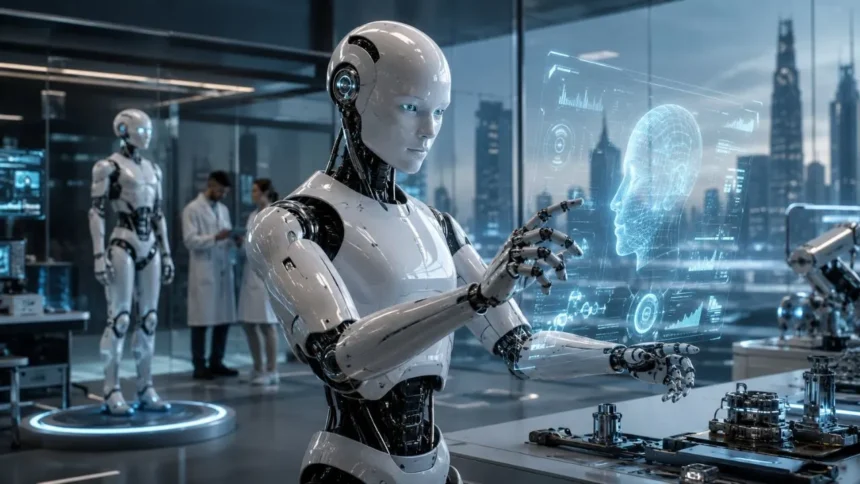
Artificial intelligence is moving beyond computer screens and entering the physical world. Figure AI is one of the companies leading this transition by developing humanoid robots that can walk, understand instructions, handle objects, and complete practical tasks. Its goal is not simply to create an impressive machine, but to build robots that can provide useful assistance in places designed for humans.
Unlike traditional industrial robots, which are normally fixed in one location and programmed for a specific task, Figure AI robots are designed to move between different environments. They have two legs, two arms, human-like hands, cameras, sensors, and artificial intelligence. This body shape allows them to use existing tools, walk through human spaces, and perform work without requiring an entire building to be redesigned.
The company has already moved beyond laboratory demonstrations. Figure robots have worked on an active automotive production line, handled warehouse items, completed household activities, and followed natural-language commands. In June 2026, the latest Figure 03 robot returned to BMW’s Spartanburg plant to demonstrate a more complex logistics and parts-sequencing workflow powered by the Helix 02 AI system.
These developments have made Figure AI an important name in humanoid robotics, embodied artificial intelligence, industrial automation, and home robotics. However, the technology is still developing, and major questions remain about reliability, safety, affordability, employment, privacy, and public acceptance. Understanding both its potential and its limitations provides a clearer picture of where humanoid robots may be heading.
What Is Figure AI and Why Does It Matter?
Figure AI is an American robotics company founded in 2022 by entrepreneur Brett Adcock. The company’s central mission is to expand human capabilities through advanced artificial intelligence. It aims to develop commercially useful, general-purpose humanoid robots that can eventually operate in workplaces, homes, and other environments created around the human body.
The term “general-purpose” is important because Figure does not want its robots to perform only one carefully programmed activity. A general-purpose humanoid robot should be able to learn different skills, understand changing surroundings, respond to spoken instructions, and move between tasks. It might handle materials in a factory, sort packages in a warehouse, and eventually assist with everyday household work.
Figure AI believes that a human-shaped machine offers practical advantages. Modern buildings, tools, shelves, doorways, stairs, workstations, and vehicles were designed for people. A robot with arms, legs, hands, and a similar range of movement can theoretically work within these spaces without requiring businesses or homeowners to install completely new systems.
This approach separates humanoid robots from conventional automation. A fixed robotic arm may be faster and more accurate at one repeated movement, but it cannot easily walk across a room, open a door, collect an unfamiliar object, or change jobs. Figure AI is attempting to combine the adaptability of a human worker with the consistency, computing power, and learning ability of an intelligent machine.
From Figure 01 to the Figure 03 Humanoid Robot
Figure 01 was the company’s first-generation humanoid robot and took its first steps in May 2023. It served as an early platform for testing movement, balance, manipulation, hardware design, and AI control. The robot helped Figure’s engineering team understand how its software, mechanical systems, electrical components, hands, and battery needed to work together.
Figure 02 represented a major improvement in physical design and real-world readiness. It featured more advanced hands, improved movement, integrated computing, better cameras, and a battery built into its torso. More importantly, Figure 02 was tested outside the company’s laboratory and used on an active production line at BMW Group Plant Spartanburg.
That deployment produced valuable operating data. Figure reported that Figure 02 completed more than 1,250 hours of runtime, loaded over 90,000 parts, took an estimated 1.2 million steps, and contributed to the production of more than 30,000 BMW X3 vehicles. The robots operated during regular 10-hour weekday shifts, giving engineers information about reliability, cycle times, accuracy, and hardware failures.
Figure 03, introduced in October 2025, was redesigned for more advanced artificial intelligence, household environments, commercial work, and high-volume manufacturing. The company reduced unnecessary parts, improved its sensory systems, developed more capable hands, introduced wireless charging, strengthened battery safety, and replaced several expensive manufacturing processes with techniques better suited to mass production.
How Figure 03 Is Designed to Work Around People
Figure 03 is designed to appear and move less like a heavy industrial machine and more like a practical assistant. Its exterior includes soft textiles and carefully positioned foam around possible pinch points. Figure says the robot has less mass and volume than Figure 02, which should make it easier to move through narrow hallways, crowded work areas, kitchens, and other human environments.
Its updated camera system provides a wider field of view, a higher frame rate, and lower visual-processing latency. These improvements help the robot observe its surroundings more frequently and react more quickly. Better visual awareness is especially important when the robot is walking through clutter, reaching inside a cabinet, handling an unfamiliar object, or working close to people.
Each Figure 03 hand includes a palm camera that provides close-range visual information when an object is blocked from the robot’s main cameras. Its fingertips also contain tactile sensors capable of detecting very small amounts of pressure. Figure reports that these sensors can recognize forces as low as three grams, helping the robot adjust its grip before an object slips or becomes damaged.
The robot also supports wireless inductive charging through coils in its feet. Instead of requiring a person to connect a cable, Figure 03 can step onto a charging platform and recharge at up to two kilowatts. This feature could allow robots to manage their energy during breaks, return to work after charging, and operate for longer periods with less direct human assistance.
Helix AI: The Intelligence Behind Figure Robots
Hardware gives a humanoid robot the ability to move, but artificial intelligence determines whether those movements are useful. Figure’s main AI platform is called Helix. It is a vision-language-action model, often shortened to VLA, which connects visual information, language understanding, decision-making, and physical control inside one learning-based system.
Vision allows the robot to identify objects, people, furniture, containers, surfaces, and obstacles. Language processing helps it understand instructions such as “place the cup in the cabinet” or “carry these parts to the next station.” The action component converts those instructions and visual observations into coordinated movements across the robot’s hands, arms, torso, head, and legs.
The original Helix system combined a slower reasoning layer with a faster movement layer. The reasoning system interpreted the environment and decided what the robot should do, while the movement system produced rapid physical commands. Figure demonstrated Helix controlling two robots that worked together to store unfamiliar grocery items using natural-language instructions.
This type of AI reduces the need to manually program every movement. A traditional robot may require a separate set of instructions for each object, position, and task. A learning-based humanoid system aims to recognize similarities between situations and adjust its behaviour. That flexibility is essential in homes and warehouses, where objects rarely remain in perfectly predictable locations.
How Helix 02 Enables Full-Body Autonomy
Helix 02, introduced in January 2026, expanded Figure’s AI control from the robot’s upper body to its entire body. The system connects information from cameras, touch sensors, and internal movement sensors directly to the robot’s actuators. This allows walking, balancing, reaching, carrying, and object manipulation to function as one continuous behaviour.
The architecture contains three main control levels. System 2 interprets language, understands the scene, and identifies the wider goal. It converts those goals into full-body movement targets at high speed. System 0 manages balance, physical contact, posture, and joint coordination at an even faster rate, allowing the robot to react to physical changes while completing a task.
System 0 was trained using more than 1,000 hours of retargeted human-motion data and reinforcement learning in over 200,000 simulated environments. Instead of manually programming separate movements for walking, turning, crouching, and reaching, Figure trained the model to learn patterns from human movement while maintaining stability.
Figure demonstrated Helix 02 unloading and reloading a dishwasher during a continuous four-minute autonomous sequence. The robot walked across a kitchen, carried dishes, opened storage areas, stacked objects, and used different parts of its body to complete the workflow. Figure states that the demonstration was performed using onboard sensors without teleoperation or human intervention.
How Figure Robots Learn New Skills
Teaching robots to work in the real world requires large amounts of diverse information. A robot trained only in a perfectly arranged laboratory may fail when lighting changes, an object moves, a surface becomes uneven, or someone places an unexpected item in its path. Figure therefore combines robot demonstrations, simulation, human-motion information, and real-world operating data.
Simulation allows engineers to train thousands of virtual robots at the same time. These digital robots can experience different floor conditions, body weights, object positions, lighting environments, and physical disturbances. Reinforcement learning rewards movements that successfully achieve a goal, helping the system develop stable behaviours before those behaviours are transferred to physical hardware.
Figure has also explored training robots through human video. Because humanoid robots have body structures and viewpoints similar to people, the company believes human activity can provide valuable training information. Its Project Go-Big initiative uses first-person human video to teach navigation and physical behaviours without requiring every example to be recorded directly by a robot.
Real-world deployments create another important learning source. Factory and logistics environments reveal equipment failures, unusual object positions, communication problems, and long-tail situations that controlled testing may miss. The larger Figure’s robot fleet becomes, the more operational information the company can collect to improve its hardware, AI models, diagnostics, software updates, and recovery procedures.
Figure AI in Manufacturing and Automotive Production
Factories provide a practical starting point for humanoid robot deployment because businesses can define tasks, measure results, and supervise the machines. Figure’s partnership with BMW placed its robots in an actual automotive manufacturing environment, where accuracy, reliability, timing, and safety are essential for keeping a production line operating.
The first major BMW use case involved loading sheet-metal parts into a welding fixture. Although the action may sound simple, each part had to be collected, carried, positioned within a small tolerance, and placed quickly enough to match the line’s cycle time. The robot also needed to adjust its movements when components were not located in exactly the expected position.
In June 2026, Figure 03 began demonstrating a more complex sequencing workflow at BMW Group Plant Spartanburg. The robot selected thin metal parts, placed them into the correct positions, moved while carrying components, and pulled a large cart. The task required both precise hand control and stronger whole-body movement within the same workflow.
This application shows why companies are interested in humanoid automation. Some manufacturing tasks are too variable for a fixed robotic arm but remain physically repetitive for employees. A mobile humanoid robot could potentially move between existing stations, handle changing objects, use human tools, and take over difficult activities without forcing a factory to rebuild every workspace.
Figure AI in Warehouses and Logistics
Warehouses contain many repetitive tasks that also require flexibility. Packages can differ in weight, size, material, colour, and shape. Boxes may arrive damaged, bags may bend while being lifted, and items may be partly hidden behind one another. These conditions make logistics an important test of robotic vision, grip control, reasoning, and adaptability.
Figure has demonstrated its Helix system handling different types of packages and sorting items in logistics environments. Rather than relying entirely on fixed coordinates, the robot uses camera information to recognize an item and adjust its grip. Its tactile sensors can provide additional information when objects move, slip, or require a softer amount of pressure.
In May 2026, Figure announced a commercial agreement with Catalyst Brands to deploy humanoid robots within its distribution and logistics network. The collaboration began at a distribution centre in Reno, Nevada, with an initial focus on physically demanding supply-chain activities.
The value of humanoid robots in logistics will depend on more than impressive demonstrations. Businesses will examine how many items a robot can handle per hour, how often it needs assistance, how quickly it recovers from errors, and whether its operating cost is competitive. Maintenance requirements, charging time, worker training, and integration with warehouse software will also affect adoption.
Can Figure AI Robots Work in the Home?
The home may be the most attractive market for humanoid robots, but it is also one of the most difficult. Homes are less structured than factories and contain fragile objects, pets, children, stairs, loose clothing, changing furniture positions, narrow spaces, reflective surfaces, liquids, and countless items that a robot may never have encountered during training.
Figure 03 includes several features intended for domestic environments. Its softer exterior reduces the amount of exposed hard material, while improved microphones and speakers support clearer voice communication. Replaceable and washable fabric coverings may also make the robot easier to maintain after completing activities involving dust, food, laundry, or household waste.
Figure has demonstrated robots loading dishwashers, folding laundry, opening doors, arranging objects, and working together to reset a bedroom. In a May 2026 demonstration, two Helix-02-equipped robots completed tasks including making a bed, hanging clothing, moving a chair, putting away headphones, and removing rubbish while responding to each other’s movements.
However, household demonstrations should not be confused with unrestricted consumer readiness. A robot that completes a prepared task may still struggle with unexpected interruptions, unusual floor layouts, pets moving under its feet, damaged objects, or unclear instructions. Home adoption will require strong safety systems, easy controls, affordable maintenance, privacy protection, and dependable performance across thousands of ordinary situations.
Scaling Production Through the BotQ Factory
Building a few working robots is very different from manufacturing thousands of reliable units. Humanoid robots contain advanced motors, actuators, sensors, batteries, cameras, electronic boards, structural components, and precision hands. Producing these systems at a practical cost requires specialised supply chains, automated testing, quality control, manufacturing software, and repair infrastructure.
Figure created BotQ as its high-volume humanoid robot manufacturing facility. The company originally stated that the first-generation production line would be capable of manufacturing as many as 12,000 robots per year. It also redesigned Figure 03 around processes such as injection moulding, die-casting, stamping, and other techniques that are faster than machining every part individually.
By April 2026, Figure reported that BotQ had produced more than 350 Figure 03 robots and demonstrated a manufacturing speed of one robot per hour. The company said this represented a 24-times improvement from its earlier rate of one robot per day. It also introduced dozens of production inspections and more than 80 functional verification tests for each completed robot.
Production scale matters because larger fleets create more than sales opportunities. They also provide additional training data, operating hours, hardware feedback, and examples of unusual failures. Figure can use this information to improve future designs and deliver software updates across its fleet. However, the ability to manufacture robots quickly does not automatically prove that every unit can perform useful work economically.
Funding, Partnerships, and Commercial Growth
Humanoid robotics requires major investment because companies must develop both advanced AI software and complex physical hardware. Figure must pay for computing infrastructure, robotics engineers, manufacturing equipment, specialised components, testing facilities, field support, data collection, and customer deployments before large-scale revenue is guaranteed.
In September 2025, Figure announced that its Series C funding had exceeded $1 billion in committed capital at a reported post-money valuation of $39 billion. The company said the funding would support Helix development, GPU infrastructure, humanoid production, real-world deployments, and larger data-collection programmes.
Figure has also developed partnerships that provide environments for both training and commercial deployment. BMW offers industrial manufacturing experience, while Catalyst Brands provides logistics and distribution opportunities. A partnership with Brookfield gives Figure access to a wide variety of residential, commercial, and logistics spaces that may support data collection and future robot applications.
These relationships are strategically important because humanoid robots cannot be improved through laboratory research alone. They must operate around real shelves, doors, containers, machinery, people, and unexpected situations. At the same time, commercial partners will expect measurable productivity, limited downtime, strong safety records, and clear financial benefits before expanding from pilot projects to large robot fleets.
Potential Benefits of Figure AI Humanoid Robots
One major benefit of humanoid robots is their potential to take over dangerous or physically exhausting work. Repeated lifting, bending, reaching, moving heavy carts, and handling materials can place significant strain on employees. Robots could perform some of these activities while allowing people to focus on supervision, maintenance, problem-solving, customer service, and higher-value work.
Humanoid robots could also help businesses respond to labour shortages. Industries such as manufacturing, warehousing, construction, healthcare support, and elder care may struggle to fill certain roles. A flexible robot that can learn multiple activities may provide more value than separate machines designed for every individual process, particularly when tasks or demand change.
In the home, future robots could support older adults, people with disabilities, busy families, and individuals recovering from injuries. They might carry items, prepare simple spaces, load appliances, collect objects, or provide reminders. These uses could help people maintain independence, although sensitive care activities would require strict supervision, strong ethical standards, and careful human involvement.
The wider benefit may be the creation of a new physical interface for artificial intelligence. Digital AI can generate text, analyse information, and answer questions, but it cannot normally interact with the physical world. Humanoid robots combine AI reasoning with movement, touch, vision, and manipulation, potentially allowing intelligent systems to turn decisions into useful real-world actions.
Risks and Challenges Facing Figure AI
Safety is the most important challenge because humanoid robots are large, powerful machines operating near people. A software error, sensor failure, unstable movement, or incorrect interpretation could cause damage or injury. Reliable emergency stops, force limits, collision detection, secure updates, controlled operating zones, and independent safety testing will be necessary for wider deployment.
Reliability is another obstacle. A commercial robot must repeat useful tasks for long periods without frequent resets or repairs. Real environments create dust, heat, vibration, spills, worn components, network problems, and unpredictable human behaviour. A successful demonstration lasting several minutes does not answer every question about months or years of daily operation.
Employment concerns will also influence public acceptance. Humanoid robots may reduce demand for certain repetitive jobs while creating new positions in robotics maintenance, fleet management, AI training, safety, and system integration. The impact will differ between industries, making worker retraining and responsible deployment important parts of the transition.
Privacy and cybersecurity become especially serious when robots enter homes. Their cameras, microphones, movement records, and environmental data could reveal sensitive details about daily life. Companies will need secure data storage, clear user controls, strong authentication, limited access, and transparent explanations of what information is recorded, uploaded, retained, or used to train future AI systems.
The Future of Figure AI and Humanoid Robotics
Figure AI’s near-term future is likely to focus on controlled commercial environments. Factories, warehouses, and distribution centres offer tasks that can be clearly measured and improved. Robots may begin with a narrow set of activities and gradually expand as their reliability, speed, dexterity, and ability to recover from mistakes become stronger.
Home robotics will probably develop more slowly because domestic environments contain greater variation and higher safety expectations. Early home robots may perform supervised activities such as tidying, carrying objects, loading appliances, or helping with simple routines. More sensitive roles involving children, medical care, or unsupervised assistance will require considerably more evidence and regulation.
The biggest technological improvements are likely to come from larger training datasets, better tactile sensors, faster visual processing, more efficient batteries, stronger actuators, and AI models that learn from fewer demonstrations. Fleet learning may also become important, allowing an improvement discovered by one robot to be tested and distributed to many others through secure software updates.
Figure AI has made meaningful progress from early prototypes to manufacturing and workplace deployments, but the wider humanoid robotics market is still at an early stage. The future will depend less on promotional videos and more on measurable results: task success, operating cost, safety, energy use, repair frequency, human satisfaction, and performance in unpredictable situations.
Conclusion
Figure AI represents an ambitious effort to bring artificial intelligence into the physical world. Its humanoid robots are designed to walk through human spaces, understand spoken instructions, manipulate different objects, and learn behaviours that would be difficult to program individually. This combination of robotics, computer vision, language models, and reinforcement learning makes Figure an important company to watch.
The progression from Figure 01 to Figure 03 shows how quickly its technology has developed. Figure 02 provided real-world manufacturing data at BMW, while Figure 03 introduced better sensory hardware, more capable hands, wireless charging, softer materials, and a design suitable for higher production volumes. Helix 02 has further expanded the robot’s ability to coordinate movement, balance, reasoning, and manipulation.
Even with this progress, general-purpose humanoid robots are not yet a simple replacement for human workers or household help. They remain expensive, technically complex systems that must prove their safety and long-term reliability. Commercial value will depend on whether they can complete useful activities consistently without requiring constant human assistance, repairs, or environmental changes.
The future of Figure AI will therefore be shaped by practical performance rather than appearance alone. When humanoid robots can safely learn new tasks, adapt to unfamiliar surroundings, and deliver clear economic or personal value, they may become a normal part of factories, warehouses, and homes. Until then, Figure’s developments offer an important view of how intelligent machines may eventually work beside people.
FAQs About Figure AI
What does Figure AI do?
Figure AI develops general-purpose humanoid robots powered by artificial intelligence. Its robots are designed to complete physical tasks in factories, warehouses, logistics centres, and eventually homes.
What is the latest Figure AI robot?
Figure 03 is the company’s third-generation humanoid robot. It includes improved cameras, tactile hands, wireless charging, home-friendly materials, advanced AI integration, and a design created for larger-scale manufacturing.
What is Helix in Figure AI?
Helix is Figure’s vision-language-action AI system. It helps robots understand visual information and spoken instructions before converting that information into coordinated physical movements.
Is Figure AI working with BMW?
Yes. Figure robots have operated at BMW Group Plant Spartanburg. Figure 02 supported vehicle production, while Figure 03 began demonstrating a more advanced logistics and parts-sequencing workflow in June 2026.
Can people buy a Figure AI robot for their home?
Figure is developing Figure 03 with household environments in mind, but it has not yet become a widely available consumer product. Further testing, safety improvements, support systems, and cost reductions are needed before broad home adoption.