

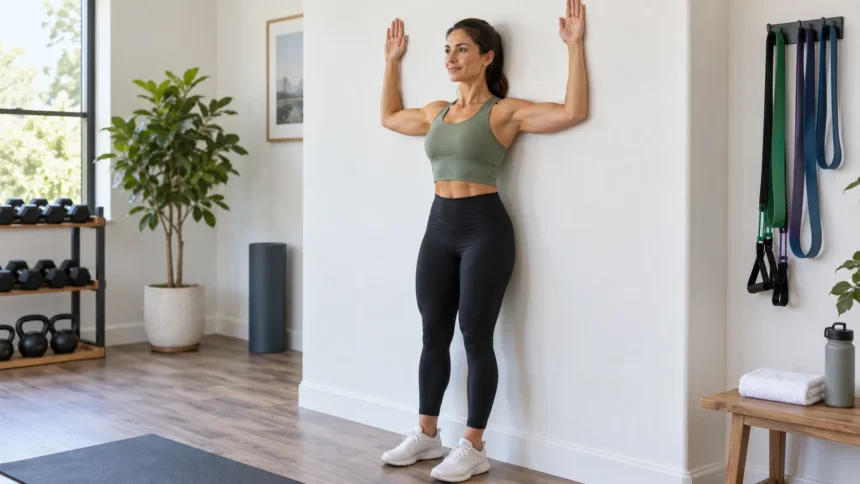
Wall slides are a simple bodyweight exercise commonly used to improve shoulder mobility, upper-back control, and awareness of arm movement. They require little or no equipment and can be performed at home, in the gym, or as part of a warm-up. When done correctly, wall slides encourage the shoulders and shoulder blades to move together through a controlled range.
Although the exercise looks easy, proper form matters. Arching the lower back, shrugging the shoulders, or forcing the arms higher than your comfortable range can reduce the quality of the movement. Learning the correct technique and choosing a suitable variation can make wall slides a useful addition to mobility, strength, and posture-focused routines.
What Are Wall Slides?
Wall slides are an upper-body mobility exercise performed while standing or sitting against a wall. You begin with your back supported and move your arms upward and downward while trying to maintain comfortable contact with the wall. The movement challenges shoulder mobility, upper-back positioning, and control of the shoulder blades.
The exercise is sometimes called a wall angel because the arm motion resembles making a snow angel while standing upright. However, different versions use slightly different starting positions and ranges. Some people begin with bent elbows at shoulder height, while others start with their arms lower and gradually slide them overhead.
Wall slides are commonly included in warm-ups, rehabilitation programs, and general mobility sessions. They can help you practice raising the arms without excessive shrugging or spinal compensation. The goal is not necessarily to press every part of your body flat against the wall, but to move smoothly within a comfortable and controlled range.
What Muscles Do Wall Slides Work?
Wall slides primarily involve muscles around the shoulders, upper back, and shoulder blades. The serratus anterior helps control the scapula as your arms move upward, while the trapezius muscles contribute to upward rotation and stabilization. Several rotator cuff muscles also work to keep the shoulder joint controlled during the movement.
The muscles of the upper back assist with maintaining an upright position as the arms travel overhead. Depending on your technique, the rear shoulders and muscles around the shoulder blades may also become active. These muscles help coordinate movement between the upper arm bone, shoulder blade, and rib cage during overhead reaching.
Your core plays a supporting role because it helps prevent excessive arching of the lower back. When shoulder mobility is limited, the body may try to gain extra range by extending through the spine. Gentle abdominal engagement can help keep the movement focused on the shoulders and upper back instead of creating unnecessary compensation.
Benefits of Wall Slides
One of the main benefits of wall slides is improved shoulder movement awareness. The wall gives you immediate feedback about your body position, making it easier to notice when your shoulders shrug or your lower back begins to arch. This can help you practice smoother overhead movement with better control.
Wall slides may also improve mobility around the shoulders and upper back when performed consistently. People who spend long hours sitting, typing, or working with their arms in front of them may find overhead movement feels restricted. Gentle wall slides provide a controlled way to explore that range without immediately adding external resistance.
Another advantage is accessibility. The exercise requires only a clear wall and a small amount of space, making it easy to include in home workouts or work breaks. It can also complement strength exercises such as overhead presses, rows, push-ups, and other movements that depend on healthy shoulder and scapular control.
How to Do Wall Slides With Proper Form
Stand with your back against a wall and place your feet a short distance forward if needed for comfort. Gently bring the back of your head and upper back toward the wall without forcing them into position. Bend your elbows and place your arms near the wall at roughly shoulder height.
Slowly slide your arms upward while keeping your shoulders relaxed and your ribs controlled. Move only as high as you can without excessive lower-back arching, shoulder pain, or noticeable shrugging. Pause briefly at the top of your comfortable range, then slowly return your arms to the starting position.
Keep the movement smooth and controlled throughout each repetition. You do not need to keep your wrists, elbows, and entire spine perfectly pressed against the wall if your mobility does not allow it. Quality matters more than forcing contact, so use the wall as a guide rather than treating it as a strict flexibility test.
Common Wall Slide Mistakes
One common mistake is arching the lower back as the arms move overhead. This often happens when the shoulders lack enough mobility to complete the movement comfortably. Instead of forcing the arms higher, reduce the range and keep your ribs from flaring excessively as you slide upward.
Another mistake is shrugging the shoulders toward the ears. This can happen when the upper trapezius takes over or when the movement becomes too difficult. Try to maintain a long neck and allow the shoulder blades to rotate naturally without creating unnecessary tension around the neck and upper shoulders.
People also sometimes press aggressively into the wall in an attempt to maintain perfect contact. This can make the movement uncomfortable and may encourage excessive tension. The exercise should feel controlled rather than forced, so allow small gaps where necessary and gradually work toward improved range as your mobility and coordination develop.
Wall Slides for Shoulder Mobility
Wall slides are particularly useful for practicing overhead shoulder movement. As the arms travel upward, the shoulder blades need to rotate and move along the rib cage. This coordinated motion helps you reach overhead without relying entirely on the shoulder joint itself.
People with limited mobility may notice that their arms stop before reaching fully overhead. That is not automatically a problem, especially if the movement remains pain-free. Work within your current range and focus on gradual improvement instead of trying to match someone else’s flexibility during each session.
Mobility changes generally require consistency rather than aggressive stretching. Performing a few controlled sets several times per week may be more helpful than forcing long sessions occasionally. Pair wall slides with gentle upper-back movement, chest stretching, and strength exercises to create a more complete shoulder mobility routine.
Wall Slides for Posture and Upper-Back Control
Wall slides are sometimes used in posture-focused routines because they encourage awareness of the upper back and shoulder blades. Sitting for long periods can make the chest and shoulders feel stiff, especially when your arms remain forward throughout the day. Wall slides provide a simple movement break that changes this position.
However, posture should not be treated as one perfect position that must be maintained constantly. The body benefits from movement variety, and frequently changing positions is usually more practical than holding yourself rigidly upright. Wall slides can support this approach by encouraging controlled movement rather than simply forcing the shoulders backward.
The exercise may also help strengthen the muscles involved in scapular control when performed with good technique. These muscles support movements such as reaching, lifting, and pressing overhead. Improving their coordination can make everyday upper-body movement feel smoother without requiring heavy resistance or complicated equipment.
How Many Wall Slides Should You Do?
Beginners can start with about 8 to 10 controlled repetitions per set. One or two sets may be enough when the exercise is being used as part of a warm-up or mobility routine. Move slowly and stop the set if your form starts to deteriorate or the shoulders become noticeably uncomfortable.
As your control improves, you can gradually increase to 10 to 15 repetitions or add another set. More repetitions are not automatically better, especially if they cause you to rush through the movement. A smaller number of high-quality repetitions is usually more useful than performing long sets with excessive arching or shoulder shrugging.
Wall slides can be performed several times per week and may even fit into short daily mobility sessions when they remain comfortable. Recovery demands are usually low because the exercise is not heavily loaded. However, people with irritated shoulders should adjust frequency according to symptoms rather than following a fixed number.
Wall Slide Variations for Different Levels
A basic standing wall slide is a good starting point for most people. If standing against the wall feels difficult, you can perform a seated variation with your back supported. This may make it easier to focus on arm movement while reducing the temptation to shift your body or change foot position.
A forearm wall slide is another useful variation. Place your forearms against the wall and slowly slide them upward while allowing the shoulder blades to rotate naturally. This version can help emphasize scapular movement and may feel more comfortable for people who struggle to keep their wrists near the wall.
More advanced versions can include a resistance band around the wrists or a light lift-off at the top of the movement. These variations increase the demand on the shoulder and upper-back muscles. Add resistance only after you can perform the basic exercise with good control and without pain.
Best Practices for Adding Wall Slides to Your Routine
Wall slides work well at the beginning of an upper-body workout because they can prepare the shoulders for reaching and pressing movements. They can also be used during short mobility breaks throughout the day. Keep the repetitions controlled and focus on movement quality rather than treating them like a high-intensity exercise.
Combine wall slides with other movements that address different areas of the body. A balanced mobility routine may include upper-back rotation, hip mobility, ankle movement, and simple foot exercises such as hammer toe exercises when toe flexibility and foot control are also a concern. Full-body movement variety can be more useful than focusing exclusively on one joint.
Progress slowly and pay attention to how your shoulders respond. Mild muscular effort is normal, but sharp pain, catching, numbness, or persistent discomfort is not something to push through. Reduce the range or choose another exercise if wall slides consistently aggravate your symptoms.
When Wall Slides May Not Be Appropriate
Wall slides may not be suitable during the early stages of certain shoulder injuries. If you recently experienced a dislocation, fracture, surgery, or significant muscle or tendon injury, follow the guidance provided by your healthcare professional. Returning to overhead movement too quickly can interfere with recovery.
People with painful shoulder impingement symptoms or limited range may also need a modified version. A smaller movement can sometimes be tolerated, while forcing the arms overhead may increase discomfort. The exact approach depends on the underlying issue, which is why persistent symptoms are better assessed individually.
Stop the exercise if you experience sharp pain, sudden weakness, significant clicking with discomfort, numbness, or symptoms that travel down the arm. These signs can indicate that the problem requires more than basic mobility work. A physiotherapist or other qualified healthcare professional can evaluate your shoulder and recommend appropriate exercises.
Conclusion
Wall slides are a simple exercise for improving shoulder mobility, scapular control, and awareness of overhead movement. They can be performed almost anywhere and require very little equipment. When used consistently, they may help the shoulders and upper back move more comfortably during workouts and everyday activities.
Proper form should always come before range of motion. Keep your ribs controlled, avoid excessive lower-back arching, and do not force the wrists or elbows against the wall. Moving through a smaller pain-free range with good control is more useful than reaching higher by compensating through other parts of the body.
Wall slides are most effective when combined with a balanced routine that includes strength, mobility, and regular movement throughout the day. Start with a manageable number of repetitions and progress gradually. If the exercise causes persistent pain or other unusual symptoms, stop and consider professional assessment before continuing.
FAQs
Are wall slides good for shoulder mobility?
Yes. Wall slides can help you practice controlled overhead movement while encouraging coordination between the shoulder blades and arms. They are especially useful when performed slowly and within a comfortable range.
How many wall slides should I do?
Beginners can start with 8 to 10 repetitions for one or two sets. You can gradually increase the number as your control improves, provided the movement remains comfortable and your form stays consistent.
Should my arms touch the wall during wall slides?
Not necessarily. Limited shoulder mobility may prevent complete contact at first. Focus on smooth, pain-free movement rather than forcing your wrists or elbows against the wall.
Can I do wall slides every day?
Gentle wall slides can be performed frequently when they do not cause irritation. Daily practice may suit some people, while others may prefer several sessions per week depending on shoulder comfort and activity level.
Why do wall slides hurt my shoulders?
Pain may be related to limited mobility, poor technique, an irritated shoulder, or an existing injury. Reduce the range and stop the exercise if discomfort is sharp, persistent, or accompanied by weakness or numbness.