

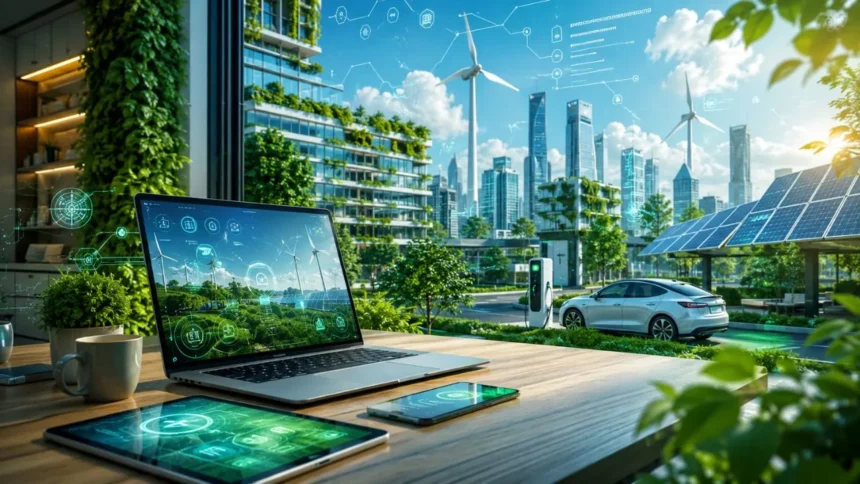
Sustainable technology refers to tools, systems and innovations designed to meet human needs while reducing environmental damage and supporting long-term social and economic wellbeing. It includes technologies that conserve energy, prevent waste, reduce pollution, protect natural resources and help communities become more resilient.
The term covers much more than solar panels or electric cars. Sustainable technology can include energy-efficient buildings, smart electricity grids, water-saving systems, recyclable electronics, low-carbon manufacturing, precision agriculture and software that helps organisations measure and reduce their environmental impact.
A technology is not automatically sustainable simply because it is new or labelled “green.” Its raw materials, manufacturing process, energy consumption, working conditions, useful lifespan and end-of-life disposal must also be considered. A genuine assessment examines the product’s complete environmental and social impact.
As governments, businesses and consumers respond to climate change, resource shortages and rising waste levels, sustainable innovation is becoming increasingly important. The goal is not to stop technological progress, but to guide it towards solutions that improve quality of life without creating greater problems for future generations.
What Is Sustainable Technology in Simple Terms?
In simple terms, sustainable technology is technology that provides a useful service while using fewer resources and causing less harm. It may reduce electricity consumption, replace fossil fuels, conserve water, prevent pollution or help materials remain in use for longer periods.
For example, an energy-efficient heat pump can provide heating and cooling while using less energy than many conventional systems. A smart irrigation system can deliver water only where and when crops need it, helping farmers avoid unnecessary water and energy consumption.
Sustainable technology can also change how products are designed. Instead of creating an electronic device that becomes useless when one component fails, a manufacturer may design it with replaceable parts, repair instructions and recyclable materials. This supports product longevity and reduces electronic waste.
The strongest sustainable solutions balance environmental, technical, economic and social considerations. A technology must work reliably and remain affordable enough to provide practical benefits. UNEP’s sustainable technology assessment approach similarly considers environmental, social, economic and technical performance together.
How Does Sustainable Technology Work?
Sustainable technology works by identifying where resources, energy or materials are being wasted and developing a better way to deliver the same service. The improvement may come from cleaner energy, more efficient equipment, intelligent software, durable materials or a redesigned production process.
Some technologies directly replace a high-pollution activity. Renewable electricity can replace power generated from fossil fuels, while an electric vehicle can reduce the need for petrol or diesel. Other technologies support sustainability indirectly by collecting data, detecting leaks or improving operational decisions.
The most effective approach examines the entire life cycle of a product. This includes raw material extraction, manufacturing, transport, everyday use, repair, reuse and final disposal. Examining only one stage can hide environmental damage occurring elsewhere in the supply chain.
Life cycle assessment helps organisations compare products and identify environmental hotspots without simply moving pollution from one stage or location to another. UNEP describes this approach as evaluating inputs, outputs and potential environmental impacts throughout a product’s complete life cycle.
The Main Principles of Sustainable Technology
The first principle is resource efficiency, which means providing more value with less energy, water and raw material. An efficient technology does not require users to sacrifice the service they need. Instead, it reduces the resources required to provide that service.
The second principle is pollution prevention. A sustainable system should reduce greenhouse gas emissions, toxic chemicals, contaminated wastewater and other harmful outputs. Preventing pollution during design and production is generally more effective than trying to clean it up after it has entered the environment.
The third principle is durability and circularity. Products should remain useful for as long as reasonably possible through reliable construction, maintenance, repair, upgrading, reuse and recycling. This reduces demand for newly extracted materials and limits the volume of waste sent to disposal sites.
The fourth principle is social responsibility. Sustainable technology should support safe working conditions, fair access and benefits that are not limited to wealthy communities. Current international approaches to green industrialisation increasingly emphasise innovation, accessible finance, resilient supply chains and a transition that places people at its centre.
Sustainable Technology vs Green Technology
Sustainable technology and green technology are often used as interchangeable terms, but their meanings can be slightly different. Green technology mainly focuses on reducing environmental damage, such as lowering emissions, preventing pollution or protecting ecosystems.
Sustainable technology usually has a broader meaning. It considers environmental performance alongside economic practicality and social wellbeing. A product may have a small carbon footprint but still be unsustainable if it depends on harmful labour practices or becomes unaffordable for the people who need it.
Clean technology, sometimes called cleantech, is another related term. It commonly describes products and services that improve energy efficiency, generate renewable power, reduce emissions or provide cleaner alternatives in transport, agriculture, water management and manufacturing.
Climate technology focuses more specifically on reducing greenhouse gas emissions or helping communities adapt to climate-related risks. Although the terms overlap, sustainable technology provides the broadest framework because it considers whether an innovation can create lasting benefits across its full life cycle.
Renewable Energy Is a Major Example of Sustainable Technology
Renewable energy technologies generate power from sources that naturally replenish, including sunlight, wind, flowing water and geothermal heat. Solar panels and wind turbines can produce electricity without burning fuel during normal operation, reducing dependence on conventional fossil-fuel power generation.
Battery storage can make renewable electricity more useful by saving energy for periods when the sun is not shining or the wind is not strong. Storage systems can also support backup power, stabilise electricity networks and help homes or businesses use more of the clean energy they generate.
Smart grids strengthen this system by using sensors, automation and digital communication to balance electricity supply and demand. They can help energy providers manage variable renewable generation, locate faults more quickly and encourage users to shift flexible consumption away from periods of high demand.
Renewable power continues to expand rapidly. The International Energy Agency projects that global renewable capacity will increase by almost 4,600 gigawatts between 2025 and 2030, with solar representing nearly 80% of the expected renewable electricity capacity expansion.
Energy-Efficient Buildings and Smart Homes
Buildings consume energy through heating, cooling, lighting, water heating, appliances and electronic equipment. Sustainable building technology aims to deliver comfortable and healthy indoor conditions while reducing unnecessary energy and water consumption.
Better insulation, efficient windows and thoughtful building orientation can reduce the amount of heating or cooling required. Heat pumps, LED lighting, efficient appliances and smart thermostats can then provide essential services using less energy than many older systems.
Building-management software can monitor occupancy, temperature and electricity demand in real time. Instead of heating, cooling or lighting an empty space, automated controls can adjust equipment according to actual conditions. This can reduce operating costs as well as the building’s carbon footprint.
Energy efficiency generally means delivering the same or improved service with less energy input. It is an important first step because lower demand reduces energy costs and eases pressure on electricity systems, including grids that are adding renewable generation and electric technologies.
Sustainable Transportation Technology
Sustainable transportation technology aims to move people and goods while reducing fuel consumption, air pollution, traffic congestion and greenhouse gas emissions. It includes electric vehicles, public transport systems, electric bicycles, cleaner fuels and intelligent traffic-management tools.
Electric cars and buses can eliminate exhaust emissions from the vehicle itself. Their overall environmental benefit depends on how the electricity is generated, how batteries are manufactured and whether materials are recovered responsibly when the battery reaches the end of its useful life.
Public transport technology can often deliver wider benefits because one train or bus can replace many separate car journeys. Real-time scheduling, contactless payments and route-planning applications can make public transport easier to use and help operators provide services more efficiently.
Sustainable mobility also includes walking and cycling infrastructure. Technology can support these options through safer road design, shared bicycles, navigation tools and connected transport systems. The best solution is not always a more advanced vehicle; it may be a system that reduces the need for unnecessary journeys.
Sustainable Manufacturing and Green Industry
Sustainable manufacturing focuses on producing goods with fewer emissions, less waste and more efficient use of energy and materials. Manufacturers may redesign production lines, recover waste heat, electrify machinery or replace harmful substances with safer alternatives.
Digital sensors can monitor equipment and identify inefficiencies before they become serious. Predictive maintenance software can detect unusual performance and schedule repairs before machinery fails. This extends equipment life, reduces downtime and prevents materials from being wasted through faulty production.
Low-carbon industrial technologies are particularly important for sectors such as steel, cement and chemicals. Possible solutions include renewable electricity, green hydrogen, efficient motors, alternative materials, carbon management and the recovery of energy that would otherwise be lost as heat.
Sustainable industrial development must remain economically practical and socially inclusive. UNIDO’s current green-industry work connects cleaner production with resource efficiency, industrial decarbonisation, resilient supply chains, innovation and opportunities for developing economies to participate in growing cleantech markets.
The Role of the Circular Economy
A traditional linear economy follows a “take, make, use and discard” model. Raw materials are extracted, turned into products and eventually thrown away. This approach increases resource consumption and creates a growing volume of waste.
A circular economy aims to keep products and materials in use for as long as possible. Sustainable design can make products easier to maintain, repair, refurbish, remanufacture and recycle. Businesses may also offer leasing, repair or take-back services rather than relying entirely on repeated product sales.
Circular technology includes material-tracking systems, advanced recycling equipment, repairable product designs and digital marketplaces for used components. It can also involve industrial partnerships in which waste from one production process becomes a useful input for another.
Recycling remains valuable, but it should not be the only strategy. Preventing waste, reducing unnecessary consumption, reusing products and extending their lifespan usually come before recycling. A life-cycle approach helps decision-makers identify where the greatest environmental improvements can realistically be achieved.
Sustainable Technology and Electronic Waste
Electronic devices contain valuable materials, but they can also contain substances that require careful handling. When phones, computers, batteries and household electronics are discarded improperly, they may contribute to pollution while valuable metals and components are lost.
Sustainable electronics can reduce this problem through longer software support, replaceable batteries, modular parts and accessible repair services. Clear product information can also help consumers understand how long a device is expected to receive security updates and whether common parts are available.
Manufacturers can support responsible disposal through collection and take-back programmes. Extended producer responsibility policies make producers responsible for products beyond the point of sale, encouraging them to consider repair, collection and recycling during the original design process.
The e-waste challenge is already substantial. The Global E-waste Monitor reported that 62 billion kilograms of electronic waste were generated worldwide in 2022, while only 22.3% was documented as formally collected and recycled using environmentally sound methods.
Sustainable Agriculture and Water Technology
Agriculture depends on soil, water, energy and predictable environmental conditions. Sustainable agricultural technology helps farmers produce food while reducing resource loss, protecting soil health and responding more effectively to drought, heat and changing weather patterns.
Precision agriculture uses sensors, satellite information and software to understand field conditions. Farmers can apply water, fertiliser or crop protection products more accurately instead of treating an entire field in the same way, reducing both costs and unnecessary environmental impact.
Smart irrigation systems can monitor soil moisture and deliver water according to crop needs. Other technologies include drought-resistant crops, solar-powered pumps, protected growing systems and tools that help farmers detect pests or plant diseases earlier.
Water technologies are also used outside agriculture. Leak-detection systems, efficient treatment methods, wastewater reuse and intelligent distribution networks can help communities protect limited supplies. A solution is most sustainable when it is suitable for local conditions and can be maintained with available skills and resources.
Is Digital Technology Sustainable?
Digital technology can support sustainability by measuring emissions, forecasting energy demand, tracking materials and improving the management of transport, agriculture and electricity systems. Data can help organisations understand problems that would otherwise remain difficult to see.
However, digital tools also require physical infrastructure. Smartphones, servers, networks and data centres depend on energy, water, minerals and manufacturing. Digital sustainability therefore involves both using technology for environmental progress and reducing the environmental and social impact of the technology itself.
UNEP describes these two sides as digitalisation for sustainability and sustainable digitalisation. The first uses digital tools to achieve environmental goals, while the second promotes digital technologies that are responsibly designed and managed throughout their life cycle.
Sustainable digital design may include efficient software, renewable-powered data centres, repairable devices, responsible mineral sourcing and longer equipment lifespans. Cloud services should also be evaluated according to actual energy, water and hardware requirements rather than being treated as impact-free virtual services.
Artificial Intelligence and Sustainable Technology
Artificial intelligence can support sustainable technology by identifying patterns across large amounts of information. It may help predict renewable energy generation, optimise building systems, identify damaged infrastructure, improve transport routes or detect waste in industrial processes.
AI can also support climate research and environmental monitoring. Machine-learning systems can analyse satellite images, model changing weather risks and help organisations understand complex supply-chain data. These uses may improve the speed and quality of environmental decisions.
At the same time, developing and operating AI systems requires data centres, computing equipment and electricity. The sustainability of an AI application depends on whether its real environmental benefit justifies its energy and material requirements, and whether a simpler solution could achieve the same result.
The IEA reported that data centres used about 415 terawatt-hours of electricity in 2024, representing roughly 1.5% of global electricity consumption. It projects data-centre demand to more than double by 2030, making efficient computing and cleaner electricity increasingly important.
Benefits of Sustainable Technology
One major benefit is lower environmental impact. Renewable energy, efficient equipment and low-carbon manufacturing can reduce greenhouse gas emissions, while cleaner materials and waste-prevention systems can limit pollution entering the air, soil and water.
Sustainable technology can also reduce long-term operating costs. An efficient appliance, building or industrial machine may require a higher initial investment but consume less energy over its useful life. Durable products may also require fewer replacements and create lower maintenance costs.
Another benefit is greater resilience. Local renewable energy, battery storage, efficient buildings and reliable water systems can help communities manage interruptions, extreme weather and rising resource costs. Resilient technology is designed to continue providing essential services during difficult conditions.
Sustainable innovation can create new industries, employment opportunities and technical skills. However, these benefits are not automatic. Training, accessible finance and thoughtful public policy are needed to ensure that workers and communities can participate in the transition rather than being left behind.
Challenges Facing Sustainable Technology
Cost remains one of the most common barriers. Some sustainable products require significant investment before savings appear. Households and smaller businesses may struggle to afford solar equipment, electric vehicles, efficient machinery or major building improvements without suitable financing.
Infrastructure can also limit adoption. Electric transport requires charging networks, renewable electricity requires stronger grids and circular manufacturing requires collection and processing systems. A good product cannot create its full benefit when the surrounding infrastructure is missing.
Material supply chains create another challenge. Batteries, electronics and renewable energy equipment depend on minerals that must be extracted and processed. Poorly managed mining can damage ecosystems or communities, demonstrating why the complete product life cycle must be considered.
Skills and maintenance are equally important. A technically advanced system may fail when local technicians cannot repair it or replacement parts are unavailable. Sustainable technology must be selected according to local conditions instead of assuming that the same solution will work equally well everywhere.
Can Sustainable Technology Cause Environmental Harm?
Sustainable technology can still cause environmental harm when it is poorly designed, manufactured or disposed of. Solar panels, batteries, wind turbines and electronic devices require materials, factories, transport and end-of-life management, even when their everyday use is relatively clean.
A technology may also create a rebound effect. When an efficient product becomes cheaper to operate, people may use it more frequently and reduce some of the expected environmental savings. Efficiency should therefore be combined with sensible system design and responsible consumption.
Projects can also damage ecosystems when their location is poorly chosen. Renewable energy developments, dams, mines and transmission lines require careful planning to protect wildlife, water resources and nearby communities. Low-carbon does not automatically mean impact-free.
These limitations do not make sustainable technology ineffective. They show why decisions should be based on evidence, life cycle assessment and local conditions. Comparing realistic alternatives is more useful than searching for a solution that has absolutely no environmental impact.
How to Recognise Greenwashing
Greenwashing occurs when environmental claims make a product or company appear more sustainable than the available evidence supports. Vague terms such as “eco-friendly,” “natural,” “clean” or “planet positive” may sound impressive without explaining what has actually improved.
A trustworthy claim should be specific and measurable. It should explain whether the product uses less energy, contains recycled material, lasts longer or creates fewer emissions. It should also clarify the comparison, measurement method and part of the life cycle being discussed.
Be cautious when a company promotes one small improvement while ignoring a much larger impact. Recyclable packaging, for example, does not automatically make the entire product sustainable if it is disposable, energy-intensive or designed to fail quickly.
Independent certifications and detailed environmental information can be helpful, although labels should still be understood carefully. Buyers should look for durability, repairability, energy performance, responsible materials and clear disposal instructions rather than relying only on green colours or nature-themed advertising.
How Businesses Can Adopt Sustainable Technology
Businesses should begin by identifying their largest sources of energy consumption, waste, emissions and resource use. Purchasing new technology without understanding the main problem can lead to expensive improvements that deliver little environmental benefit.
The next step is to set clear objectives. A company may want to reduce electricity demand, prevent water loss, improve material recovery or lower transport emissions. Measurable goals make it easier to compare technologies and track whether the investment is working.
Decision-makers should consider total ownership cost rather than purchase price alone. Energy use, maintenance, reliability, training, repair and disposal can significantly affect the real cost of a technology over its operating life.
Businesses should also examine supplier practices and product data. Strong procurement requirements can encourage manufacturers to provide durable equipment, disclose environmental impacts and support responsible end-of-life management. Sustainable technology works best when it is part of a wider operational strategy.
How Consumers Can Make Better Technology Choices
Consumers can start by asking whether a new purchase is necessary. Extending the life of a working device through maintenance, repair or upgrading may have a lower impact than replacing it with a slightly more efficient model.
When purchasing new technology, compare energy efficiency, warranty length, software support and repair options. A durable product that receives updates and has replaceable parts may provide better long-term value than a cheaper device designed for a short lifespan.
Consider the complete ownership experience. Check electricity or fuel consumption, availability of replacement parts and whether the manufacturer provides a reliable collection or recycling programme. These factors can reveal costs and environmental impacts that are not visible in the purchase price.
Consumers should also use technology efficiently after buying it. Appropriate temperature settings, power-management features, regular maintenance and responsible disposal can improve performance. Sustainable technology still depends on how it is installed, operated and managed.
What Is the Future of Sustainable Technology?
The future of sustainable technology will increasingly connect clean energy, digital systems and circular design. Renewable generation, battery storage, efficient buildings and electric transport will need to work together rather than being developed as isolated products.
Products are also likely to become easier to track across their life cycle. Digital records may provide information about materials, repairs, ownership and recycling, helping businesses recover valuable components and giving consumers clearer product information.
Artificial intelligence may improve energy management and environmental monitoring, but pressure will also grow to make computing infrastructure more efficient. Data centres will need cleaner electricity, improved cooling systems and transparent reporting of energy, water and hardware use.
The central challenge will be scaling innovation fairly. Sustainable technology must become accessible to developing economies, smaller businesses and lower-income households. Long-term progress will depend on finance, skills, infrastructure, responsible policy and cooperation between governments, industries and communities.
Conclusion
Sustainable technology is the responsible development and use of tools that meet present needs while protecting resources and opportunities for the future. It aims to reduce pollution, improve efficiency, prevent waste and support social and economic wellbeing.
Examples include renewable energy, smart grids, efficient buildings, electric transport, precision agriculture, water-saving systems and circular product design. Digital tools and artificial intelligence can also contribute when their own energy and material impacts are properly managed.
No technology is completely free from environmental impact. Reliable evaluation requires examining raw materials, production, transport, everyday use, repair and final disposal. A product should not be described as sustainable based on one attractive feature alone.
The most sustainable future will not come from innovation alone. It will require better design, responsible consumption, supportive infrastructure and fair access. Technology becomes truly sustainable when it solves real problems without passing unacceptable costs to other people, places or generations.
Frequently Asked Questions
What is an example of sustainable technology?
Solar panels are a common example because they generate electricity from renewable sunlight. Other examples include heat pumps, electric buses, smart irrigation systems and energy-efficient buildings.
Why is sustainable technology important?
It helps reduce pollution, conserve natural resources and lower greenhouse gas emissions. It can also reduce long-term costs, improve resilience and support cleaner economic development.
Is sustainable technology the same as green technology?
The terms overlap, but sustainable technology is usually broader. It considers environmental protection as well as economic practicality, social wellbeing and long-term performance.
Are electric cars considered sustainable technology?
Electric cars can be a sustainable transport option, particularly when powered by cleaner electricity. Their battery materials, manufacturing impact, vehicle size and end-of-life management must also be considered.
What are the disadvantages of sustainable technology?
Possible disadvantages include high initial costs, infrastructure requirements, material supply concerns and limited access to skilled maintenance. Poorly designed products may also shift environmental harm rather than remove it.